
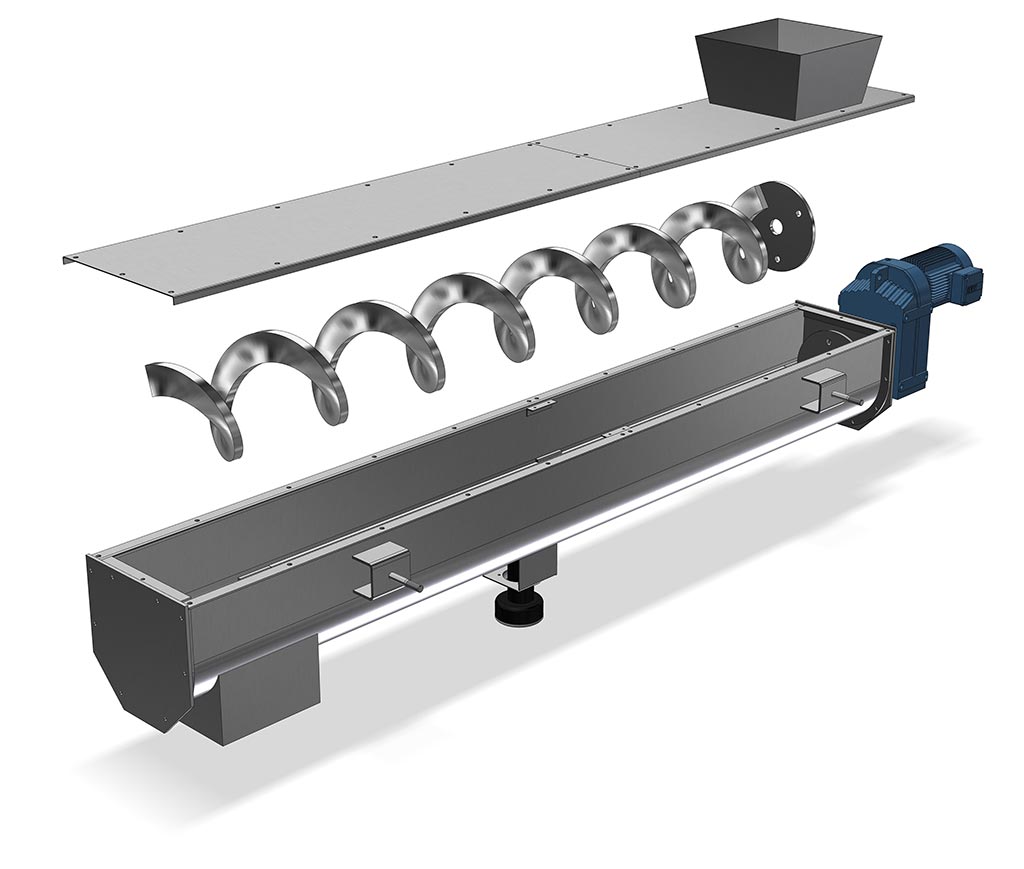
What is a Screw Conveyor? An Overview
A screw conveyor, also commonly known as a screw auger conveyor or simply an auger, is a mechanism that uses a rotating helical screw blade (flighting) within a trough or tube to move liquid or granular materials. They are one of the most widely used systems for conveying bulk materials in the world .
The fundamental principle is simple: as the screw rotates, material is pushed axially along the trough. However, the engineering behind this simple action is surprisingly complex. The performance of a conveyor screw is influenced by factors like rotational speed, the pitch of the flighting, the clearance between the screw and the housing, and the angle of operation .
Screw conveyors are valued for several reasons:
-
Versatility: They can handle a wide range of materials, from fine powders to large pellets, and even sludges.
-
Multiple Functions: Beyond conveying, they can be used for mixing, blending, dewatering, heating, cooling, and feeding downstream equipment .
-
Sealed Operation: Enclosed designs prevent dust emissions and product contamination, making them ideal for food and chemical applications .
-
Configurability: They can be designed for horizontal, inclined, or vertical operation .
Key Types of Screw Conveyors for Beer Brewing
Flex Screw Conveyor (Flexible Screw Conveyor)
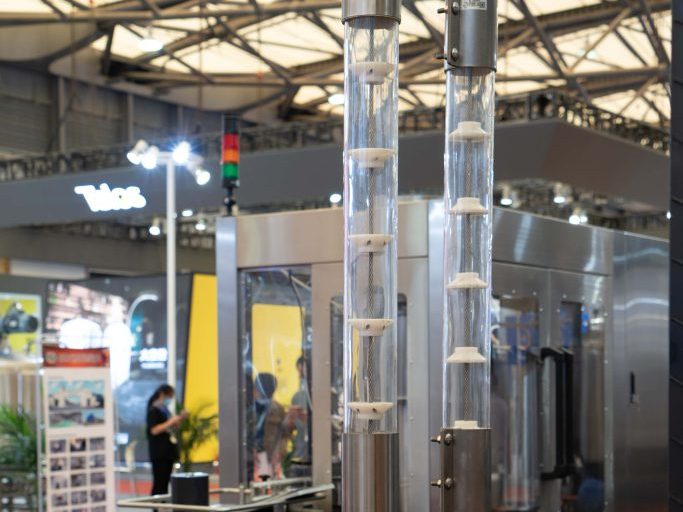
A flex screw conveyor is a specialized type designed for versatility in path routing. Unlike rigid conveyors, these machines utilize a flexible spiral screw within a flexible or rigid plastic tube. This design allows the conveyor to be maneuvered around obstacles, through tight spaces, and even from room to room .
-
Best For: Moving materials in facilities with space constraints or complex layouts.
-
Key Advantage: The flexible screw is the only moving part contacting the material, resulting in very low maintenance. It is also easy to clean, particularly the tilt-down versions which allow for quick screw removal and wash-down .
Conveyor Screw and Conveyor Screws
These terms refer to the helical flighting assembly itself, the heart of the system. Conveyor screws are not one-size-fits-all; they come in various designs to handle different materials and functions.
-
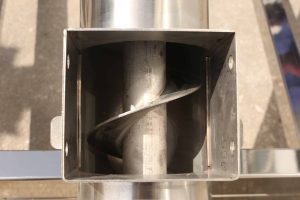
Helicoid Flight: Made from a flat bar stock wound into a helix. This is the most common and economical type .
-
Sectional Flight: Made from individual sections of plate steel formed into circles and welded together. Stronger and more durable for heavy-duty applications.
-
Cut Flight: The continuous flight is notched or cut to provide mixing action.
-
Ribbon Flight: Used for sticky materials that might build up on a standard shaft, as it consists of a continuous spiral ribbon attached to the shaft by supports .
Screw Auger Conveyor
The term screw auger conveyor is often used interchangeably with “screw conveyor,” though “auger” traditionally refers to a drilling tool. In industrial settings, it emphasizes the conveyor’s ability to bore through and move heavy, dense materials. Companies like PRAB engineer these advanced systems specifically to handle abrasive materials like metal chips, utilizing heavy shafts and hardened flights to extend service life .
Inclined Screw Conveyor
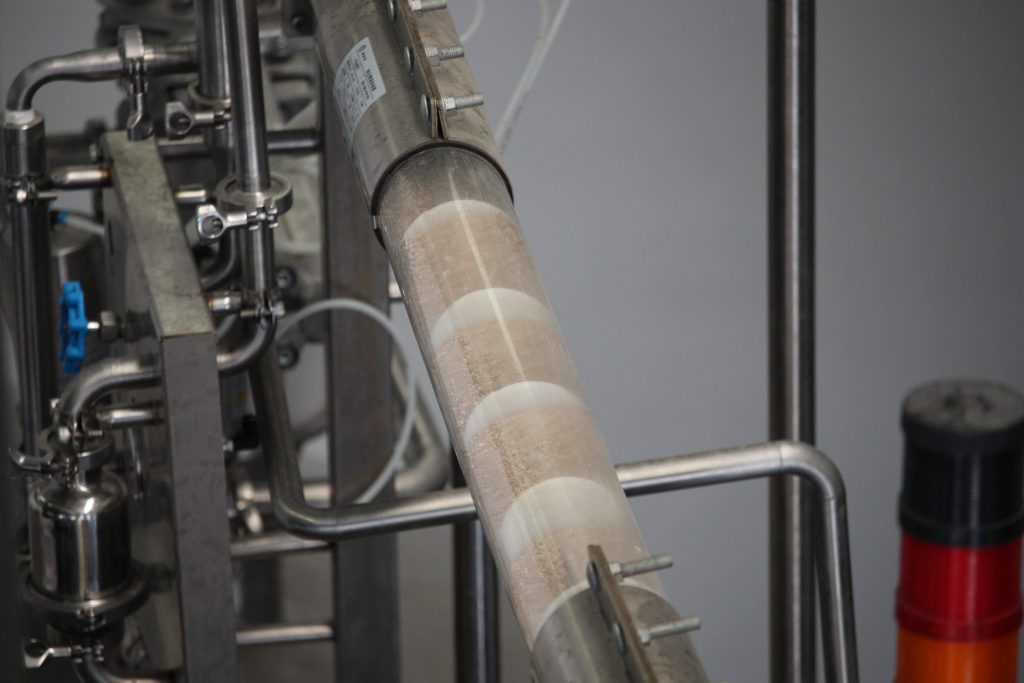
While horizontal conveyors are straightforward, things get complicated when space requires a slope. An inclined screw conveyor operates at an angle, typically up to 45 degrees or more. The physics of inclined conveying are challenging. As the angle increases, material tends to slide back and tumble, reducing efficiency .
-
Design Challenges: Research using Discrete Element Method (DEM) has shown that the radial clearance (the gap between the screw and the trough) is critical in inclined applications. The optimal clearance is often 1.5 to 3 times the particle size to prevent jamming while maintaining throughput .
-
Solution: Inclined conveyors often require shorter pitches, tubular housings (rather than troughs), and higher rotational speeds to move material effectively.
Key Design Considerations and Performance Factors
Selecting the right conveyor involves more than just picking a type out of a catalog. Several engineering factors determine whether a system will succeed or fail in your application.
1. The Critical Role of Radial Clearance
One of the most significant factors affecting screw conveyor performance is the radial clearance—the gap between the outer edge of the screw flight and the inner wall of the trough or tube. If the clearance is too large relative to the particle size, efficiency plummets as material slips backward. If it is too small, you risk jamming and excessive wear.
A recent study published in Particuology confirmed that the radial clearance should be optimally 1.5 to 3 times the particle size. This range minimizes material jamming and maximizes performance across different inclination angles and material types .
2. Material Characteristics
The material being conveyed dictates the conveyor screw design.
-
Free-flowing Pellets: Standard pitch screws work well.
-
Fine Powders: Require close tolerances and possibly variable pitch to prevent flooding.
-
Fragile Materials: Gentle handling is required. Flexible screw conveyors are excellent here, as the rolling action of the material prevents separation of blends and minimizes degradation .
-
Moist or Sticky Materials: Ribbon screws or shaftless designs are often necessary to prevent buildup.
3. Incline and Distance
As mentioned with inclined screw conveyors, angle matters. Horizontal conveyors can handle long distances (over 30 meters) with low wear . As the incline increases, efficiency drops, and the conveyor must be designed specifically to compensate for this loss.
Screw Conveyor Configurations: Trough vs. Tube
Choosing between an open or enclosed system is a fundamental decision. The table below outlines the differences between the two primary configurations, based on industry standards and applications .
| Feature | Trough Screw Conveyor (Open/U-Type) | Tubular Screw Conveyor (Enclosed/Pipe) |
|---|---|---|
| Design | A U-shaped bottom with a cover (may or may not be enclosed). | A fully enclosed pipe. |
| Best Application | Horizontal or slightly inclined installations. Ideal for metering, mixing, or feeding. | Steep inclines or vertical installations. Dust-tight applications. |
| Material Flow | Material can be observed during operation (if uncovered). | Material is completely hidden; fully dust-tight. |
| Maintenance | Easier access to the screw and trough interior. | Requires disassembly or clean-out ports for access . |
| Typical Industries | Grain handling, wastewater (screenings), heavy manufacturing. | Food processing, fine chemicals, pharmaceuticals, brewing. |
Flexible Screw Conveyors vs. Other Conveyor Types
For many modern facilities, especially in food and beverage, the choice often comes down to flexible screw conveyors versus other enclosed systems. Understanding the differences is key .
-
Flexible Screw Conveyors:
-
Pros: Lowest cost, simple maintenance (only one moving part), excellent for re-blending mixtures, dust-free, can be routed around obstacles.
-
Cons: Not suitable for extremely abrasive materials or very moist sludges. The flexible screw can wear over time with abrasive products.
-
Ideal Use: Transferring flour, sugar, grains, and pellets from bulk bags to process equipment.
-
-
Aero Mechanical Conveyors:
-
Pros: High conveying capacity, total batch transfer, operates at any angle.
-
Cons: More complex mechanism (cable and disc), potential for product degradation with fragile items, higher speeds .
-
-
Tubular Drag Conveyors:
-
Pros: Ultra-gentle handling, can convey in three dimensions (eliminating transfer points), handles fragile and hygroscopic materials well.
-
Cons: Lower capacity relative to size, more moving parts (chain/cable and discs) .
-
Applications in the Brewing and Food Industry
As a brewery equipment manufacturer, SKE understands that the quality of the final product begins with the handling of raw ingredients. In a brewery, malted barley and adjunct grains must be moved from storage silos to the mill house, then to the mash tun.
This is where the conveyor screw proves its value. A standard trough conveyor might be used for horizontal movement of grain, but a flex screw conveyor is often superior for navigating the tight spaces of a brewhouse. It can lift grain vertically and then transition to a horizontal run to feed the mill, all in one continuous, sealed system. This prevents dust explosions, keeps the brewery clean, and ensures that the grain is handled gently to preserve the integrity of the husk, which is vital for efficient lautering.
For spent grain removal (wet, sticky material) after the mashing process, a different type of screw auger conveyor is required—typically a heavier-duty unit with a shaftless design or a tubular conveyor capable of handling the moisture content without jamming .

Frequently Asked Questions (FAQ)
Q: Can a screw conveyor handle sticky or wet materials?
A: Yes, but the design must be adapted. Standard conveyors with a central shaft can become clogged with sticky materials. For applications like dewatered sludge or spent grains, a shaftless screw conveyor or a ribbon flight screw is recommended. These designs minimize contact points where material can build up .
Q: How do I determine the right size screw conveyor for my brewery or plant?
A: Sizing is based on required capacity (cubic feet per hour or tons per hour), material density, and conveyor length. You must also consider the trough loading percentage (how full the trough should be). Industry standards, such as ANSI/CEMA 300-2015, provide dimensional standards for components like troughs, screws, and discharges to ensure compatibility and safety . Consulting with a manufacturer like SKE is the best way to get a precise calculation.
Q: What maintenance does a flexible screw conveyor require?
A: One of the main advantages of a flex screw conveyor is its low maintenance. The primary maintenance task is inspection and occasional replacement of the flexible screw itself, which is the only moving part that contacts the product. For sanitary applications, many models feature a tilt-down design that allows the screw to be pulled out easily for thorough cleaning and inspection .
Q: Is an inclined screw conveyor less efficient than a horizontal one?
A: Yes, generally. As the incline angle increases, the conveyor’s volumetric efficiency decreases because material tends to slide back down the trough. This can be mitigated by using a shorter pitch screw, increasing the rotational speed, or using a fully enclosed tubular housing to contain the material .
Conclusion
Whether you are moving metal chips in a fabrication plant or malted barley in a craft brewery, the screw conveyor remains an indispensable tool. From the highly adaptable flex screw conveyor to the heavy-duty screw auger conveyor and the space-saving inclined screw conveyor, there is a design to meet every challenge.
At SKE, we leverage our expertise in gentle material handling from the brewing industry to provide robust, sanitary, and efficient conveying solutions. By understanding the critical role of components, clearances, and configurations, you can ensure that your bulk materials are moved reliably, safely, and efficiently from intake to process.
- Facebook: SKE Equipment Facebook
- Email: info@skeequipment.com
For more information on how SKE can integrate advanced conveyor technology into your production line, contact our engineering team today.