
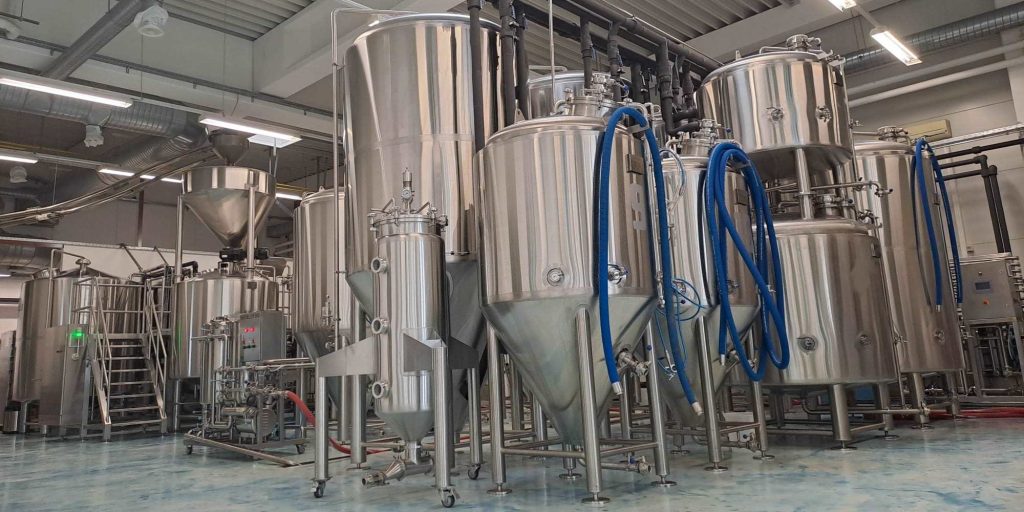
For thousands of years, the art of brewing has transformed simple grains into a beverage cherished worldwide: beer. At the heart of this transformation lies a natural miracle—beer fermentation. While the basic principle of yeast converting sugar into alcohol and CO₂ has remained unchanged for millennia, the technology used to control this process has evolved dramatically.
In the modern brewing industry, consistency, purity, and efficiency are paramount. This is where the vessel makes all the difference. As a professional brewery equipment manufacturer, SKE understands that whether you are a homebrewer looking to upgrade or a commercial enterprise scaling up production, the choice of equipment—specifically your stainless steel fermentation tank—will define the quality of your final product.
In this guide, we will dive deep into the biology of fermentation, the engineering behind the perfect beer fermenter, and why the conical fermenter has become the gold standard for breweries worldwide.
Chapter 1: Understanding Beer Fermentation – The Biological Foundation
Before discussing the tanks, we must respect the biology. Beer fermentation is the metabolic process where yeast consumes fermentable sugars extracted from malt (the wort) and produces ethanol, carbon dioxide, and flavor compounds.
The Two Stages of Fermentation
While it seems like a single event, professional brewers view fermentation in two phases:
-
Primary Fermentation: The most active period. Yeast multiplies rapidly and converts the majority of sugars. This stage generates significant heat and requires strict temperature control to prevent off-flavors.
-
Secondary Fermentation (Conditioning): Activity slows. The yeast begins to flocculate (clump together) and settle out. During this phase, diacetyl (a potential off-flavor) is reabsorbed, and the beer matures.
Top vs.Bottom Fermenting Yeast
The type of beer dictates the yeast used:
-
Ale (Top-Fermenting): These yeasts (Saccharomyces cerevisiae) work at warmer temperatures (15-24°C) and rise to the top of the tank during fermentation . They produce fruity esters.
-
Lager (Bottom-Fermenting): These yeasts (Saccharomyces pastorianus) work at much colder temperatures (3.3-14°C) and settle at the bottom . They create clean, crisp profiles.
Understanding this biological requirement for temperature variation and sediment collection is key to understanding why we need specialized tanks.
Chapter 2: The Evolution of Brewing Vessels
Historically, fermentation was done in open wooden barrels or clay pots. These were difficult to clean (sanitation issues), offered no temperature control, and exposed the beer to airborne infections.
The introduction of stainless steel fermentation tank technology was the single greatest leap in brewing hygiene. Stainless steel (specifically 304 and 316L grades) offers a non-porous, corrosion-resistant surface that does not impart flavors and can be sterilized effectively.
The Shift to Enclosed Systems
Modern tanks are Closed Pressure Vessels. This allows for:
-
Capture of CO₂: To naturally carbonate the beer or collect it for purging.
-
Oxygen Exclusion: Preventing oxidation, which causes stale, papery flavors.
Chapter 3: Why the Conical Fermenter is the Industry Standard
If you look inside any professional brewery, you will see rows of towering vessels with distinctive funnel-shaped bottoms. This is the conical fermenter, often referred to as a “Unitank” because it can perform both primary and secondary fermentation in a single vessel.
The Genius of the 60-70° Cone Angle
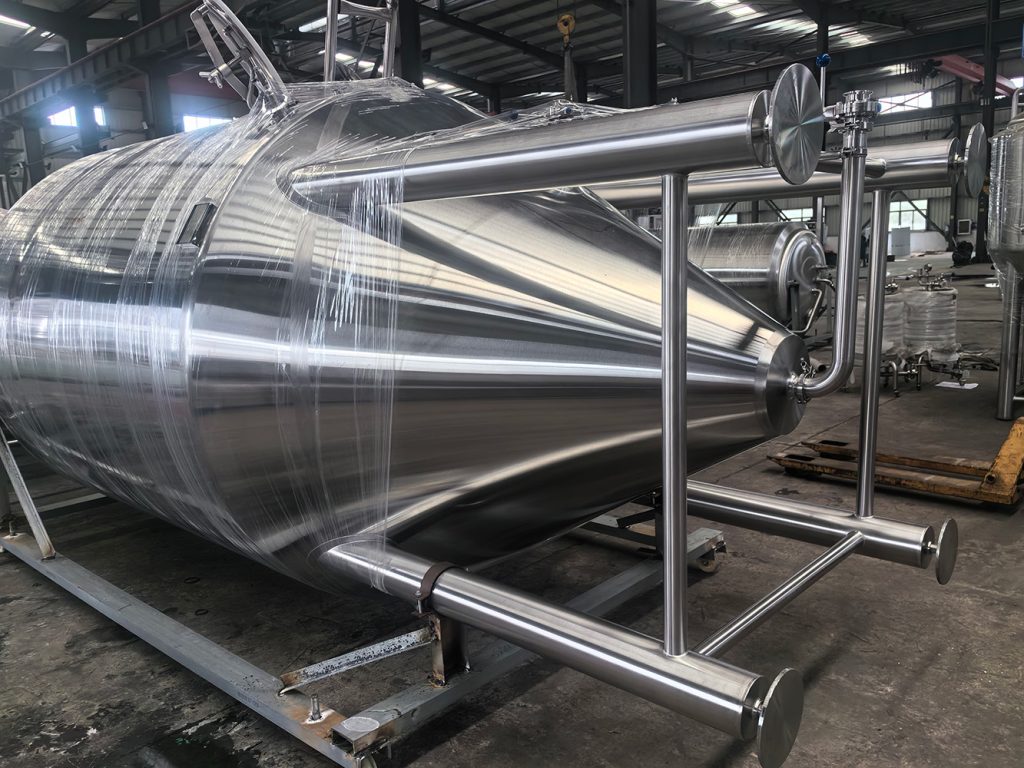
The defining feature of a conical fermenter is the sloped bottom. As fermentation completes, yeast and trub (hot break material) naturally settle out of the beer. Due to gravity and the steep angle of the cone (typically 60-70°), this sediment slides down and collects at the tip of the cone.
Key Benefits of Conical Design
-
Effortless Yeast Harvesting: At SKE, we fit our cones with a bottom dump valve. Brewers can simply open the valve to extract healthy, viable yeast for repitching in subsequent batches, saving costs on yeast procurement.
-
Reduced Oxidation Risk: Traditional flat-bottom tanks require “racking”—siphoning the beer off the sediment into a new tank. Every transfer risks oxygen exposure. With a conical fermenter, you dump the sediment out from the bottom and leave the beer sitting undisturbed on top.
-
Clarity and Quality: By removing the yeast cake promptly, you reduce the risk of autolysis (yeast dying and releasing off-flavors). This leads to cleaner, better-tasting beer.
Comparison of Traditional vs. Conical Fermentation
| Feature | Flat-Bottom / Carboy | Conical Fermenter (Unitank) |
|---|---|---|
| Sediment Removal | Requires siphoning (racking) to secondary vessel. | Dumped easily via bottom valve. |
| Oxidation Risk | High (multiple transfers). | Low (single vessel). |
| Yeast Harvesting | Difficult and messy. | Simple and hygienic. |
| Cleaning | Manual scrubbing often required. | CIP (Clean-in-Place) compatible. |
Chapter 4: Anatomy of a Commercial Beer Fermenter
For those looking at a commercial beer fermenter, the stakes are higher. These vessels, ranging from 5 BBL to over 1000 BBL, must withstand immense pressure and hydrostatic forces. At SKE, we engineer our tanks to meet rigorous standards like AS1210 and PED . Here is what sets industrial-grade equipment apart:
1. Cooling Zones (Glycol Jackets)
Fermentation generates heat. If the temperature rises too high, the yeast becomes stressed and produces harsh fusel alcohols.
-
Multi-Zone Cooling: Professional commercial beer fermenter tanks feature welded cooling jackets on the sidewall and the cone . Glycol circulates through these jackets to maintain precise temperatures.
-
Cone Cooling: This is critical. Because the cone holds the yeast sediment, if this area gets too hot, autolysis occurs. Cooling the cone keeps the harvested yeast healthy.
2. Pressure Ratings
Unlike basic homebrew equipment, a commercial beer fermenter is a pressure vessel.
-
Pressure Fermentation: Brewers can apply back pressure (usually up to 15 PSI) to suppress further yeast activity and naturally carbonate the beer (spunding), eliminating the need for artificial carbonation.
3. CIP (Clean-in-Place) Systems
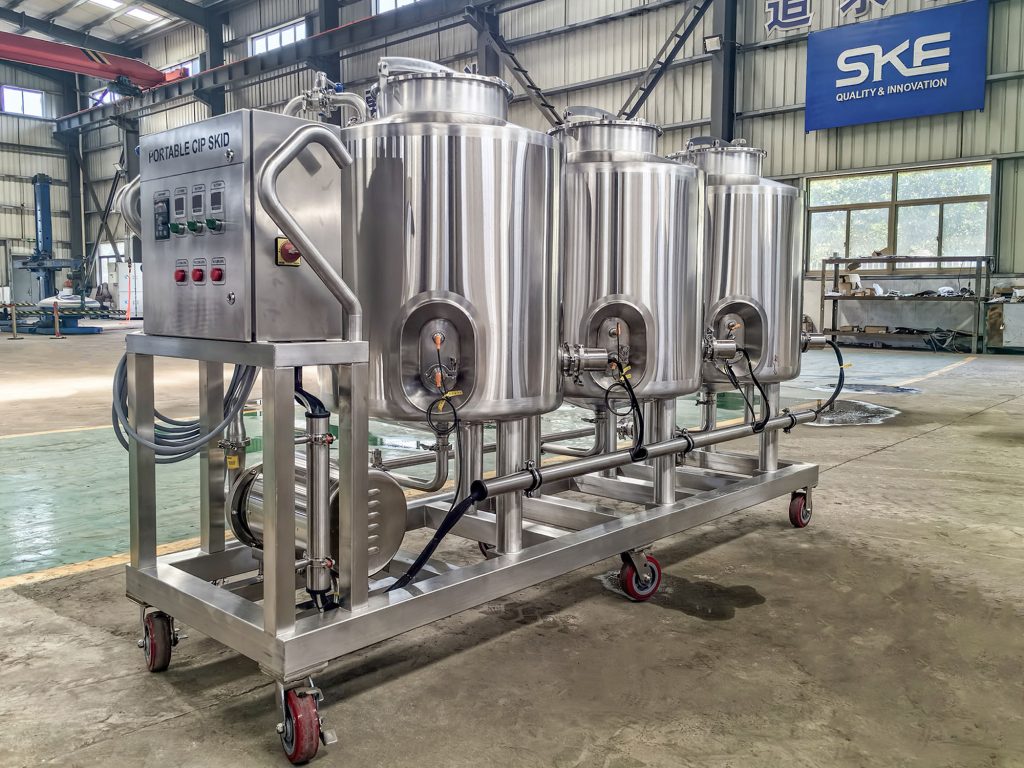
A stainless steel fermentation tank must be sterile. SKE tanks are equipped with spray balls (rotary or static) that blast caustic and sanitizing solutions at high pressure to clean every internal surface without a person needing to enter the tank.
4. Instrumentation
Modern tanks are fitted with:
-
Thermowells: To hold temperature probes .
-
Sample Valves: To take gravity readings without opening the manway.
-
Pressure Relief Valves (PRVs): Critical safety devices to prevent over-pressurization .
Chapter 5: Commercial vs. Homebrew – Scaling Up
The principles are the same, but the execution differs. Many homebrewers start with glass carboys and move to small plastic or stainless steel beer fermenter units. While a home conical fermenter offers the same benefits of sediment collection, a commercial beer fermenter must address volume and safety.
Customization for Scale
At SKE, we recognize that a brewpub has different needs than a regional production brewery.
-
Space Optimization: For brewpubs, we design tanks with a small footprint but tall height to maximize volume in limited spaces.
-
Turnkey Solutions: For industrial clients, we provide fully automated systems with integrated control panels (featuring Siemens or similar components) that manage the entire fermentation cycle, from glycol valve actuation to CIP sequencing.
Chapter 6: Why SKE Equipment?
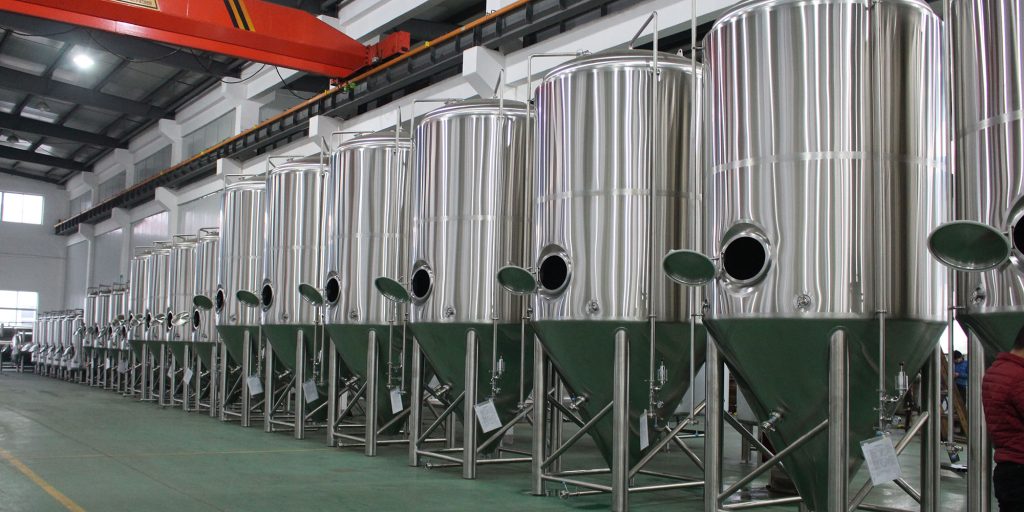
As a manufacturer with roots dating back to 2000, SKE (Ningbo ShihKuang Engineering Equipment Limited) has grown alongside the modern craft beer revolution . We believe that engineering is the “magic” that turns a concept into a perfect pint.
Quality Assurance and Certifications
When you invest in a stainless steel fermentation tank, you are investing in the longevity of your business. SKE tanks are engineered in accordance with international standards, including ASME, PED, and AS1210 . We do not cut corners on raw materials.
Our production process includes:
-
Spectral Analysis: Verifying the exact composition of our stainless steel.
-
X-Ray Testing: Ensuring welds are flawless and capable of holding pressure for decades.
-
Surface Roughness Testing: We achieve surface finishes down to ≤0.1μm in our electro-polished tanks, ensuring maximum hygiene and easy cleaning.
Advanced Fabrication
We utilize automated laser welding and robotic polishing to ensure that every commercial beer fermenter leaving our factory has perfect geometry and consistent weld quality—something manual fabrication cannot guarantee.
Chapter 7: The Future – Automation and De-alcoholization
The brewing industry is constantly evolving. SKE is at the forefront of these trends to help our clients stay competitive.
Automated Yeast Propagation
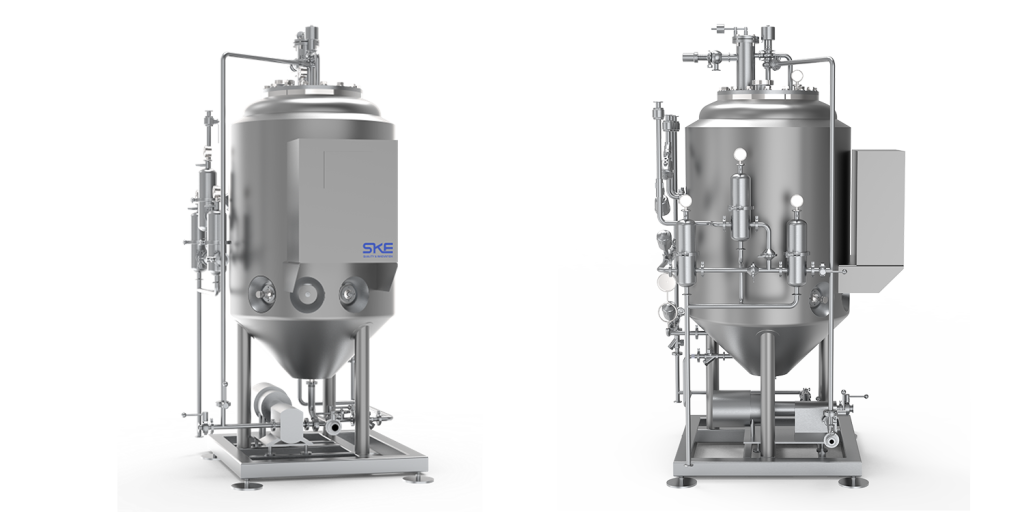
Consistency is king. SKE offers advanced yeast propagation systems that allow breweries to grow their own pure yeast cultures from a slant to a pitchable volume. This ensures that every batch of fermentation starts with healthy, vital yeast, free from contamination.
The Rise of Low-Alcohol Beer
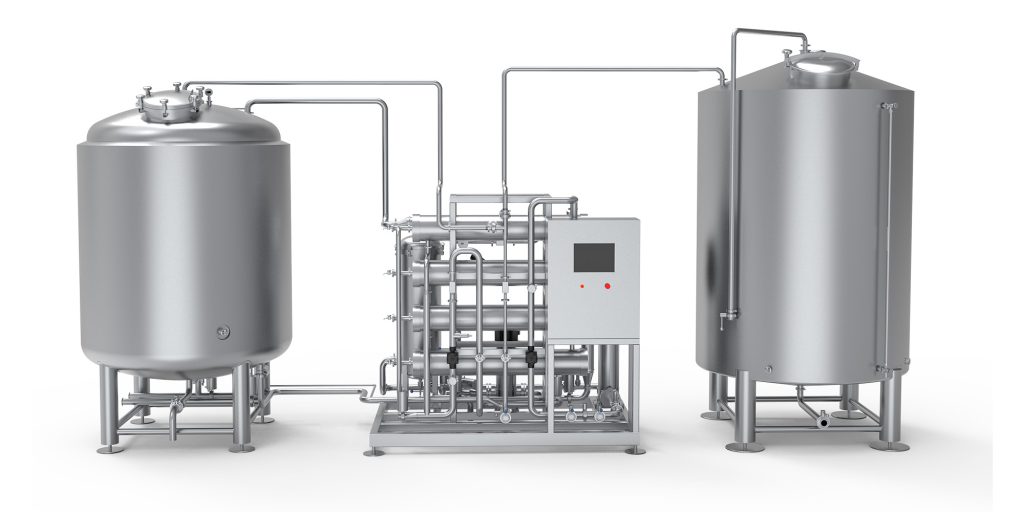
Consumer demand for low and no-alcohol beverages is soaring. SKE has recently launched new dealcoholization systems that gently remove alcohol from fully fermented beer using vacuum distillation or membrane technology. This allows breweries to expand their portfolios without investing in separate, limited fermentation processes.
Conclusion
Mastering beer fermentation requires a synergy of biological understanding and mechanical precision. While the yeast does the hard work, it is the vessel that dictates success or failure. The conical fermenter is not just a tank; it is a tool that empowers brewers to achieve clarity, consistency, and character.
Whether you are a craft brewery looking to expand, or an industrial facility seeking to optimize efficiency, the quality of your stainless steel fermentation tank is the foundation of your brand.
- Facebook: SKE Equipment Facebook
- Email: info@skeequipment.com
At SKE, we are dedicated to advancing processing technology. We invite you to partner with us to build a commercial beer fermenter solution tailored to your unique recipe and space.
Frequently Asked Questions (FAQ)
Q1: What is the difference between a fermenter and a Bright Beer Tank (BBT)?
A: A fermenter (like a CCT) is where the biological process of fermentation occurs; it contains yeast and is designed for active cooling and sediment collection. A Bright Beer Tank (BBT) is a storage vessel after fermentation. The beer is transferred (under pressure) to the BBT after the yeast is removed. BBTs are designed to hold clear, carbonated beer at a stable temperature until packaging.
Q2: Why is a conical fermenter better than a flat-bottom tank?
A: The conical shape allows for the efficient collection and removal of sediment (trub and yeast) without moving the beer. This minimizes the risk of oxidation and contamination, allows for easy yeast harvesting, and improves the final clarity of the beer compared to flat-bottom tanks where sediment sits in a wide layer.
Q3: Can I lager in a stainless steel fermentation tank?
A: Yes. A unitank or conical fermenter is perfect for lagering. The vessel must have robust cooling jackets (specifically on the cone) to maintain the near-freezing temperatures required for lagering (0-4°C) over several weeks.
Q4: How do I clean a commercial beer fermenter?
A: Commercial tanks are cleaned using a CIP (Clean-in-Place) system. After the tank is emptied, a series of cleaning cycles (usually a warm water rinse, caustic wash, acid wash, and sanitizing rinse) are pumped through spray balls inside the tank. This cleans and sanitizes the interior surfaces without requiring manual entry.