Introduction to Stainless Mixing Tanks
In countless industrial processes, from food and beverage production to pharmaceuticals and chemical manufacturing, the ability to effectively blend, agitate, and homogenize various substances is paramount. This is where the stainless mixing tank plays a central and indispensable role. A stainless mixing tank is a specialized vessel designed for the efficient mixing of liquids, solids, or gases, utilizing agitators or impellers to achieve a desired consistency, reaction, or dissolution. The choice of stainless steel as the primary construction material is not incidental; it’s a deliberate decision driven by its unparalleled hygienic properties, corrosion resistance, and structural integrity, making it ideal for environments where cleanliness and product purity are non-negotiable.
At its core, a mixing tank facilitates various operations such as dispersion, emulsification, suspension, and heat transfer. The design of each stainless mixing tank can vary significantly based on the specific industrial application, from simple open-top designs with basic agitators to highly sophisticated, jacketed vessels with multiple impellers, baffles, and integrated temperature control systems. This versatility underscores its importance across a spectrum of industries, directly impacting product quality, process efficiency, and operational safety. Understanding the fundamental principles and variations of these tanks is crucial for any business seeking to optimize its production lines.
The materials that make up these tanks are critical. While various materials can be used for tanks, stainless steel—particularly grades like 304 and 316L—stands out due to its inherent advantages. Grade 304 offers good corrosion resistance and is suitable for many general applications, while 316L, with its added molybdenum content, provides superior resistance to chlorides and other aggressive chemicals, making it the preferred choice for pharmaceutical and marine applications. SKE specializes in crafting high-quality aseptic tanks and mixing solutions from these premium grades, ensuring longevity and compliance with stringent industry standards. The robust construction and smooth, non-porous surface of a stainless mixing tank prevent contamination and simplify cleaning, which are vital for maintaining product integrity and regulatory compliance. Therefore, investing in a well-designed and constructed stainless steel mixing vessel is a cornerstone of efficient and compliant industrial processing.
Versatile Applications Across Industries
The ubiquity of the stainless mixing tank across diverse industrial landscapes is a testament to its adaptability and critical functionality. These tanks are not merely containers; they are sophisticated process solutions that drive innovation and efficiency in numerous sectors. In the fiercely regulated food and beverage industry, stainless mixing tanks are indispensable for blending ingredients, preparing syrups, fermenting beverages, and pasteurizing products. Their hygienic surfaces prevent bacterial growth and cross-contamination, crucial for consumer safety and product quality. For example, in dairy production, they are used for milk standardization, cream separation, and the creation of yogurt and ice cream mixes, often requiring precise temperature control and gentle agitation.
The pharmaceutical industry relies heavily on the sterile and precise capabilities of the stainless mixing tank. Here, these vessels are used for preparing solutions, suspensions, and emulsions for drug formulations, vaccines, and active pharmaceutical ingredients (APIs). The requirement for impeccable sterility means that often 316L stainless steel is chosen, and tanks are designed with minimal crevices, polished surfaces, and capabilities for Clean-in-Place (CIP) and Sterilize-in-Place (SIP) systems. This ensures compliance with stringent Good Manufacturing Practices (GMP) and prevents any risk of product degradation or contamination.
Beyond these highly regulated sectors, chemical processing plants utilize stainless mixing tanks for a vast array of applications, including blending solvents, synthesizing compounds, formulating paints, coatings, and adhesives, or even managing wastewater treatment chemicals. The corrosion resistance of stainless steel is particularly valuable here, allowing for the safe handling of aggressive chemicals without compromising the tank’s structural integrity or leaching contaminants into the product. Cosmetic manufacturers use them for blending lotions, shampoos, and perfumes, where consistency and aesthetic appeal are key. Even in the biotechnology sector, stainless tanks are essential for cell culture media preparation and fermentation processes, demanding advanced control over environmental conditions within the tank. SKE’s extensive experience in engineering specialized CIP systems perfectly complements our mixing tanks, ensuring thorough cleaning and sterility for any demanding application.
The ability of a stainless mixing tank to handle a wide range of viscosities, temperatures, and pressures, coupled with various agitation options, makes it a truly versatile piece of equipment. From high-shear mixing for emulsions to gentle blending for sensitive products, the specific configuration of the impeller type, motor power, and baffling system can be customized to achieve optimal results for each unique application. This broad applicability, combined with the material’s inherent advantages, solidifies the stainless mixing tank as a foundational asset in modern industrial processing across multiple global markets.
Key Benefits of Stainless Steel in Mixing Tanks
The selection of manufacturing materials for industrial equipment is a critical decision that profoundly impacts performance, longevity, and operational costs. For mixing tanks, stainless steel consistently emerges as the material of choice due to a compelling set of benefits that address the demanding requirements of various industries. Foremost among these is its exceptional corrosion resistance. Stainless steel forms a passive layer (chromium oxide) on its surface when exposed to oxygen, which naturally repairs itself if scratched. This characteristic makes the stainless mixing tank highly resilient to a wide range of corrosive substances, from acidic food ingredients to harsh chemical reagents, significantly extending the lifespan of the equipment and reducing the need for frequent replacements.
Another paramount advantage, especially in food, beverage, and pharmaceutical industries, is the hygienic nature of stainless steel. Its non-porous, smooth surface inhibits the adhesion and growth of bacteria and other microorganisms. This makes cleaning and sanitization processes, such as Clean-in-Place (CIP) and Sterilize-in-Place (SIP), highly effective and efficient. The ability to achieve and maintain high levels of cleanliness is not just about product freshness; it’s a critical factor for regulatory compliance and ensuring consumer safety. A well-maintained stainless mixing tank significantly reduces the risk of cross-contamination and ensures product purity, which is particularly important for sensitive formulations.
Durability and mechanical strength are also significant benefits. Stainless steel is a robust material that can withstand high temperatures, pressure variations, and the mechanical stresses of continuous agitation without deforming or failing. This inherent strength contributes to a longer service life and reduces downtime for repairs, leading to greater operational reliability and lower total cost of ownership over time. Furthermore, stainless steel is a sustainable choice. It is a fully recyclable material, meaning that at the end of its long service life, the stainless mixing tank can be recycled, contributing to a circular economy and reducing environmental impact. Modern fabrication techniques and welding procedures, mastered by manufacturers like SKE, ensure that all corners and seams are smooth and free from crevices, further enhancing cleanability and preventing product hang-up.
Finally, the aesthetic appeal and ease of maintenance further bolster its advantages. A polished stainless steel surface not only looks professional but also makes visual inspection easier, helping operators quickly identify any potential issues. Its resistance to staining and easy-to-clean nature means less time and resources are spent on upkeep, allowing businesses to focus more on production. The combination of corrosion resistance, hygienic properties, durability, and recyclability makes the stainless mixing tank an economically sound and environmentally responsible investment for any operation requiring reliable and high-performance mixing capabilities. For specialized sanitary applications, SKE also offers advanced sanitary magnetic mixers designed to integrate seamlessly into our stainless tanks, providing a seal-less, contamination-free mixing solution.
Types and Designs of Stainless Mixing Tanks
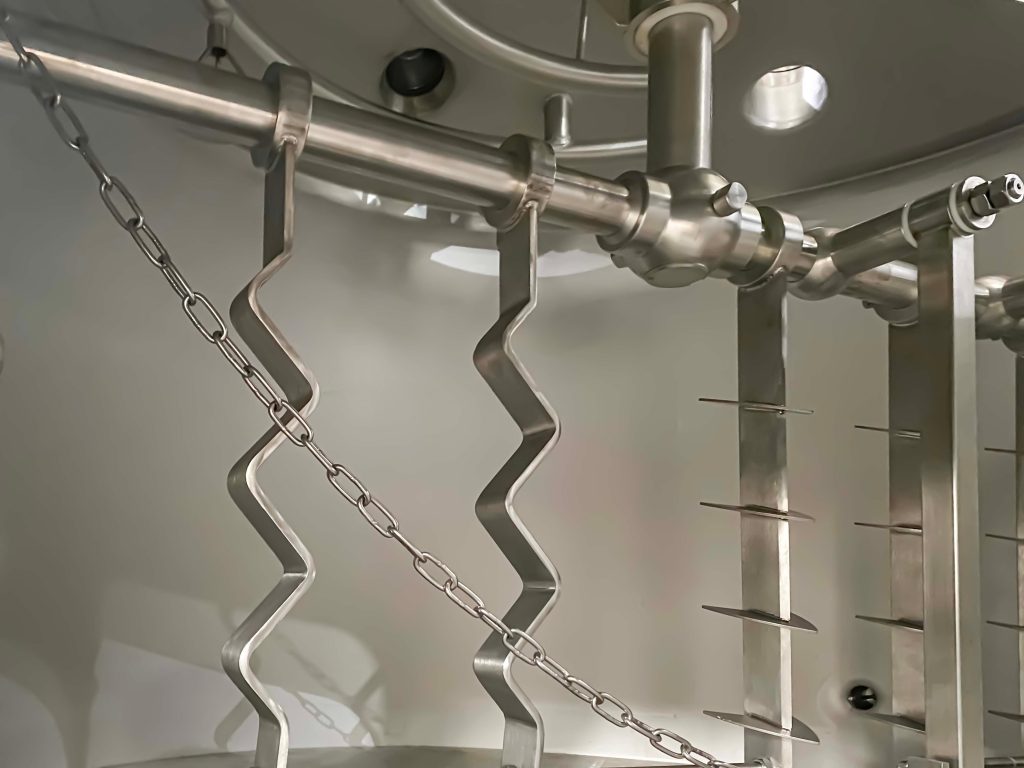
The world of stainless mixing tank technology is diverse, reflecting the vast range of applications they serve. While the core function of mixing remains constant, the specific design, features, and types of agitators vary significantly to optimize performance for different materials and processes. Understanding these variations is key to selecting the most suitable equipment for a given operation. One primary differentiator is the agitator type, which directly influences the mixing action. Propeller agitators are common for low-viscosity liquids, creating axial flow and efficient blending at high speeds. Turbine agitators, with their flat or pitched blades, are versatile, suitable for a range of viscosities, and generate both radial and tangential flow. Anchor agitators, designed to scrape the tank walls, are ideal for high-viscosity products where wall adhesion is a concern, or for enhancing heat transfer.
Beyond agitators, the overall design of the stainless mixing tank itself can vary. Open-top tanks are suitable for processes where fumes are not an issue and easy access for ingredient loading and cleaning is paramount. Closed-top tanks, on the other hand, are essential for processes requiring sterile conditions, pressure, vacuum, or the containment of volatile substances. Many closed tanks are equipped with manways, sight glasses, and various ports for instrumentation and process connections. Another crucial design element is the presence of baffles. These are stationary plates typically installed on the interior walls of the tank, interrupting the swirling motion created by the agitator and converting it into more effective radial and axial flow, thus preventing vortex formation and enhancing mixing efficiency.
Temperature control is often a vital aspect of mixing processes. This leads to the implementation of jacketed stainless mixing tanks. Jacketed tanks feature an outer shell that creates a space (the jacket) around the main vessel, through which a heating or cooling medium (e.g., steam, hot water, chilled water, or glycol) can be circulated. This allows for precise temperature regulation of the product during mixing, crucial for reactions, dissolution, or maintaining product stability. Dimple jacket designs offer excellent heat transfer efficiency and are robust. Half-pipe coil jackets are also common for high-pressure heating/cooling applications. SKE produces a range of jacketed tanks, from steam jacketed kettles to full-scale bioreactors, all engineered for precise temperature control and efficient mixing.
Other specialized designs include conical bottom tanks for complete drainage of viscous products or the concentration of solids, and reactors, which are essentially mixing tanks designed to facilitate chemical reactions under controlled conditions, often with reinforced walls and advanced instrumentation. High-shear mixers, which can be in-tank or inline, use rotor-stator mechanisms to create intense shear forces for emulsification, dispersion, and homogenization, particularly for challenging formulations. The selection process for a stainless mixing tank must carefully consider these design elements in conjunction with the process requirements, including the properties of the materials to be mixed, the desired end product characteristics, process temperature, and operational pressures.
Critical Criteria for Selecting a Stainless Mixing Tank
Choosing the right stainless mixing tank is a complex decision that significantly impacts operational efficiency, product quality, and long-term costs. It’s not a one-size-fits-all scenario, and a thorough understanding of key selection criteria is essential to make an informed investment. The first and perhaps most critical factor is the properties of the material to be mixed. This includes viscosity (from water-like to thick pastes), density, corrosiveness, abrasiveness, and temperature sensitivity. For highly viscous substances, strong agitators and specific impeller designs (like anchors or helical ribbons) are necessary, often requiring higher horsepower motors. For corrosive materials, higher grades of stainless steel, such as 316L or even duplex stainless steels, might be required to ensure long-term integrity.
Secondly, the desired mixing outcome dictates many design choices. Are you aiming for simple blending, dissolving solids, suspending particles, creating emulsions, facilitating heat transfer, or promoting a chemical reaction? Each objective requires a different approach to agitator type, speed, and tank geometry. For example, high-shear mixers are ideal for emulsification, while paddle or propeller agitators might suffice for basic blending. The homogeneity target, meaning how uniformly mixed the product needs to be, also plays a role in determining mixing time and agitator configuration for your stainless mixing tank.
Operational parameters like tank volume, operating temperature, and pressure are also paramount. The required volume directly influences the tank’s size, while temperature and pressure considerations will determine if jacketing is needed, and the thickness and design of the tank walls. Regulatory compliance is another non-negotiable criterion, especially for the food, pharmaceutical, and biotech industries. Tanks for these sectors must adhere to strict sanitary design principles, often requiring ASME BPE (Bioprocessing Equipment) standards, FDA guidelines, and cGMP (current Good Manufacturing Practices). This includes specific surface finishes (e.g., 2B, Ra value), crevice-free welding, and the use of sanitary fittings. SKE ensures all our stainless steel equipment, including sophisticated mixing tanks, meets these rigorous standards, guaranteeing compliance and peace of mind.
Finally, practical considerations such as installation space, budget, ease of cleaning, and maintenance requirements should not be overlooked. An efficient stainless mixing tank should not only perform its primary function but also integrate seamlessly into existing production lines. Consideration of future capacity needs, automation levels, and integration with other processing equipment (like pumps, filters, or filling lines) are also crucial for a future-proof investment. Engaging with experienced manufacturers and engineers, like those at SKE, who can offer tailored solutions and expert advice, is invaluable in navigating these complex choices and ensuring the selected stainless mixing tank optimally serves your specific process needs.
Maintenance and Longevity of Stainless Mixing Tanks
The longevity and consistent performance of a stainless mixing tank are directly correlated with effective maintenance practices. While stainless steel is renowned for its durability and corrosion resistance, it is not impervious to wear and tear, especially in demanding industrial environments. A robust maintenance regimen not only extends the operational life of the tank but also ensures product purity, optimizes process efficiency, and minimizes costly downtime. The cornerstone of maintenance for any stainless steel vessel is regular and thorough cleaning. For sanitary applications, this involves implementing strict Clean-in-Place (CIP) or Sterilize-in-Place (SIP) protocols. These automated systems use cleaning solutions, rinses, and sanitizers to remove product residue and microbial contaminants without manual intervention, saving time and ensuring consistent hygiene standards. For non-sanitary applications, manual cleaning might be sufficient but still requires appropriate cleaning agents that are compatible with stainless steel to prevent pitting or discoloration.
Beyond cleaning, routine mechanical inspections are critical. Operators should regularly check the agitator system, including the motor, gearbox, shaft, and impellers. Look for any signs of wear, corrosion, or damage, such as unusual vibrations, excessive noise, or leaks. Bearings and seals, particularly mechanical seals on agitator shafts, are common wear parts and should be inspected for integrity and replaced as needed to prevent product leakage or contamination. Gaskets and O-rings on manways, nozzles, and fittings also require routine inspection and replacement to maintain a tight seal and prevent ingress of contaminants or loss of product. The structural integrity of the stainless mixing tank itself should also be assessed. Look for any signs of cracks, dents, or deformations, especially around welds and support structures. While stainless steel is rugged, impact damage can compromise its surface passivation and lead to localized corrosion.
Proper record-keeping is an often-underestimated aspect of maintenance. Documenting inspection dates, findings, and any repairs or replacements provides a historical record that can help predict future maintenance needs, identify recurring issues, and optimize spare parts inventory. Training personnel on best practices for operating and maintaining the stainless mixing tank is equally important. This includes proper startup and shutdown procedures, understanding agitation limits, and proper handling of cleaning chemicals. Investing in high-quality components and spare parts, preferably from the original equipment manufacturer like SKE, ensures compatibility and performance. By adhering to a comprehensive maintenance schedule and proactive inspection protocols, businesses can maximize the return on their investment in stainless mixing tanks, ensuring years of reliable, efficient, and compliant operation. SKE offers comprehensive support for all our equipment, including guidance on optimal maintenance schedules and readily available spare parts to ensure the longevity of your investment.
Future Innovations in Mixing Tank Technology
The landscape of industrial processing is constantly evolving, driven by demands for greater efficiency, sustainability, and product quality. The stainless mixing tank, while a mature technology, is not immune to these forces, and future innovations are set to further enhance its capabilities and integration within smart manufacturing environments. One significant area of development is the integration of advanced sensors and real-time monitoring systems. Imagine a mixing tank equipped with sensors that continuously monitor parameters such as pH, temperature, viscosity, density, and even the concentration of specific components, all in real-time. This level of granular data allows for dynamic adjustments to mixing speed, temperature, or ingredient addition, leading to more precise process control, reduced waste, and more consistent product quality. The implementation of AI and machine learning algorithms will take this a step further, enabling predictive maintenance, anomaly detection, and automated recipe optimization for your stainless mixing tank.
Sustainability is another key driver of innovation. Future stainless mixing tanks will likely incorporate more energy-efficient agitator designs, motors, and insulation materials to reduce power consumption and heat loss. Advances in computational fluid dynamics (CFD) modeling allow engineers to simulate and optimize mixing processes with unprecedented accuracy, leading to designs that achieve desired mixing outcomes with less energy input. Furthermore, the push for eco-friendly operations could see the development of more efficient and environmentally benign cleaning agents and processes for CIP/SIP systems, reducing water and chemical usage. The use of advanced materials, while still heavily relying on stainless steel for its core benefits, might explore new alloys or surface coatings that offer even greater corrosion resistance or specialized functionalities for unique applications.
Automation and modularity are also shaping the future of mixing tank technology. Integrated automation platforms will allow tanks to seamlessly communicate with upstream and downstream equipment, creating fully automated production lines. Modular tank designs, with interchangeable components (e.g., agitators, jackets, filtration units), will offer greater flexibility for manufacturers who need to adapt quickly to changing product demands or production scales. Rapid customization and configurability will become increasingly important. For instance, SKE is continuously researching and developing solutions that integrate our core tank agitator technologies with smart controls, anticipating these future needs. Finally, the concept of smaller, distributed mixing units might gain traction in certain industries, allowing for more localized production and reduced transportation costs. The future stainless mixing tank will not just be a vessel but an intelligent, energy-efficient, and highly adaptable component of the interconnected factory of tomorrow, pushing the boundaries of what’s possible in industrial processing.
Frequently Asked Questions about Stainless Mixing Tanks
What are the primary advantages of using a stainless mixing tank over other materials?
Stainless steel offers superior corrosion resistance, crucial for handling a wide range of chemicals and maintaining product integrity. Its non-porous and smooth surface ensures high hygiene standards, easy cleaning (often via CIP/SIP systems), and prevents bacterial growth, which is vital for food and pharmaceutical applications. Additionally, stainless steel provides excellent durability, withstands high temperatures and pressures, and is a sustainable, recyclable material, leading to a longer operational lifespan and lower total cost of ownership compared to other materials.
How do I choose the correct type of agitator for my stainless mixing tank?
The choice of agitator depends on several factors, including the viscosity of the product, the desired mixing outcome (e.g., blending, suspension, emulsification), and the tank volume. Propellers are ideal for low-viscosity liquids, turbines for a range of viscosities and strong fluid movement, while anchor agitators are best for highly viscous products or applications requiring wall scraping to enhance heat transfer. High-shear mixers are used for intense emulsification and dispersion. Consulting with a specialist like SKE can help tailor the agitator design to your specific process requirements.
What is the significance of “”jacketed”” in a stainless mixing tank?
A jacketed stainless mixing tank features an outer shell that creates a cavity around the main vessel. This jacket allows a heating or cooling medium (like steam, hot water, or chilled glycol) to circulate, providing precise temperature control for the product inside. This is crucial for processes requiring specific temperatures for reactions, dissolution, crystallization, or maintaining product stability. Jacketed tanks significantly enhance process control and are common in chemical, pharmaceutical, and food processing industries.
What maintenance is required for a stainless mixing tank?
Regular maintenance is key to prolonging the life of your stainless mixing tank. This typically includes routine cleaning (using CIP/SIP for sanitary applications), inspections of the agitator system (motor, gearbox, shaft, impellers) for wear and tear, checking seals and gaskets for leaks, and assessing the tank’s structural integrity for any damage. Proper lubrication, calibration of instrumentation, and prompt replacement of worn components are also vital. Adhering to a scheduled preventative maintenance program is highly recommended to ensure optimal performance and avoid unscheduled downtime.
Need a Custom Stainless Mixing Tank Solution?
Our team at SKE specializes in designing and manufacturing high-quality stainless mixing tanks tailored to your unique industrial needs. From specific capacities to advanced temperature control and agitation systems, we deliver robust and efficient solutions.
Connect with us today for a consultation or to learn more about our products!
Facebook |
Email: info@skeequipment.com
Fill out the contact form at the bottom of the page to get started!