In the competitive landscape of modern brewing, consistency is king. However, the true enemy of beer quality is not just time or temperature—it is contamination. For breweries ranging from microbreweries to the largest liquor companies globally, maintaining sterile conditions in tanks, pipes, and valves is non-negotiable.
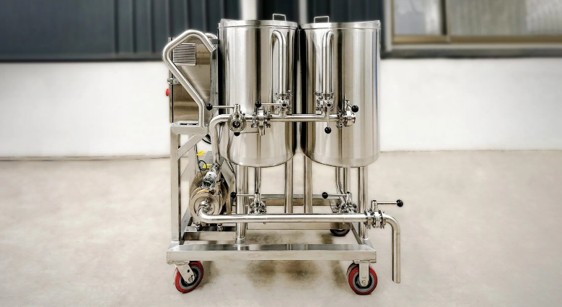
This is where CIP equipment (Clean-in-Place) becomes the unsung hero of the brewhouse. Unlike manual cleaning, which requires disassembling machinery, CIP systems circulate cleaning solutions through enclosed pipelines without dismantling a single fitting. At SKE, we specialize in integrating these sophisticated systems to ensure that every batch of beer meets the highest standards of purity.
This guide will dive deep into the mechanics of CIP systems, the critical role of the CIP pump, the function of the CIP tank, and why industry giants rely on this technology.
What is CIP Equipment and Why Does It Matter?
CIP equipment refers to the ensemble of tanks, pumps, valves, heat exchangers, and spray devices designed to clean the interior surfaces of pipes and vessels without disassembly. For a brewery, the stakes are incredibly high. Residual yeast, bacteria, or protein buildup can ruin an entire batch, leading to significant financial loss.
The science behind CIP involves a combination of thermal sterilization, mechanical action (scrubbing), chemical dissolution (caustic and acid washes), and time. Modern CIP equipment automates these four variables with precision.
By utilizing automated CIP, breweries eliminate human error. The system ensures that every corner of a fermentation tank receives the same spray intensity. For a brewery looking to scale production, manual cleaning becomes a bottleneck. Automated CIP systems accelerate turnaround times, allowing brewers to move from fermentation to packaging faster and safer.
Anatomy of a CIP System: Tanks, Pumps, and Controls
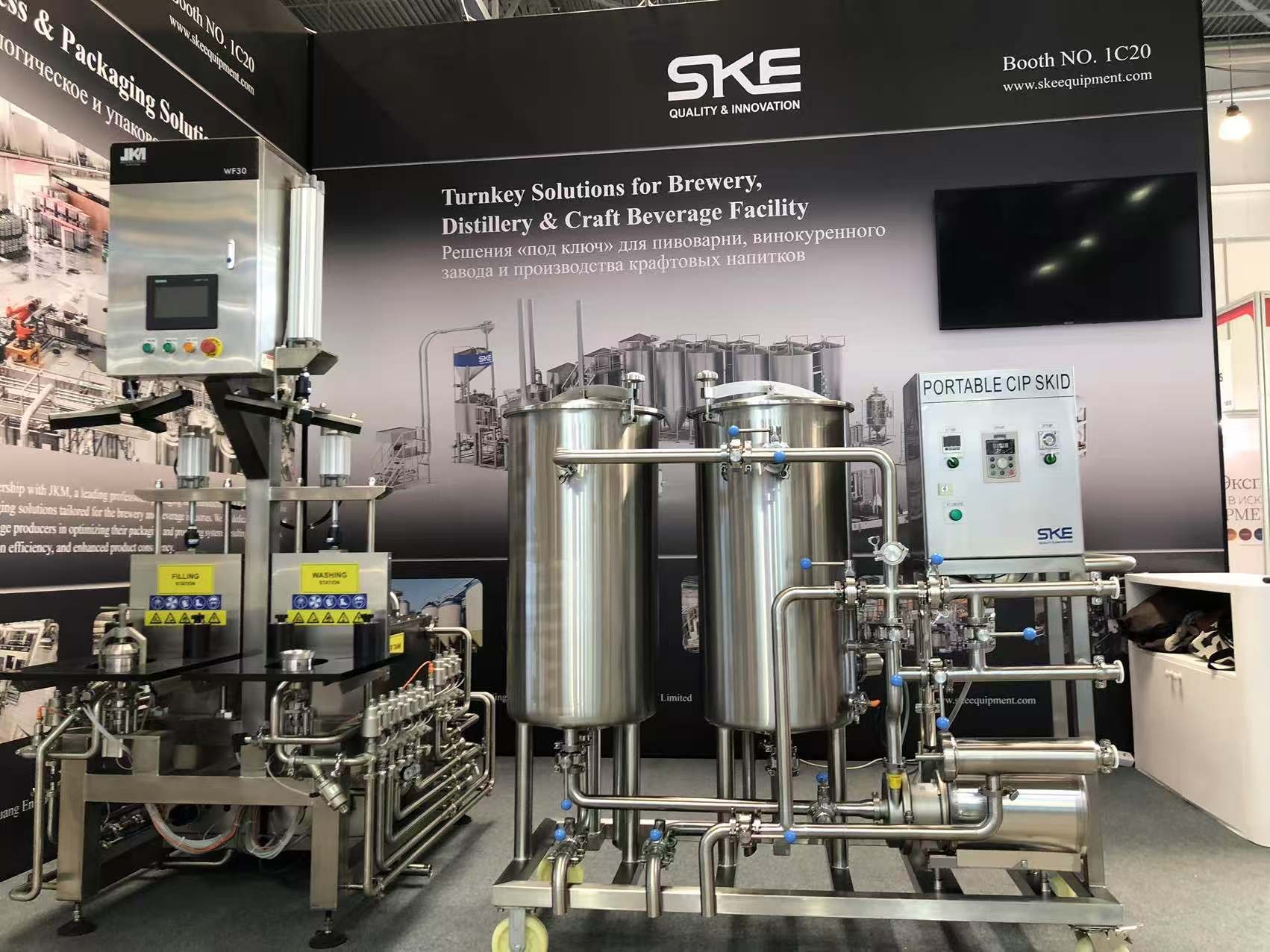
A standard CIP skid is a masterpiece of hygienic engineering. It typically consists of three main CIP tanks: one for hot water, one for caustic solution, and one for acid sanitizer. Some advanced systems use a single tank with return lines, but dedicated tanks offer better chemical recovery and efficiency.
The heart of the operation is the CIP pump. This is not a standard transfer pump; it is designed to overcome the friction loss of long pipe runs while delivering fluid at a specific velocity. To achieve proper cleaning, the fluid velocity must create turbulent flow (Reynolds number > 4000) to scour away biofilms.
At SKE, we design our control panels with PLC automation. This allows operators to set recipes for different vessels. A fermentation tank requires different spray patterns than a heat exchanger. The control system monitors conductivity (to ensure chemical concentration is correct) and temperature, automatically adjusting valves to route the fluid back to the correct tank.
The Critical Role of the CIP Pump in Brewery Hygiene
The CIP pump is arguably the most stressed component in a brewhouse. It must handle abrasive caustic soda at high temperatures (typically 85°C or 185°F) and acidic washes, all while maintaining high flow rates.
There are two primary types of CIP pumps: Centrifugal and Positive Displacement.
-
Centrifugal pumps are common for general spraying due to their high flow rates.
-
Positive displacement pumps (like the Bredel CIP hose pumps) excel in dosing viscous additives like yeast or fruit purees without shearing the product.
Recent innovations, such as the Bredel CIP pump technology, have solved a major industry pain point: velocity. Standard hose pumps often cannot achieve the necessary 2.5 meters per second flow rate required for effective cleaning without damaging the hose. Newer designs feature retractable shoes that open the hose during CIP, allowing full flow without compression wear.
For the largest liquor companies, choosing the right pump impacts the bottom line. A pump that lasts longer and reduces maintenance downtime is a strategic asset.
How Large Liquor Companies Optimize CIP
When we look at the largest liquor companies—such as the AB InBev, Heineken, and Kirin—their scale demands radical efficiency. A small brewery might use 5-6 hectoliters of water per hectoliter of beer, but giants have pushed boundaries.
For example, Brasil Kirin partnered with chemical experts to revamp their CIP process. By switching to a single-step cleaning process (eliminating intermediate rinses), they achieved:
-
50% reduction in water usage.
-
56% reduction in energy consumption.
-
32% reduction in wastewater.
Similarly, the Budweiser plant in Putian (China) utilizes a comprehensive CIP recovery center. They use reverse osmosis to recover “gray water” from the final rinse to serve as the initial rinse for the next cycle. This aligns with the global push for “Net Zero” water brewing.
These case studies prove that investing in high-quality CIP equipment is not just a quality measure; it is a sustainability metric that boosts profit margins.
Future Trends: Water Recovery and Neutral Detergents
The future of CIP equipment is green. We are seeing a shift towards “reduced chemistry” and water recovery. The largest liquor companies are lobbying for systems that can capture the final rinse water from one tank and store it specifically to pre-rinse the next dirty tank. This “cascade” system can cut water usage by over 30%.
Additionally, new technologies like electro-activated water are emerging. These systems produce a neutral pH, high-oxidation cleaning solution that is less dangerous for workers to handle and easier on wastewater treatment plants, while still killing microbes effectively.
SKE is at the forefront of these innovations, ensuring our clients are ready for the next generation of environmental regulations.

Conclusion
CIP is not just about cleaning; it is about protecting your brand. Investing in the right CIP equipment ensures that every pint tastes exactly as the brewer intended. From the forceful spray of the CIP pump to the chemical storage of the CIP tank, every component must work in harmony.
We have learned that the largest liquor companies view CIP as a core competency—a way to save water, reduce energy, and maximize production uptime. At SKE, we build brewing equipment that masters these complexities. We invite you to explore how our automated solutions can bring precision and peace of mind to your production line.
Technical Specifications: SKE CIP System Components
To provide a clearer picture of the engineering behind our solutions, below is a specification table for a standard SKE CIP skid. Please note that all parameters are customizable based on brewhouse capacity.
| Component | Specification | Material / Standard | SKE Advantage |
|---|---|---|---|
| CIP Tanks | 500L – 30,000L Capacity | SUS 304 / 316L Stainless Steel | Dimpled jackets for steam heating; Conical bottom for full drainage. |
| CIP Pump | Centrifugal or PD (Hose) | Flow: 10 – 100 m³/h | Variable Frequency Drive (VFD) included for velocity control. |
| Spray Device | Static Spray Ball or Rotary Jet Head | Coverage: 360° | Low-flow, high-impact nozzles to reduce water usage. |
| Filtration | Basket Strainer (Return Line) | Mesh: 30 – 60 mesh | Protects the CIP pump from trub and gasket fragments. |
| Valves | Mix-proof & Butterfly Valves | DIN / 3A Standard | Leak detection ports; prevents cross-contamination. |
| Heating | Plate Heat Exchanger | SS316 Plates | Instantaneous heating of caustic solutions; faster cycles. |
Frequently Asked Questions (FAQ) About CIP Equipment
Q1: How often should I run a CIP cycle on my fermentation tanks?
A: Generally, a CIP cycle should be run immediately after a tank is emptied (bright beer tank) or at the end of the fermentation cycle. You should never let soil dry on a tank surface, as it becomes exponentially harder to remove. For largest liquor companies, tanks are often scheduled for CIP back-to-back to maximize asset utilization.
Q2: What is the ideal velocity for a CIP pump in a brewery?
A: For effective cleaning of pipelines, the industry standard requires a flow velocity of at least 1.5 meters per second (m/s), though 2.5 m/s is preferred for heavy-soil applications like heat exchangers. This ensures turbulent flow, which creates the scrubbing action needed to remove biofilms.
Q3: Can I use the same CIP tank for caustic and acid?
A: Technically yes, but it is highly discouraged unless you perform extensive rinsing between batches. Residual acid mixed with caustic creates a neutralization reaction, generating heat and rendering both solutions useless. SKE recommends dedicated CIP tanks for each chemical to guarantee recovery purity and safety.
Q4: How do I prevent “beer stone” buildup?
A: Beer stone (calcium oxalate) cannot be removed by standard caustic alone. You must use an acid wash cycle (Nitric/Phosphoric acid blend) periodically. Automated CIP equipment with conductivity sensors ensures the acid concentration remains high enough to dissolve these mineral deposits without damaging the stainless steel.
Q5: What maintenance does a CIP pump require?
A: It depends on the pump type. Centrifugal pumps require seal checks. For hose pumps (peristaltic), the main maintenance item is the hose itself. Newer CIP pump designs (like Bredel) allow you to retract the shoes during CIP, drastically extending hose life compared to older models.
Contact Us
If you have any further questions, feel free to reach out!
- Facebook: SKE Equipment Facebook
- Email: info@skeequipment.com
For more personalized assistance, please fill out the contact form at the bottom of this page. We look forward to helping you with your brewing needs!