A few major companies dominate the global beer industry. When we talk about large beer companies, we mean those that produce billions of liters of beer every year. These companies don’t just brew beer—they manage large-scale, complex supply chains and biochemical engineering processes.
To understand the beer in your hand, you first need to understand the equipment that makes it. The world’s largest beer manufacturers operate facilities as big as small cities. They need highly efficient, hygienic, and durable equipment to keep their international brands tasting the same everywhere.
For industrial equipment manufacturers like SKE, working with these giant beer companies is the highest standard of success. We provide the core equipment that keeps these breweries running: from energy-saving fermentation tanks to fully automated sugar extraction systems. Without precise engineering, a global lager would taste different in every country.
This article looks at the world’s top beer manufacturers and the technical equipment they need to stay operational.
Who Are the Largest Beer Manufacturers in the World?
The ranking of the world’s largest beer manufacturers is fairly stable, based on annual sales volume and global market reach. According to the latest financial data, AB InBev remains the clear leader. Heineken and China Resources Snow Breweries follow closely behind.
Here’s a quick look at these top companies:
| Rank | Company | Headquarters | Key Global Brands | Annual Volume (Million Hectoliters) |
|---|---|---|---|---|
| 1 | AB InBev | Belgium | Budweiser, Stella Artois, Corona | ~500+ |
| 2 | Heineken | Netherlands | Heineken, Amstel, Tiger | ~250+ |
| 3 | China Resources Snow | China | Snow Beer | ~110+ |
| 4 | Carlsberg | Denmark | Carlsberg, Tuborg | ~100+ |
| 5 | Molson Coors | USA/Canada | Coors Light, Miller Lite | ~80+ |
All these large beer companies face the same key challenge: keeping their beer’s taste consistent across dozens of countries. This means every storage tank and pipe must meet strict biochemical standards.
The Equipment Backbone: Fermentation and Storage
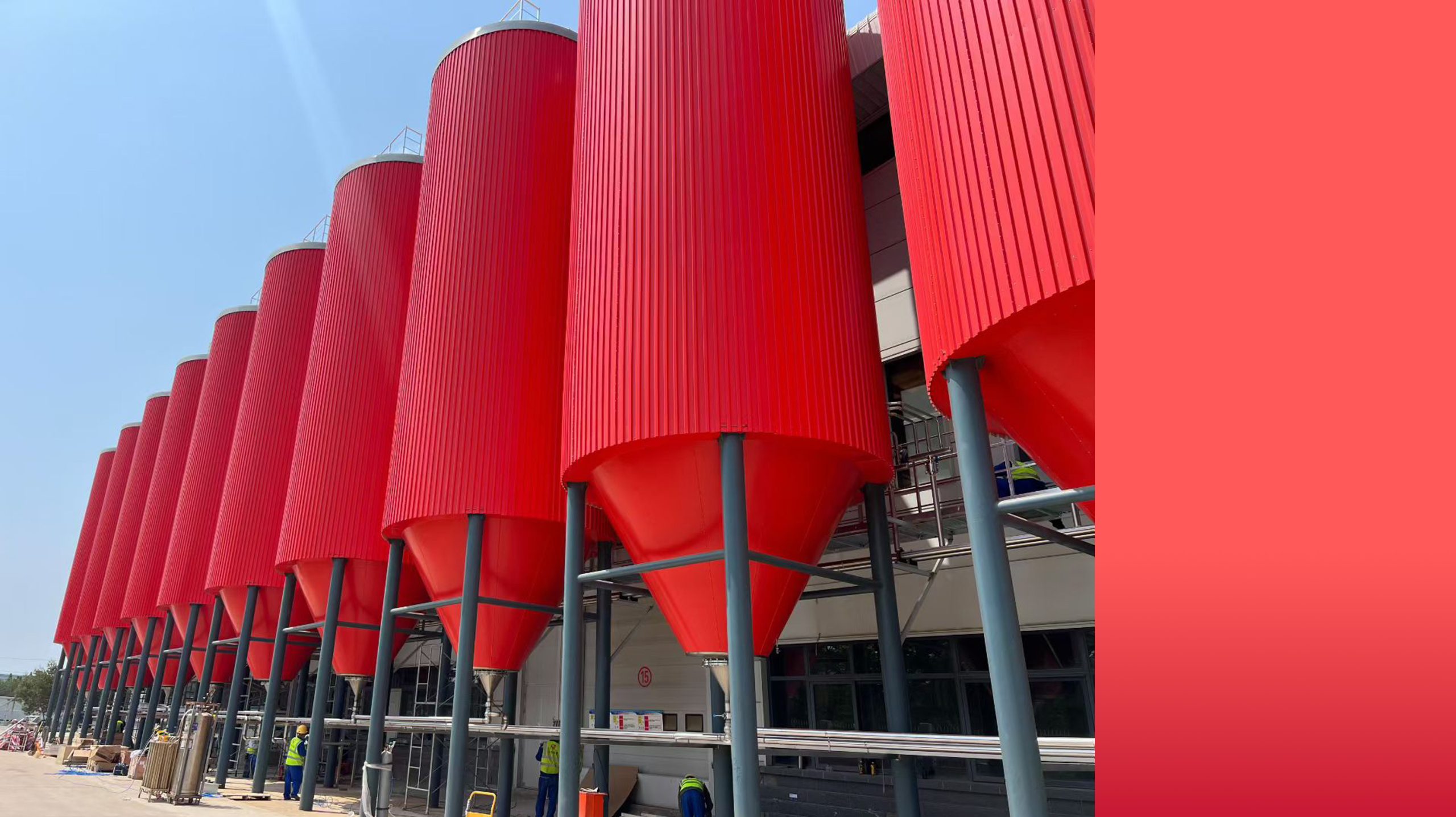
When you look at how the largest beer manufacturers operate, one piece of equipment stands out as the heart of their facilities: the fermentation tank. Unlike the small 10-barrel tanks used in craft breweries, large beer companies use vertical cylindrical tanks that hold more than 3,000 hectoliters (300,000 liters) each.
The Role of Fermentation Tanks
Fermentation creates heat. Yeast turns sugars into alcohol and CO2, which generates a lot of heat. For large beer companies, controlling this heat across hundreds of tanks is a major engineering challenge.
SKE builds large-scale fermentation tanks with built-in cooling jackets. Our dimpled jackets provide maximum surface area for glycol to circulate, keeping the temperature stable within +/- 0.5°C. This precision prevents off-flavors (like diacetyl or acetaldehyde) that would ruin large batches of beer.
Storage and Maturation
After the first fermentation stage, beer enters the lagering (aging) phase. Storage tanks hold the beer for weeks or even months. For the world’s largest beer manufacturers, space is valuable.
SKE designs vertical and horizontal storage tanks to maximize space efficiency. We use food-grade stainless steel (AISI 304 or 316L) to prevent corrosion and bacteria growth. Our tanks have conical bottoms to make yeast collection easy, plus CIP (Clean-in-Place) spray balls for thorough cleaning.
Every tank SKE ships meets pressure ratings and has an internal surface roughness (Ra) of less than 0.8µm—exceeding international hygiene standards.
The Brewhouse: Sugar Extraction Systems
Before fermentation comes mashing and lautering (grain separation). Large beer companies can’t afford inefficient grain separation, so they use continuous or high-volume batch systems.
SKE provides complete sugar extraction and mashing equipment:
-
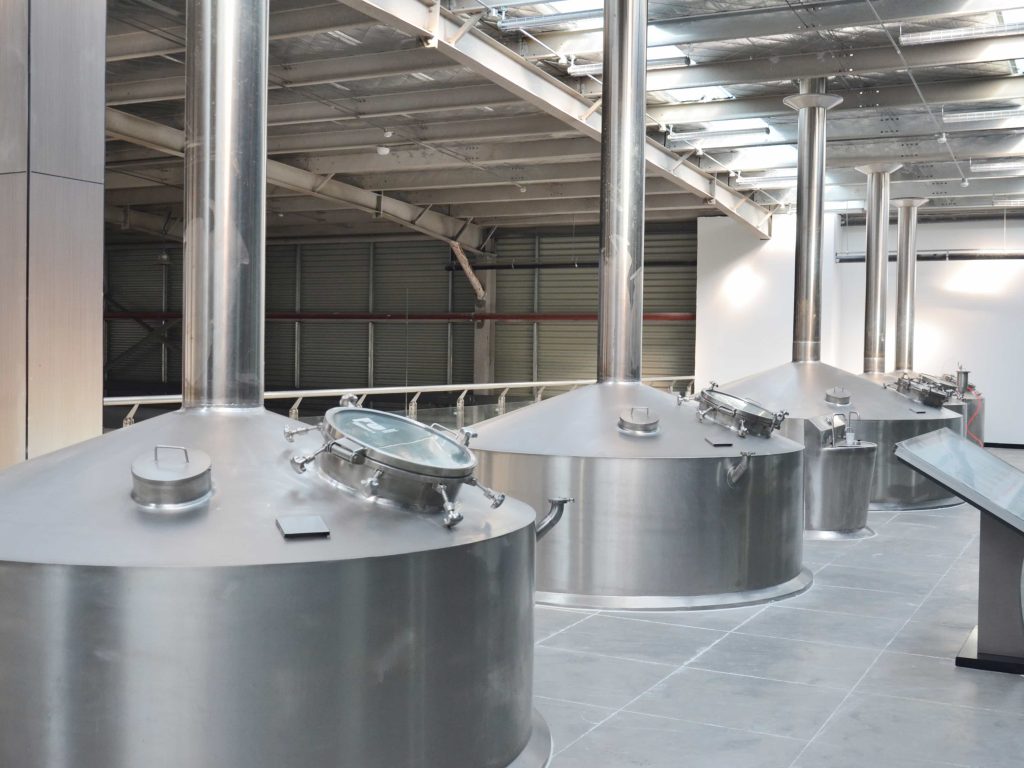
Mash Tuns: Insulated tanks with precise mixers. We add steam injection to quickly adjust temperatures (50°C for protein rest, 65-70°C for saccharification).
-
Lauter Tuns: These tanks are wide and shallow. SKE’s raking mechanisms prevent grain beds from compacting, so we can efficiently extract high-gravity wort (over 16°P). This maximizes the amount of beer produced per ton of malt.
-
Kettles and Whirlpools: Our internal calandria heating systems reduce burning (caramelization) while creating a strong boil to remove DMS (dimethyl sulfide).
SKE’s equipment has dual-seal pumps and backup heating systems to avoid any downtime.
Automation and Control Systems
How SKE Integrates Automation
We don’t just sell metal tanks—we sell smart, automated systems. SKE provides modular automation systems that connect with a brewery’s existing equipment.
-
Real-time Monitoring: Our sensors track specific gravity, pH, dissolved oxygen, and temperature nonstop.
-
Automated Valve Trains: SKE’s pneumatic valve manifolds control the flow of beer between 100+ tanks without any manual help.
-
CIP Optimization: Our automated CIP cycles reuse water and caustic chemicals, cutting utility costs by up to 30%. For large beer companies, this saves millions of dollars each year.
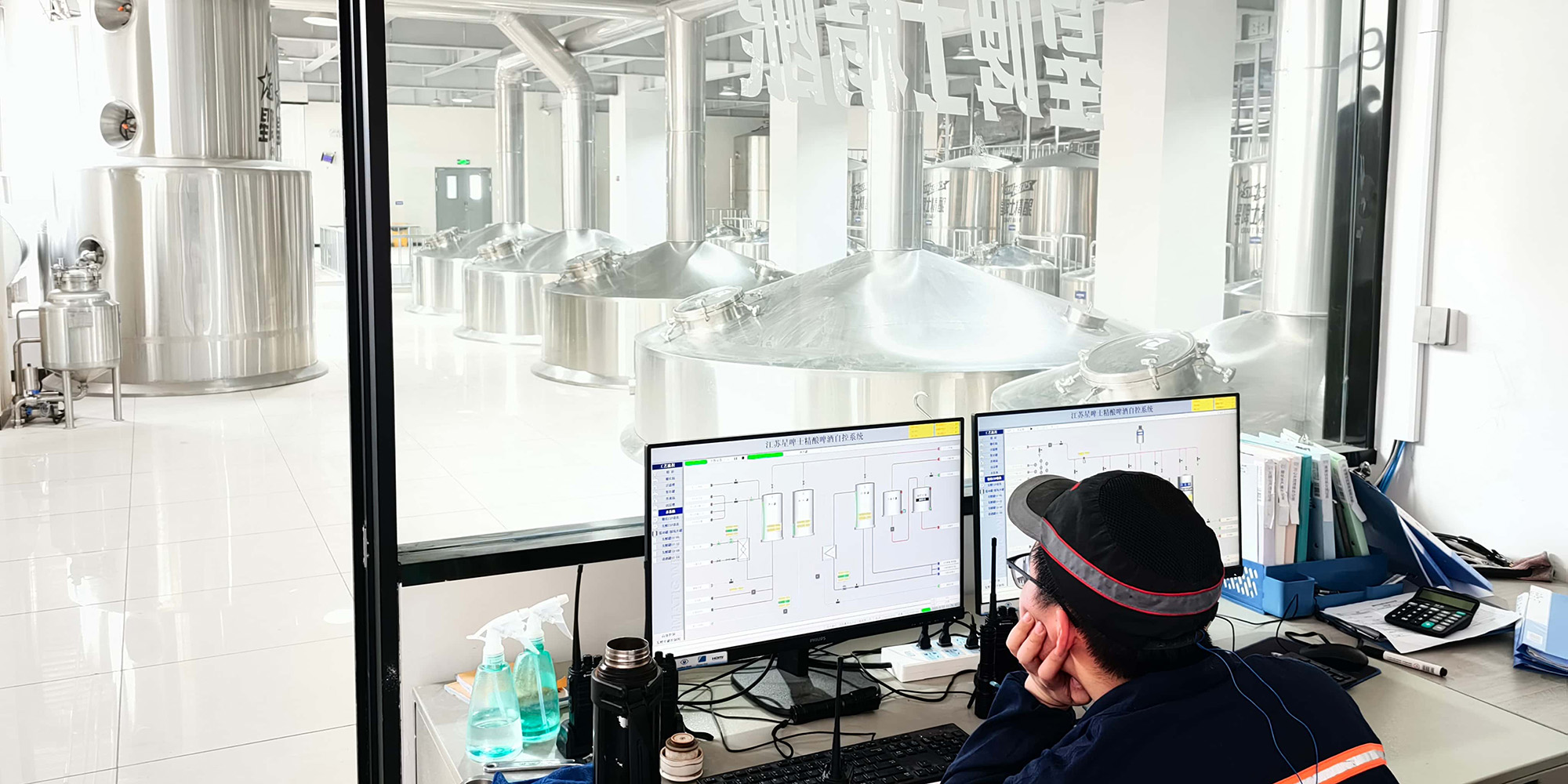
A typical SKE-controlled brewhouse lets one operator manage the entire mashing, boiling, and whirlpool process from a touchscreen. This precision ensures a Budweiser brewed in Brazil tastes exactly like one brewed in Belgium.
Quality Control and Hygiene Standards
For large beer companies, a single contamination incident can mean destroying a batch worth $2 million. That’s why equipment design focuses on hygienic engineering.
SKE follows EHEDG (European Hygienic Engineering & Design Group) guidelines. Our key contributions include:
-
Eliminating Dead Legs: Any pipe branch that doesn’t have flowing liquid risks bacterial growth. SKE designs manifolds with no dead legs.
-
Polish Welding: We use orbital welding for automated tube connections, creating smooth, seamless joints where bacteria can’t hide.
-
Surface Finish: All surfaces that touch beer get a 180-grit mechanical polish followed by electropolishing. This removes tiny peaks and valleys where microbes could grow.
The world’s largest beer manufacturers thoroughly audit their suppliers. SKE holds ISO 9001 and ASME certifications, allowing us to build pressure vessels for global markets—including the EU (PED) and North America (Section VIII).
Why SKE Is the Partner for Large Beer Companies
You now know the technical demands of large beer production. Here’s why you should choose SKE as your equipment manufacturer:
-
Customization: Standard tanks rarely fit existing brewery spaces. SKE’s engineers design tanks with custom diameters, heights, and manway positions.
-
Scale: Our workshops (over 50,000 square meters) can build tanks weighing more than 500 tons. We use specialized logistics to deliver and install storage tanks.
-
End-to-End Service: SKE manages the entire project—from 3D modeling and FEA stress analysis to on-site assembly and commissioning.
-
Cost Efficiency: By owning our own steel processing and welding lines, SKE cuts out middlemen, reducing costs for large beer companies.
Whether you need a single fermentation tank or a complete brewhouse capable of producing 10 million hectoliters a year, SKE has the engineering expertise to deliver.
FAQ: Large Beer Companies and Industrial Equipment
Q1: What are the biggest challenges large beer companies face during fermentation?
A: The main challenges are temperature control and yeast management. Large tanks (over 5,000 hectoliters) create pressure differences that stress yeast. SKE solves this with external cooling jackets and conical bottoms, which let you collect yeast easily without opening the tank.
Q2: How often do large beer manufacturers replace their storage tanks?
A: Stainless steel tanks last 25 to 40 years with proper maintenance. However, large beer companies often upgrade tanks to meet new capacity needs or improve CIP efficiency. SKE offers retrofitting services to add automated valves to older storage tanks.
Q3: Can SKE provide automation systems for existing breweries?
A: Yes. SKE specializes in upgrading existing breweries (brownfield projects). We can integrate our SCADA and PLC automation systems into your current tanks and pipes without tearing down your setup. This minimizes disruption for large beer companies.
Q4: What is the typical lead time for an SKE fermentation tank?
A: Standard cylindrical tanks (500-1000 HL) take 12-14 weeks to produce. Custom tanks for the world’s largest beer companies (5000+ HL) may take 20-24 weeks, including shipping and on-site welding.
Q5: Do large beer companies use the same equipment as craft breweries?
A: No. The metal used is similar, but the tank design is different. Large beer companies need steeper cone angles (60°-75°) for better yeast flow and higher pressure ratings (2.5-3.0 bar) to support centrifugal yeast separation. SKE builds equipment exclusively for industrial use, not craft breweries.
Q6: How does SKE ensure sanitary welds on large storage tanks?
A: We use automated orbital welding machines for longitudinal seams and X-ray every joint. For the world’s largest beer companies, we also provide borescope videos of internal welds before final polishing.
Conclusion: Engineering the Future of Global Brewing
The world’s largest beer manufacturers are always looking to become more efficient. Whether it’s using less water in the brewhouse or improving yeast survival in fermentation tanks, even small efficiency gains matter when producing billions of liters of beer.
SKE is ready to be your strategic supplier. We combine large-scale manufacturing capacity with precise automation. When you partner with SKE, you’re not just buying a tank—you’re investing in decades of brewing engineering experience.
If you’re a large beer company looking to upgrade your sugar extraction line or expand your storage tanks, contact SKE today for a technical consultation and custom quote.
- Facebook: SKE Equipment Facebook
- Email: info@skeequipment.com
For more personalized assistance, please fill out the contact form at the bottom of this page. We look forward to helping you with your brewing needs!