
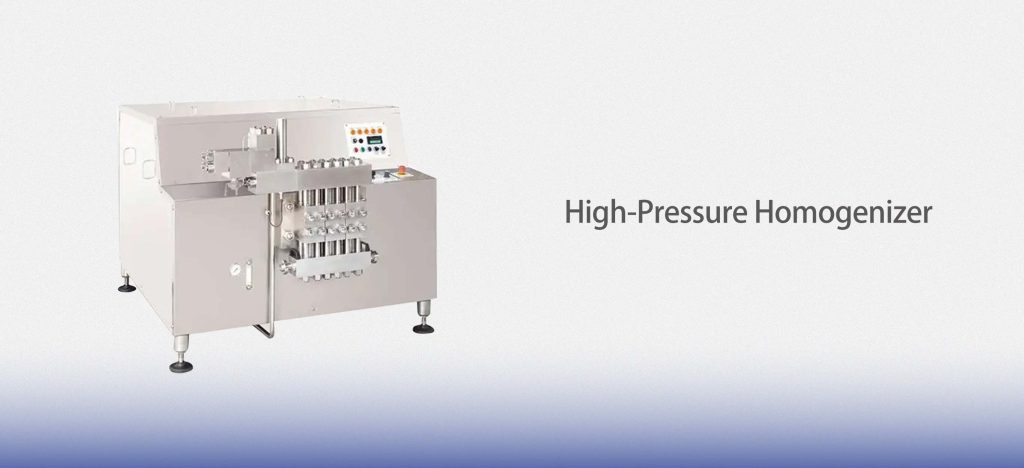
A standard high pressure homogenizer stalls out on certain formulations: hazy IPAs with high protein and polyphenol load, RTD cocktails carrying essential oils, oat-based stouts with real fat content. When particle size needs to drop below what 400 bar can reach, or when an emulsion has to survive months on a shelf without a cold chain, the next step up is ultra-high-pressure homogenization — equipment running above 1,000 bar (100 MPa), sometimes past 4,000 bar (400 MPa).
This is not the same purchase decision as a standard homogenizer. The physics changes, the cost structure changes, and the published research on what ultra-high pressure actually does to a beverage is more specific — and more mixed — than most vendor pages let on. This guide works through the real data: what happens to particle size, what happens to spoilage organisms, and what it costs to run.
Key Takeaways
- Ultra-high-pressure homogenization (UHPH) is defined in the food-science literature as processing above 200 MPa (2,000 bar), with the entire pressure event lasting under 0.2 seconds and time inside the valve itself under 0.02 seconds — fast enough to fragment structures down to 100–300 nanometers (ScienceDirect, tiger nut milk study).
- In a published dairy trial, raising pressure to 300 MPa cut the mean fat globule size (D[4,3]) from 3.81 µm to 0.189 µm — but the same 300 MPa treatment also accelerated lipid oxidation and produced some particle re-aggregation, a real trade-off the marketing copy for this equipment rarely mentions (Journal of Dairy Science, via PubMed).
- UHPH measurably reduces spoilage yeast — up to 7 log reduction in grape juice at 300 MPa — but food-safety researchers are explicit that it is not a validated substitute for pasteurization (BIO Web of Conferences, OIV 2023).
- Valve design is where most of the achievable energy savings live: engineering studies on updated valve geometries report up to 20% lower energy draw at the same pressure and output (ScienceDirect, valve design study).
What Actually Happens Above 200 MPa
A standard high pressure homogenizer for beverage work runs 150–400 bar (15–40 MPa). Ultra-high-pressure systems operate in an entirely different band — above 200 MPa (2,000 bar), with some continuous industrial systems now built to run as high as 400 MPa (GEA homogenizer specifications).
The forces inside the valve are the same three at work in any homogenizer — shear, impact, and cavitation — but at UHPH pressures they act on a much shorter timescale and with far more energy behind them. Published process measurements put the full pressurization-to-discharge event at under 0.2 seconds, with the liquid spending less than 0.02 seconds inside the valve gap itself. In that fraction of a second, the process can fragment biological structures — cell walls, protein aggregates, fat globules — down to the 100–300 nanometer range, an order of magnitude finer than what standard homogenization reaches.
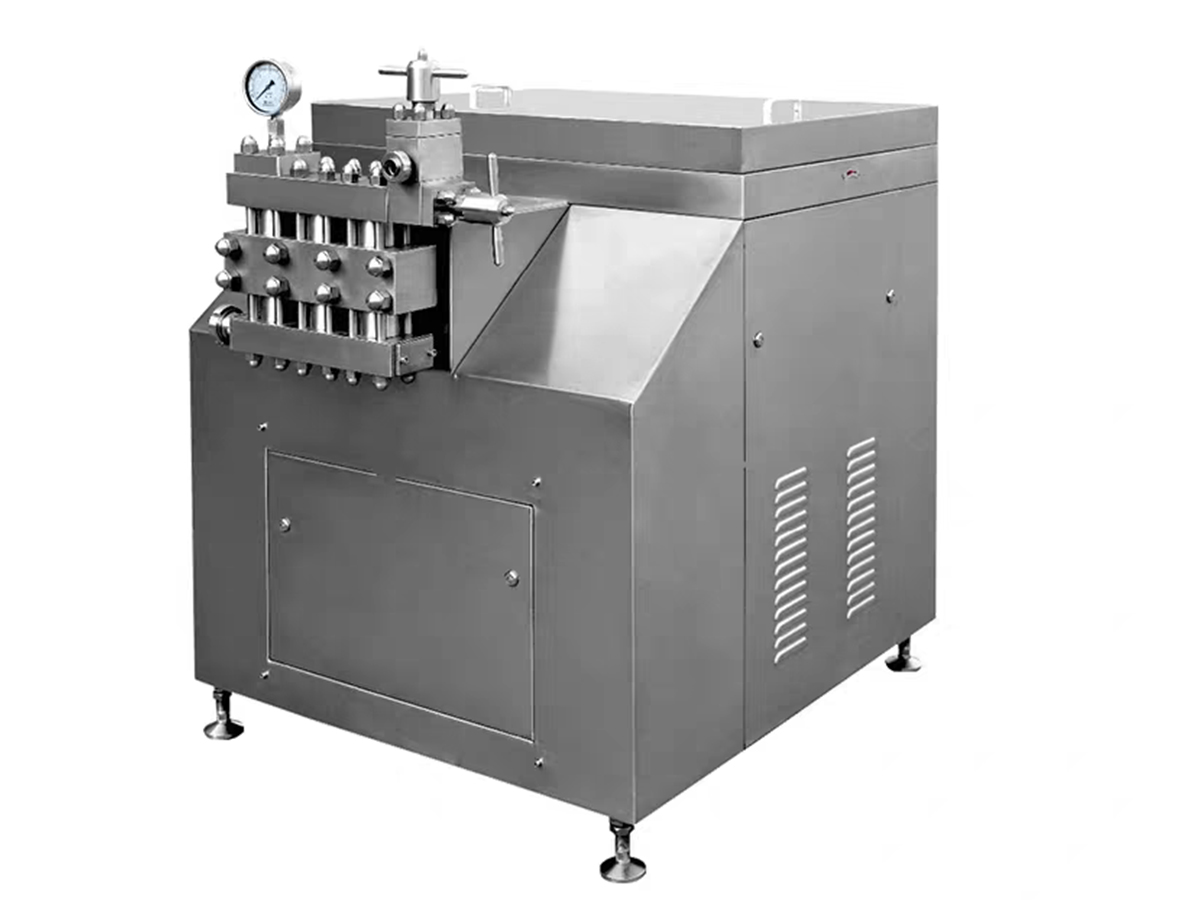
That nanoscale fragmentation is the entire reason this equipment exists. It is also the reason it costs so much more to buy and run — generating and controlling that much force on a continuous production line is a harder engineering problem than standard homogenization.
The Data: How Much Smaller, and What Comes With It
Vendor pages tend to state particle-size claims without a source. The peer-reviewed research is more specific, and more honest about the downside.
In a controlled dairy study, raising homogenization pressure to 300 MPa reduced the volume-weighted mean fat globule diameter (D[4,3]) from 3.81 µm in the untreated control down to 0.189 µm — roughly a 20-fold reduction. That number is exactly the kind of result equipment vendors point to. What the same study also found: at 200–300 MPa, UHPH accelerated lipid oxidation in the product, and at 300 MPa specifically, some of the newly-created fat particles began re-aggregating rather than staying dispersed (Journal of Dairy Science, via PubMed).
For a brewery evaluating this equipment for a fat- or oil-containing product — a milk stout, an RTD cream cocktail, a nitro coffee beer — that trade-off matters more than the headline particle-size number. Running at the pressure that gives the smallest particles is not automatically the right operating point; oxidation risk and re-aggregation both scale with pressure too, and the optimum is product-specific.
Microbial Reduction Is Real — and Real Bounded
UHPH’s antimicrobial effect is one of the more genuinely useful side benefits of the technology, and it is backed by more published data than the particle-size claims:
| Product / Organism | Conditions | Result | Source |
|---|---|---|---|
| Zygosaccharomyces bailii (fruit juice) | 100 MPa, 8 passes | >2.5 log CFU/mL reduction | PubMed 20492240 |
| Spoilage yeast (rice wine) | 172 MPa, 5 passes | >4 log reduction | PMC6049100 |
| Spoilage yeast (grape juice) | 300 MPa | Up to 7 log reduction | BIO Web of Conferences, OIV 2023 |
| Microbial load (almond beverage) | 300 MPa, 75°C inlet | Inactivation comparable to UHT thermal treatment | PMC5302318 |
That last result is notable — at high enough pressure and inlet temperature, UHPH can match thermal pasteurization for microbial load in a specific tested product. It is not, however, a validated kill-step across the board. The studies above are product- and organism-specific, run under controlled lab conditions, and none of them stand in for a validated HACCP kill-step in a commercial brewery. If a product’s safety plan depends on microbial reduction, that reduction needs to be validated for that exact product and process — not assumed from a published result on a different beverage.
Standard vs. Ultra-High-Pressure: The Actual Numbers
Our guide to standard high pressure homogenization covers the 150–400 bar range that handles most specialty beer formulations. Here is where ultra-high-pressure actually separates from it:
| Factor | Standard High Pressure | Ultra-High-Pressure |
|---|---|---|
| Operating pressure | 150–400 bar (15–40 MPa) | >2,000 bar (200 MPa), up to 4,000 bar in continuous systems |
| Achievable particle size | ~0.5–1 µm median | 0.1–0.3 µm (100–300 nm) |
| Process time in valve | Milliseconds | <0.02 seconds |
| Microbial log reduction | Minimal, not a design target | 2.5–7 log reduction demonstrated in specific products |
| Lipid oxidation risk | Low | Elevated at 200–300 MPa in fat-containing products |
| Typical equipment cost | Baseline | Substantially higher — multiple times the capital cost |
When the Upgrade From Standard Actually Pays Off
The decision to move from standard to ultra-high-pressure homogenization should follow the formulation, not the brewery’s size or budget alone. It is worth the jump when:
- Standard homogenization (150–400 bar) has already been tried on the actual formulation and the emulsion or suspension still separates before the intended shelf life.
- The product carries fine particulates — fruit fiber, plant protein, insoluble botanicals — that need to stay below roughly 0.3 µm to avoid visible sedimentation.
- Some measurable spoilage-organism reduction is wanted as a secondary hurdle alongside — not instead of — a validated thermal or chemical kill-step.
- Production volume is high enough that the equipment’s cost per unit of output is manageable; UHPH capital and energy costs do not scale down gracefully for small batch runs.
It is very likely the wrong tool when a standard homogenizer hasn’t actually been tested on the formulation yet, when the product has no fat or oil phase to stabilize, or when the brewery’s real constraint is budget rather than physics. Most specialty beer and RTD formulations stabilize fine in the 150–400 bar range; ultra-high-pressure is a fix for the formulations that specifically don’t.
The Operating Cost Nobody Puts on the Spec Sheet
Two costs scale disproportionately once pressure crosses into UHPH territory:
Energy. Pushing product to 2,000–4,000 bar takes substantially more pump energy than 400 bar, and that draw is continuous, not one-time. Engineering research on valve geometry shows this is also where the biggest efficiency gains are available: optimized valve designs have demonstrated up to 20% lower energy consumption at equivalent pressure and throughput compared to older valve geometries (ScienceDirect, valve design study). Ask any UHPH vendor for the valve generation their quoted unit uses, not just its rated pressure.
Valve and seal wear. The same forces that fragment particles erode the valve seat and seals faster at ultra-high pressure than at standard pressure. Brewery-scale precedent for managing this exists: Carlsberg’s Fredericia brewery runs GEA VARIVENT valve systems specifically to extend component life and reduce unplanned downtime on high-pressure processing lines (GEA). Budget for scheduled valve replacement as a fixed operating cost, not an occasional repair.
Managing the Trade-offs
Lipid oxidation: if the product has a fat or oil phase, run trials at the lowest pressure that hits the required particle size rather than defaulting to the maximum the equipment offers — the dairy data above shows oxidation risk climbs with pressure.
Re-aggregation: verify particle-size distribution after homogenization, not just immediately after the valve. Some products showed particles reforming post-processing at the highest tested pressures.
Energy cost: specify current-generation valve geometry when quoting equipment; the efficiency gap between valve designs is large enough to matter over years of continuous operation.
Microbial claims: treat any UHPH log-reduction number as specific to the product and organism it was measured on. Validate independently before it factors into a food-safety plan.
Frequently Asked Questions
What pressure counts as “ultra-high-pressure” homogenization?The food-science literature generally uses 200 MPa (2,000 bar) as the threshold, with some continuous industrial systems now built to run as high as 400 MPa.
Does ultra-high-pressure homogenization replace pasteurization?No. Published studies show meaningful log-reduction of spoilage organisms — up to 7 log in one grape juice study — but researchers are explicit that this is not a validated substitute for a proper thermal or chemical kill-step. Any food-safety claim needs independent validation on the specific product.
Why would a smaller particle size ever be a problem?It usually isn’t, but the pressure required to reach it can be. In dairy research, the pressure that produced the smallest fat globules (300 MPa) also accelerated lipid oxidation and caused some particle re-aggregation — the smallest achievable size and the best product outcome are not always the same operating point.
How much more does ultra-high-pressure equipment cost to run than standard homogenization?Energy draw and valve wear both increase substantially above 2,000 bar. Valve design accounts for up to a 20% swing in energy use between equipment generations at the same pressure, so the operating-cost gap depends heavily on which system is being quoted.
Does every brewery working with fruit or flavored beer need this equipment?No. Most fruit and flavored beer formulations stabilize adequately with standard 150–400 bar homogenization. Ultra-high-pressure is for formulations that have already been tested at standard pressure and still don’t hold.
Where This Leaves a Buyer
Ultra-high-pressure homogenization does what the particle-size numbers promise — the dairy research alone shows a 20-fold reduction in fat globule size at 300 MPa. What it doesn’t do is arrive free of trade-offs: oxidation risk rises with pressure, valve wear accelerates, energy cost climbs, and any microbial-reduction claim needs product-specific validation before it means anything for food safety.
For most specialty beer and RTD programs, a standard high pressure homogenizer handles the formulation. Ultra-high-pressure earns its cost when standard pressure has been tried on the actual product and demonstrably falls short — not as a default upgrade.
SKE engineers both standard and ultra-high-pressure homogenization systems for brewery and beverage production lines. Contact SKE with your formulation’s specific stability problem, and we’ll help determine which pressure range actually solves it.
- Facebook: SKE Equipment Facebook
- Email: info@skeequipment.com
Fill out the contact form below for customized solutions. We fully support all your production equipment demands for breweries and beverage plants.