
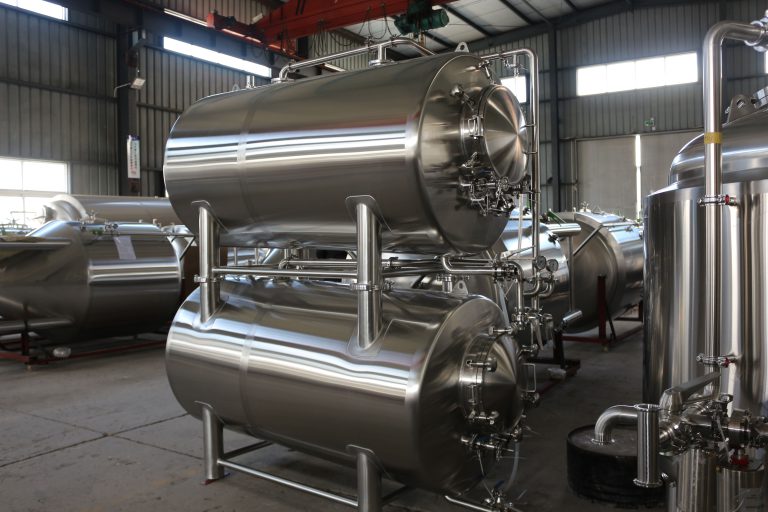
A horizontal brite tank is a stainless steel tank for finished beer. It holds, cools, clarifies, and carbonates beer before packaging. The tank lies on its side. This shape makes the liquid layer shallow. A shallow layer can help yeast settle. It can also help a brewery use its building height well.
For mid-to-large breweries, the choice between a horizontal brite tank and a vertical one is not just about tank size. The decision affects brewery layout, clarification, carbonation, cleaning, and daily work.
Horizontal tanks can be a good choice for lagers, conditioned beers, and large batches. But they also need careful design for drainage, cleaning, and carbonation.
This guide explains how horizontal brite tanks work, their main benefits and limits, and what to check before buying one.
What Is a Horizontal Brite Tank?
A horizontal brite tank is a stainless steel pressure tank. Breweries use it to store and condition beer after main fermentation. It gives beer a controlled place for cold storage, settling, carbonation adjustment, and packaging preparation.
A vertical brite tank stands up. A horizontal brite tank lies on its side. This changes the shape of the liquid space. It affects how solids settle, how CO₂ moves in the beer, and how cleaning equipment reaches the inside surfaces.
The main jobs of a horizontal brite beer tank are:
-
Clarification: yeast and small particles settle at the bottom.
-
Cold conditioning: the tank keeps beer at the right temperature.
-
Carbonation control: the tank holds beer at the target CO₂ level or supports carbonation.
-
Beer storage: the tank holds beer before transfer or packaging.
Breweries with large production often think about horizontal tanks. Building height, tank arrangement, and conditioning needs can all affect the choice.
But a horizontal tank is not always better. The result depends on tank size, process design, cooling power, and daily work procedures.
Why Mid-to-Large Breweries Choose Horizontal Brite Tanks
Horizontal brite tanks have several practical benefits. They are most useful when a brewery needs large volumes or a special tank layout.
1. Better Use of Building Height
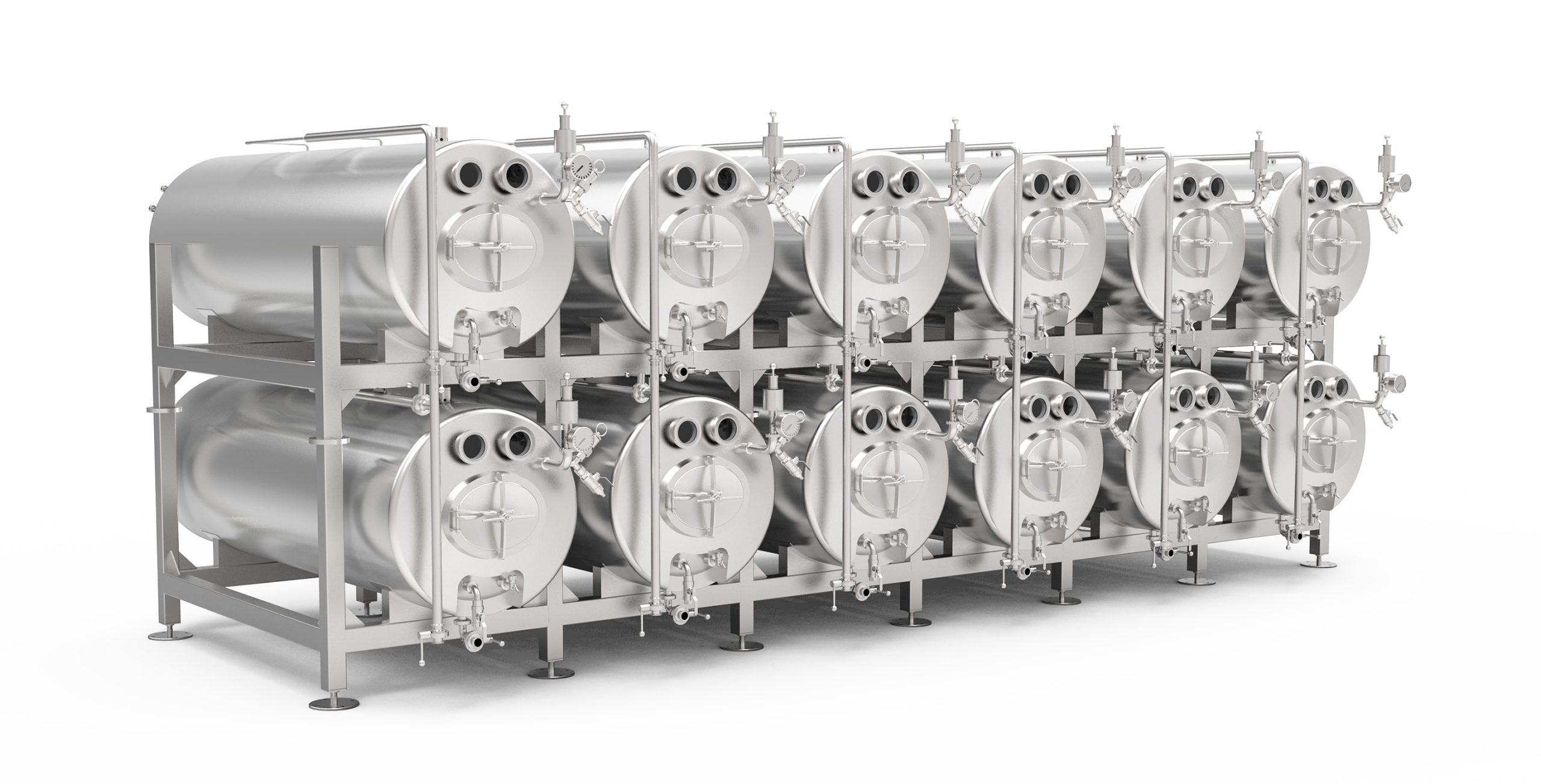
One main reason for choosing a horizontal tank is stacking.
Some buildings have little floor space but enough ceiling height. In this case, horizontal tanks can sit on strong steel frames. Two or more tanks can be placed one above the other. This raises total capacity in the same floor area.
This can help a brewery grow without building a new hall.
But stacking needs good engineering. The frame must hold the tanks, the beer, and the equipment. Workers also need safe platforms and enough space for maintenance.
Horizontal tanks do not always use less floor space than vertical tanks. Their main benefit comes from a good stacked layout.
2. Large Capacity Without Too Much Height
As production grows, each brite tank must hold more beer.
A large vertical tank needs a lot of height. This can be a problem in buildings with low ceilings, pipes, or little space for lifting.
A horizontal brite tank gives another option. Its volume can grow by changing the diameter and length. The total height stays low.
For large batches, this can make installation and layout easier.
The final design must still meet pressure, structural, cooling, and safety standards.
3. Possible Benefits for Beer Clarification
Clarification is a main technical reason for choosing horizontal tanks.
After fermentation, beer may still hold yeast cells, protein particles, and other solids. In cold storage, these particles slowly fall to the bottom.
A horizontal tank has a shallow liquid depth. A vertical tank with the same volume has a tall liquid column. In the horizontal tank, particles travel a shorter distance to the bottom.
The shape also gives a larger settling area compared with the liquid depth.
For some beers, this can support natural clarification. It can reduce the solids that move to the next step.
But tank shape alone does not control clarification time. It also depends on:
-
yeast type and how well it settles
-
beer temperature
-
particle size and amount
-
beer composition and haze stability
-
filling and transfer conditions
-
conditioning time
So a brewery should choose a horizontal brite tank based on its real beer types and clarity goals. It should not assume the tank will always make beer clear faster.
4. Lower Pressure on Settled Yeast
Another possible benefit is the lower liquid height.
A horizontal tank can have lower pressure at the bottom because the liquid column is shorter. This may put less pressure on settled yeast during conditioning.
But yeast autolysis is complex. Temperature, storage time, yeast health, and handling also affect it. Autolysis means yeast cells break down and can give off-flavors.
A horizontal tank alone cannot stop autolysis. It can only be one part of a good conditioning plan.

Horizontal Brite Tank vs. Vertical Brite Tank
Both tank types do similar jobs. But their shapes create different operating needs.
| Feature | Horizontal Brite Tank | Vertical Brite Tank |
|---|---|---|
| Installation | Lies on its side | Stands upright |
| Building height | Low profile | Needs more height |
| Floor space | Larger footprint unless stacked | Usually smaller footprint |
| Stacking | Can sit on steel frames | Less common |
| Clarification | Shallow depth may help settling | Taller liquid column |
| Carbonation | Needs careful control | Usually easier |
| CIP cleaning | Needs careful design | Simpler shape |
| Main use | Special layouts and conditioning | General beer finishing |
Carbonation in Horizontal Brite Tanks
Carbonation is an important point when choosing a horizontal brite tank.
Many breweries use a carbonation stone to add CO₂ to beer. The stone makes small bubbles. The bubbles rise through the beer. CO₂ then moves from the bubbles into the beer.
This works best with small bubbles, long contact time, low temperature, and correct pressure and gas flow.
In a horizontal tank, the liquid may be shallow. Bubbles can reach the surface fast. If gas goes in too quickly, some CO₂ may escape before it dissolves. Fast gas flow can also make foam, cause uneven carbonation, or disturb settled solids.
This does not mean carbonation stones cannot work in horizontal tanks. It means the stone position, gas flow, pressure, and procedure must be designed well.
Inline Carbonation During Transfer
For many breweries, inline carbonation is a good option.
Instead of adding all CO₂ inside the tank, the brewery adds CO₂ to the beer in the pipe during transfer. A carbonation system controls the gas and mixing before the beer enters the brite tank.
This method has several benefits:
-
better control of CO₂ during transfer
-
less need for in-tank carbonation
-
less disturbance of settled yeast
-
good fit with automated transfer
The horizontal brite tank then only keeps the beer at the right temperature and pressure.
But inline carbonation still needs good flow control, pressure monitoring, and accurate CO₂ measurement.
Natural Carbonation and Conditioning
Some breweries use natural carbonation during secondary fermentation.
Yeast turns sugar into alcohol and CO₂. The final CO₂ level depends on yeast activity, sugar, temperature, and pressure control.
A horizontal brite tank can be part of a good conditioning process. But its shape alone does not create natural carbonation.
The time needed varies by beer style and method. Breweries should set the process by the target CO₂ level and quality needs.

CIP Cleaning: Key Design Points
Cleaning is an area where horizontal brite tanks need careful design.
Their long shape can make full cleaning and draining hard. Yeast, beer residue, and hop particles may collect along the bottom or near the outlet.
If the cleaning system is not well designed, some inside surfaces may not get enough cleaning.
For mid-to-large breweries, CIP performance should be part of the tank design. It should not be left as a problem after installation. CIP means clean-in-place: cleaning the tank with liquids and spray devices, without taking it apart.
1. Tank Slope and Drainage
A horizontal brite tank should drain toward the outlet.
The slope, outlet position, and inside shape all affect how much liquid stays after emptying.
There is no single slope for every tank. The right design depends on tank length, diameter, support, and drainage needs.
The goal is to reduce leftover liquid and stop yeast or cleaning liquid from collecting in wrong areas.
2. Correct Outlet Valve Size
The outlet must fit the solids in the process.
Yeast, trub, and hop residue can block the outlet if it is too small or in the wrong place.
Outlet size and valve type should depend on tank size, product type, and discharge needs.
A three-inch butterfly valve may suit some tanks. But it should not be treated as a rule for all tanks.
3. Effective CIP Spray Coverage
The cleaning system must reach the whole inside surface.
Depending on tank size and shape, one rotating spray device or several devices may be needed.
Key design points include:
-
position of the cleaning device
-
spray coverage
-
cleaning flow rate
-
working pressure
-
cleaning temperature
-
chemical strength
-
cleaning cycle time
For long horizontal tanks, one spray device without a coverage check can create cleaning risks. The final CIP design should be checked with coverage tests and cleaning checks.
4. Safe Removal of Heavy Solids
Large amounts of settled yeast and hop residue may need extra work before cleaning.
Breweries should drain and pre-rinse loose solids before CIP.
Any manual work must only start after the tank is isolated, fully depressurized, and confirmed safe. Opening a manway or entering a tank must follow lockout and confined-space safety rules.
Cleaning chemicals cannot replace proper solids removal when a lot of material has built up.
Frequently Asked Questions
1.What is the main difference between horizontal and vertical brite tanks?
The main difference is the shape. Horizontal tanks lie on their side and have a low profile and shallow liquid depth. Vertical tanks stand up. This affects clarification, carbonation, cleaning, and brewery layout.
2.Can you carbonate beer in a horizontal brite tank?
Yes. You can carbonate beer in a horizontal brite tank with a carbonation stone and controlled CO₂ flow. But the shallow liquid may reduce bubble contact time. Inline carbonation during transfer is another good option.
3.Why do breweries stack horizontal brite tanks?
Breweries stack horizontal brite tanks to add capacity when floor space is limited but building height is available. Stacking needs strong steel frames, safe platforms, and enough space for maintenance.
4.How long does clarification take in a horizontal brite tank?
There is no fixed time. It depends on beer style, yeast type, temperature, particles, and conditioning. Some beers clear in days or weeks. Others need more time or extra clarification steps.
5.What outlet valve size is suitable for a horizontal brite tank?
The right size depends on tank volume, yeast amount, hop residue, and drainage needs. Larger outlets may be needed for heavy solids. The maker should choose the valve design for the process.
6.Does SKE manufacture custom horizontal brite tanks?
Yes. SKE designs and makes brewery tanks and custom beer processing equipment for different production sizes. We can build horizontal brite tanks to your volume, layout, cooling, outlet, CIP, and stacking needs.
Conclusion
A horizontal brite tank is a special solution for breweries that need flexible tank layouts, large volumes, and controlled beer conditioning.
Its main benefits are a low profile, possible stacking, and a shallow liquid depth that may help natural clarification. At the same time, carbonation, drainage, and CIP cleaning need careful design.
For mid-to-large breweries, the choice between horizontal and vertical brite tanks should be based on the whole process, not tank size alone.
As a professional brewery equipment manufacturer, SKE provides custom tank design and manufacturing for different brewery layouts and production needs. From single brite tanks to complete brewery projects, the right equipment starts with understanding your goals, space, and process.
Contact SKE to discuss your horizontal brite tank needs and build a tank solution that fits your brewery.
- Facebook: SKE Equipment Facebook
- Email: info@skeequipment.com
Fill out the contact form below for customized solutions. We fully support all your production equipment demands for breweries and beverage plants.