
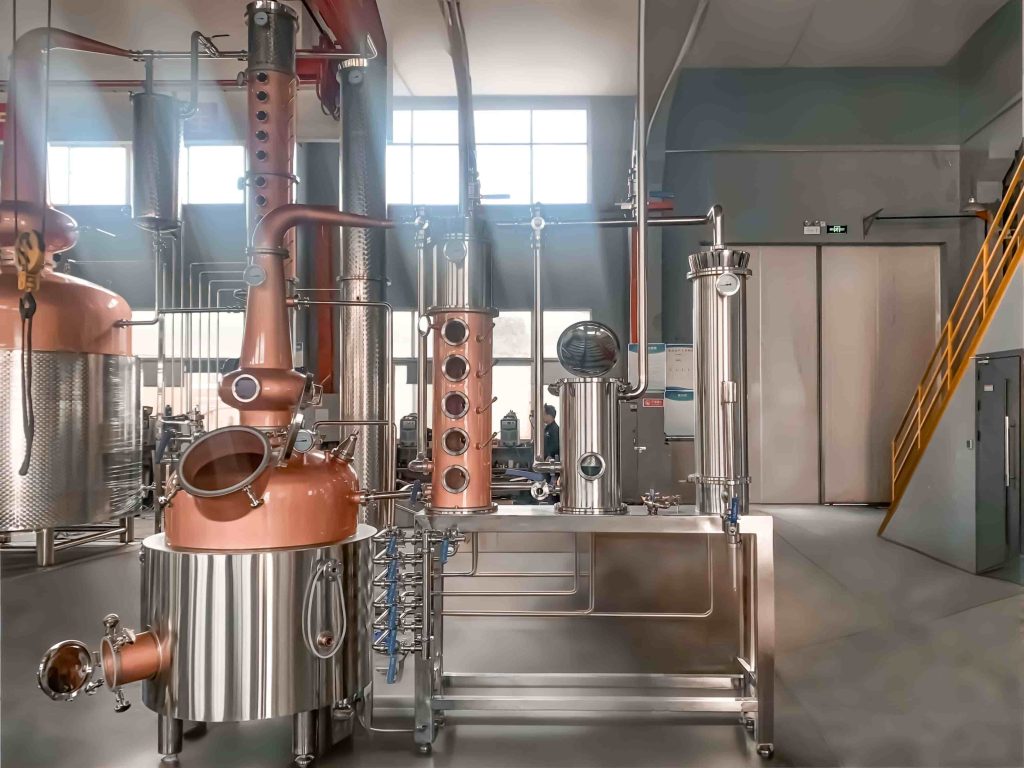
Distillation is an important process in the production of spirits and other alcohol products. It separates different components in a liquid by using differences in their volatility.
For breweries and distilleries, choosing the right distillation device can affect production capacity, product quality, energy use, and operating efficiency.
But what exactly is a distillation device? How does it work? What is the difference between a pot still and a column still? And how should a producer choose the right system?
In this guide, SKE explains the basic principles of distillation in simple language. It also compares common types of distillation equipment and explains the main features to consider when choosing a system for commercial production.
Key Takeaways
- Distillation separates components by boiling-point differences: heating, vapor formation, separation, condensation, and collection are the same five steps regardless of scale.
- Pot stills favor batch production and flavor character; column stills trade some of that character for continuous operation and higher throughput.
- Material choice matters beyond durability — copper reacts with sulfur compounds during spirit production, which is why many commercial stills combine stainless steel structure with copper components.
- Distilled spirits production in the US falls under TTB regulation (27 CFR Part 19), which affects equipment metering, tank identification, and security requirements beyond process design alone.
What Is a Distillation Device?
A distillation device is equipment used to separate components in a liquid mixture based on differences in volatility.
The basic process is simple. The liquid mixture is heated until part of it becomes vapor. The vapor then moves into a condenser, where it is cooled and changed back into liquid.
Because different components have different boiling points, the vapor can contain a different concentration of each component than the original liquid. This allows producers to separate and concentrate specific components.
Distillation is widely used in the production of spirits such as whiskey, vodka, and rum. It is also used in food, chemical, and pharmaceutical industries.
A basic distillation system normally includes a heating system, a boiling vessel or still, a pot still or distillation column, a condenser, product collection vessels, and temperature and pressure monitoring devices.
Larger commercial systems may also include pumps, automated valves, PLC controls, and flow meters. The size and design of the system depend on the product, production capacity, required alcohol concentration, and level of automation.
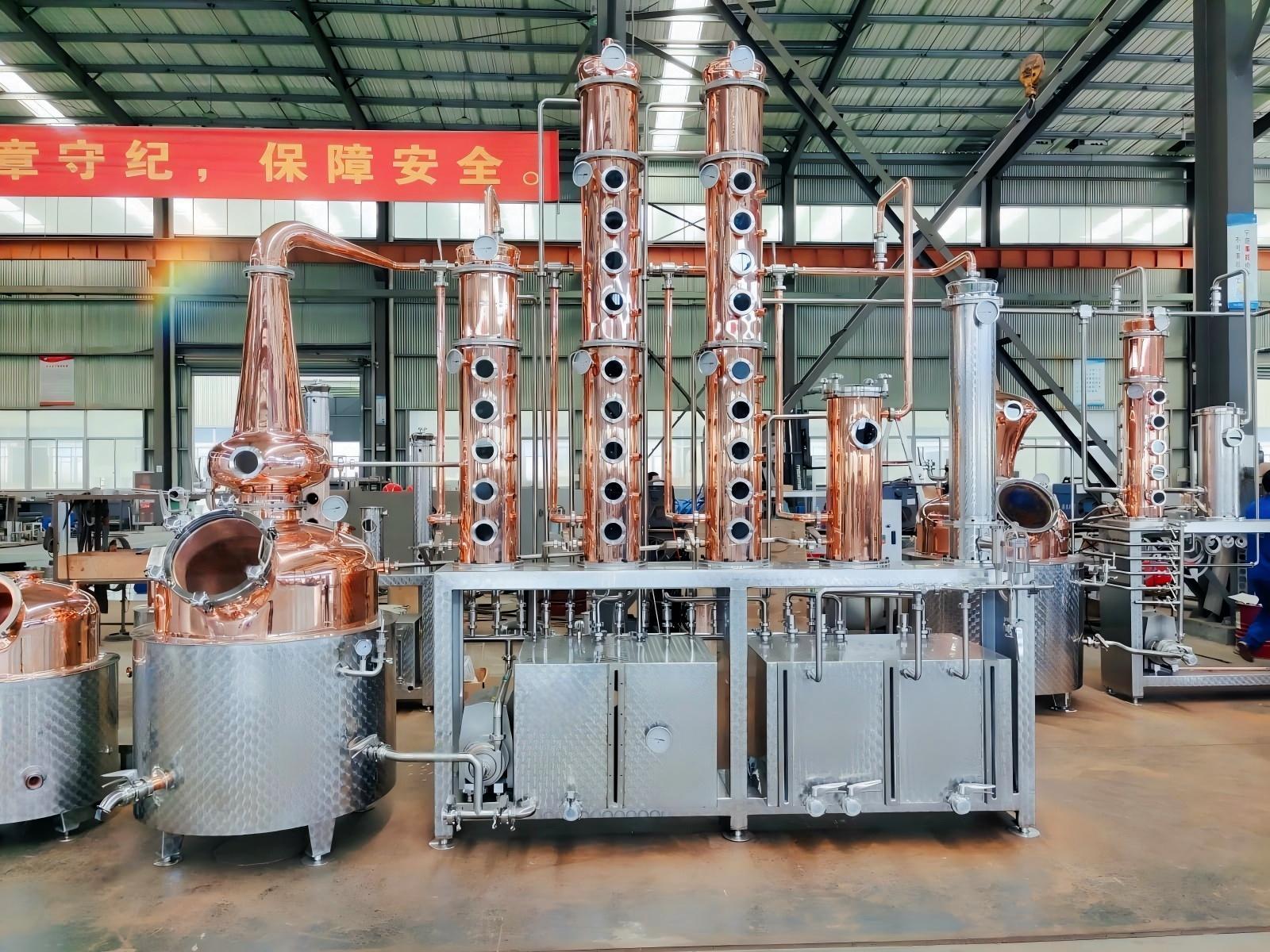
Distillation Machine, Distillation Set, and Distillation Apparatus
The terms distillation machine, distillation set, and distillation apparatus are often used to describe distillation equipment. However, their meaning can vary depending on the industry and supplier.
Distillation Machine
A distillation machine usually refers to a complete equipment system designed for a specific production application.
Commercial distillation machines may include heating and steam systems, distillation vessels or columns, condensers, pumps, sensors, automated valves, and PLC control systems.
These systems are suitable for craft distilleries, beverage producers, and larger industrial operations.
Distillation Set
A distillation set usually refers to a smaller package containing the main components needed for a distillation process.
Small sets are common in laboratories, educational applications, and small-scale production. Commercial producers normally require equipment with higher capacity, stronger construction, and more advanced process control.
Distillation Apparatus
Distillation apparatus is a broader technical term for equipment used for distillation.
The term can describe a simple laboratory glass setup or a large industrial distillation system. Therefore, it is useful as a general term but does not always describe the size or capacity of the equipment.
In short, these terms are not strict industry classifications. The actual equipment design and application are more important than the name used by a supplier.
How Does a Distillation Device Work?
The basic distillation process can be divided into several steps.
Step 1: Heating
The liquid mixture is placed in the still or feed system. Heat is then applied through steam, electricity, gas, or another suitable heating method.
As the temperature increases, more volatile components begin to enter the vapor phase.
Step 2: Vapor Formation
The vapor contains a different concentration of components than the original liquid.
For example, ethanol is more volatile than water. Under suitable conditions, the vapor phase contains more ethanol than the liquid mixture. This difference is the basis of alcohol distillation.
Step 3: Separation
In a pot still, the separation mainly occurs during batch distillation.
In a column still, the vapor moves through trays or packing. Repeated contact between vapor and liquid improves separation and allows the system to produce a more concentrated product.
This is one of the main differences between pot and column distillation.
Step 4: Condensation
The vapor enters a condenser. Cooling water or another cooling medium removes heat from the vapor. The vapor then changes back into liquid.
Common condenser designs include shell-and-tube condensers, coil condensers, and other sanitary heat-exchange designs. The condenser must be sized correctly for the vapor load and required production capacity.
Step 5: Product Collection
The condensed liquid is collected for further processing or storage.
In spirit production, operators may separate different fractions of the distillate. Depending on the process, these can include the heads, heart, and tails.
The exact separation method depends on the product, equipment design, raw material, and production process.
Pot Still vs. Column Still
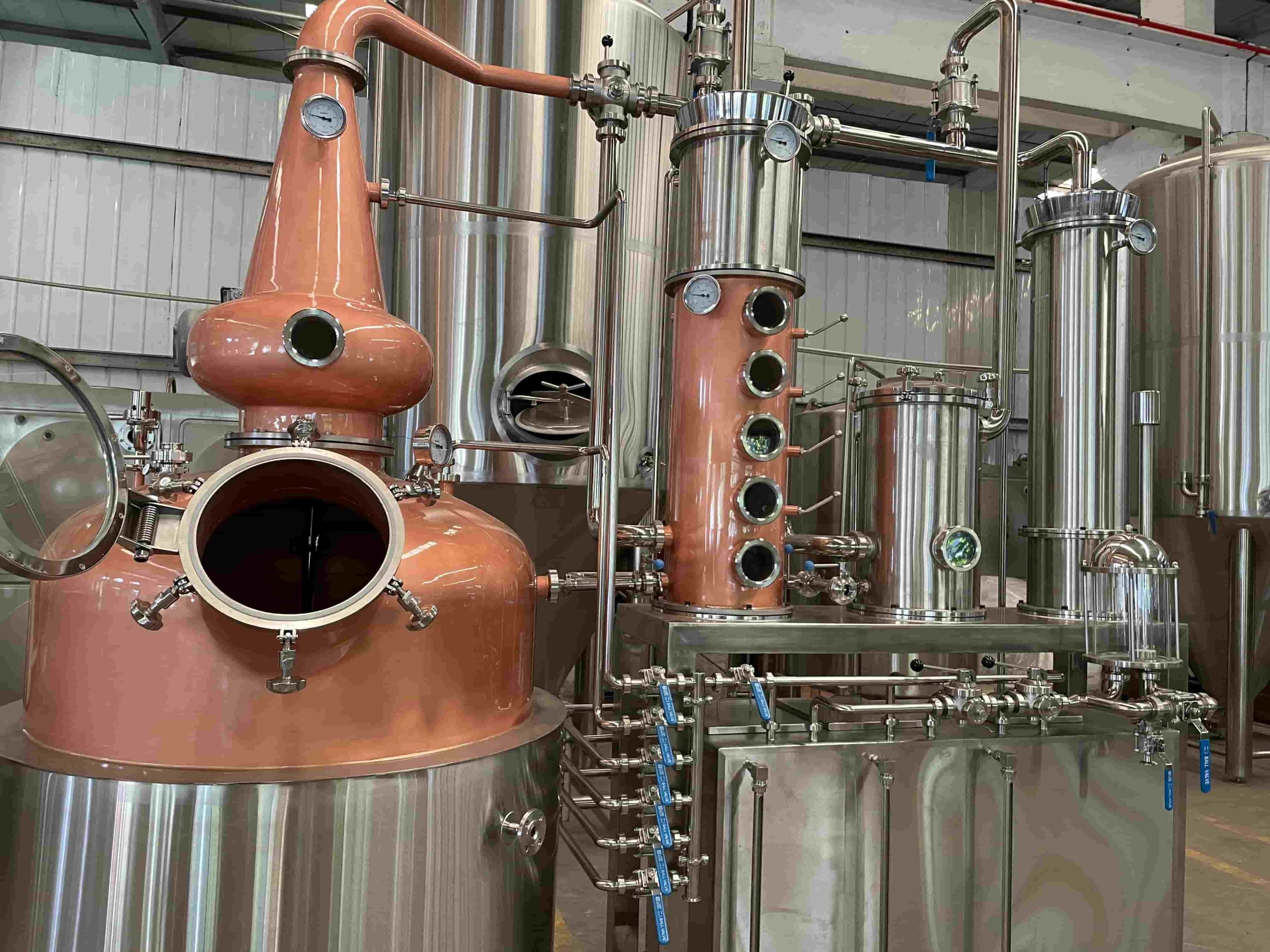
One of the most important decisions when selecting distillation equipment is choosing between a pot still and a column still.
| Feature | Pot Still | Column Still |
|---|---|---|
| Operation | Batch | Continuous or semi-continuous |
| Production Capacity | Low to medium | Medium to very high |
| Flavor Character | Often retains more raw-material character | Can produce a cleaner, more neutral spirit |
| Automation | Low to medium | Medium to high |
| Process Control | Relatively simple | More advanced |
| Typical Application | Craft spirits | Large-scale spirit production |
| Production Efficiency | Lower | Higher |
A pot still is often a good choice for producers who want strong control over batch production and product character.
A column still is better suited to producers who need high throughput, stable operation, and efficient separation.
Some producers also choose a hybrid distillation system. This can combine features of pot and column systems to provide greater flexibility.
What Distillation Equipment Does a Brewery Need?
Breweries mainly produce beer, so distillation is not part of every brewery’s standard process.
However, some breweries also produce spirits, distilled beverages, or other alcohol products. In these cases, distillation equipment can become an important part of the production system.
A brewery may consider distillation equipment when it wants to expand into spirits production, develop new beverage products, process suitable alcohol-containing streams, improve the use of certain production by-products, or enter new beverage markets.
The required equipment depends heavily on the intended application.
Why Even the Biggest Brewery May Use Distillation
You might ask: why would the biggest brewery need a distillation device? After all, breweries make beer, not spirits. But many large breweries also produce distilled products. They may make whiskey, vodka, or ready-to-drink cocktails.
A big brewery often uses distillation for several reasons. It can create new products and reach new markets. It can use excess beer or by-products. It can improve sustainability by reducing waste. It can also experiment with flavors and styles.
Large breweries need large distillation machines. These machines must be reliable, efficient, and easy to clean. They also need to meet strict safety and quality rules.
SKE provides distillation equipment for both small and large producers. We understand the needs of breweries and distilleries. Our devices are designed for quality, safety, and ease of use.
Key Features to Consider When Choosing a Distillation Device
Choosing the right commercial distillation equipment requires more than looking at vessel capacity. The complete process should be considered.
1. Material
Stainless steel is widely used for commercial beverage equipment because it is durable, hygienic, and easy to clean.
Copper is also commonly used in spirit production. It can interact with certain sulfur compounds and may affect the character of the final spirit.
Many distillation systems use stainless steel for the main structure while incorporating copper components where appropriate.
2. Capacity
Capacity should match your production requirements.
A system that is too small can create production bottlenecks. A system that is much larger than necessary can increase the initial investment and operating costs.
When selecting capacity, consider batch size, production hours, number of production runs, future expansion, and available installation space.
3. Heating Method
Common heating methods include steam, electric heating, and direct heating.
Steam heating is common in larger commercial systems because it provides stable and controllable heat. Electric heating can be suitable for smaller systems and applications where simple temperature control is important.
The heating method should be selected according to production scale, available utilities, energy costs, and local requirements.
4. Automation and Control
Modern commercial distillation systems can use sensors, automated valves, flow meters, and PLC control systems.
Automation can help operators monitor temperature, pressure, flow, heating conditions, product collection, and process stages.
A higher level of automation can improve repeatability and reduce manual work, especially in larger production facilities.
5. Condenser Design
The condenser must remove enough heat to condense the vapor produced by the still or column.
Shell-and-tube heat exchangers are widely used in commercial beverage processing because they can provide efficient heat transfer and can be designed for sanitary applications.
The condenser size should be matched to the production capacity and cooling system.
6. Safety
Safety is one of the most important factors in distillation system design.
Commercial equipment may require suitable pressure monitoring, temperature monitoring, pressure relief devices, emergency shut-off systems, and automated control functions.
Because distillation involves heat, vapor, and often flammable alcohol, the equipment must be designed and operated according to applicable safety standards and local regulations, and in the US, commercial distilled spirits production also falls under TTB requirements for distilled spirits plants.
7. Cleaning and Maintenance
Hygienic design is important for beverage production.
Smooth stainless steel surfaces, suitable connections, accessible components, and appropriate cleaning systems can make routine maintenance easier.
For larger production facilities, cleaning requirements should be considered during equipment design rather than after installation.

Comparison of Common Distillation Devices
Different producers have different production goals. The following table gives a simple comparison.
| Distillation Type | Typical Application | Capacity | Automation | Main Advantage |
|---|---|---|---|---|
| Pot Still | Craft spirits | Low to medium | Low to medium | Strong control over batch character |
| Column Still | Commercial spirit production | Medium to high | Medium to high | Efficient separation |
| Continuous Still | Large-scale production | High to very high | High | High throughput |
| Hybrid Still | Flexible production | Medium to high | Medium | More process flexibility |
| Laboratory Apparatus | Testing and education | Very low | Low | Simple and easy to observe |
There is no single best distillation device for every producer.
The right system depends on production volume, product type, desired alcohol concentration, flavor goals, available utilities, space, and budget.
Why Choose SKE for Distillation Equipment?
SKE is a professional manufacturer of brewing and beverage processing equipment.
For breweries and distilleries, equipment design should match the complete production process. This includes capacity, heating, condensation, control, cleaning, and installation requirements.
SKE can provide customized distillation equipment based on the customer’s production needs.
Our equipment solutions can be designed around factors such as required production capacity, stainless steel construction, pot or column distillation, heating method, condenser configuration, automation level, process control, cleaning requirements, plant layout, and future expansion.
Instead of using a standard machine for every application, a customized system can be developed around the actual production process.
SKE can also support customers with equipment selection, system design, manufacturing, installation support, commissioning, and technical guidance.
Whether you are developing a new distillery, adding spirit production to an existing brewery, or expanding production capacity, choosing the right equipment at the planning stage can help improve long-term operating efficiency.
Frequently Asked Questions
Q1: What is a distillation device?
A distillation device is equipment used to separate components in a liquid mixture based on differences in volatility. It normally uses heating, vapor formation, condensation, and product collection.
Q2: What is the difference between a pot still and a column still?
A pot still normally operates in batches and is often used for craft spirit production. A column still uses trays or packing to improve separation and can provide higher production capacity and more continuous operation.
Q3: What is the best material for distillation equipment?
Stainless steel and copper are both widely used. Stainless steel provides durability and easy cleaning, while copper can play an important role in some spirit-production processes. The best choice depends on the product and process.
Q4: Can a brewery use a distillation machine?
Yes. A brewery can use distillation equipment when it also produces spirits or other distilled products. The equipment should be selected according to the required capacity and production process.
Q5: Is a distillation set suitable for commercial production?
Small distillation sets are generally not designed for large commercial production. Commercial producers usually need purpose-built equipment with suitable capacity, materials, controls, safety systems, and cleaning features.
Written by Mandy, Marketing Specialist at SKE Equipment with two years of experience covering the company’s brewing and beverage processing equipment. Technical details in this guide were reviewed by SKE’s engineering team before publication.
Final Thoughts
A distillation device is more than a simple heating and cooling machine. It is a process system designed to separate and concentrate components in a liquid mixture.
For craft producers, a pot still may provide the flexibility needed for batch spirit production. For larger producers, column or continuous systems can provide higher capacity, better process control, and greater production efficiency.
When choosing commercial distillation equipment, producers should consider the complete process, including capacity, material, heating, condensation, automation, cleaning, and safety.
SKE provides customized brewing and distillation equipment for different production requirements. From equipment selection and system design to manufacturing and technical support, SKE can help breweries and distilleries develop a practical distillation solution.
If you are planning a new distillation system or expanding an existing production line, contact SKE to discuss your process and equipment requirements.
- Facebook: SKE Equipment Facebook
- Email: info@skeequipment.com
Fill out the contact form below for customized solutions. We fully support all your production equipment demands for breweries and beverage plants.