
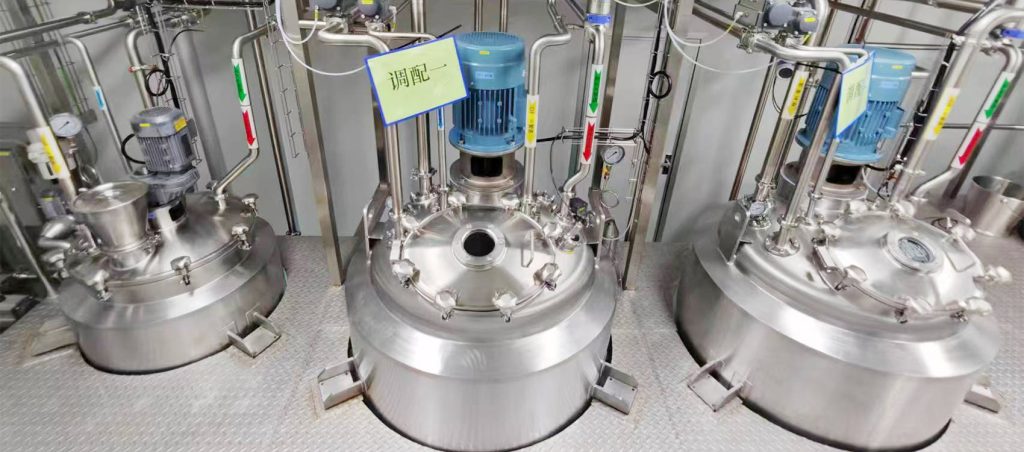
A brewhouse mixing tank, a set of cylindro-conical fermenters, and a flash pasteurizer rarely get evaluated together — most buying guides cover them as separate purchases. But on a real production line they’re one connected system: a bottleneck or a hygiene gap in any one of the three shows up as a quality problem in the finished beer, regardless of how good the other two are.
This guide covers what each system actually does, the specifications that matter for mid-to-large breweries, and where the three have to work together rather than in isolation.
Key Takeaways
- Flash pasteurization dose is governed by a defined formula — PU = t × 1.393^(T−60) — and most commercial lagers target 15–25 PU at roughly 72°C for 20–30 seconds, not an arbitrary temperature/time combination (SiWC Brewery; Brewing Science, Flash Pasteurization of Beer: A Critical Review).
- Hygienic fermenter interiors typically target Ra ≤0.8 µm, a finish level that supports reliable CIP cycles and is benchmarked against ASME BPE surface criteria (Craft Brewing Business).
- Dimple-plate cooling jackets create turbulent glycol flow for faster heat transfer than smooth jackets; multi-zone dimple jacket designs with improved insulation have shown 8–15% lower glycol runtime in pilot comparisons (Vesfil, Cooling Jacket Types for Fermentation Vessels).
What Is a Mixing Tank and Why It Sets the Ceiling for Everything Downstream
The brewing process begins before fermentation, in the brewhouse mixing tank. This vessel combines milled grain (grist) with hot water to create the mash. In a mid-to-large brewery, this is rarely a simple mash tun — it’s a dedicated mixing tank, sometimes called a mash mixer or cereal cooker, built to blend malt and water thoroughly before the mash moves on to the lauter tun for separation.
Mixing quality here determines how much fermentable sugar the brewhouse actually extracts. Poor mixing leaves dry pockets in the grain bed and causes caking in downstream piping; a properly specified mixing tank shortens feed time and reduces the dust that dry-crushed grain generates.
What a mixing tank needs to get right:
- Hydration: Even hydration of grain particles, with no dry pockets.
- Enzyme activation: Holding the ideal temperature band for starch-converting enzymes to work.
- Flow: Minimizing caking in transfer piping, a common failure point with dry-crushed grain.
From the mixing tank, mash is pumped to lautering for separation, and the resulting wort moves to fermentation. Brewhouse yield is set largely at this first step — a mixing tank that’s undersized or poorly agitated for the grain bill puts a ceiling on everything that follows.

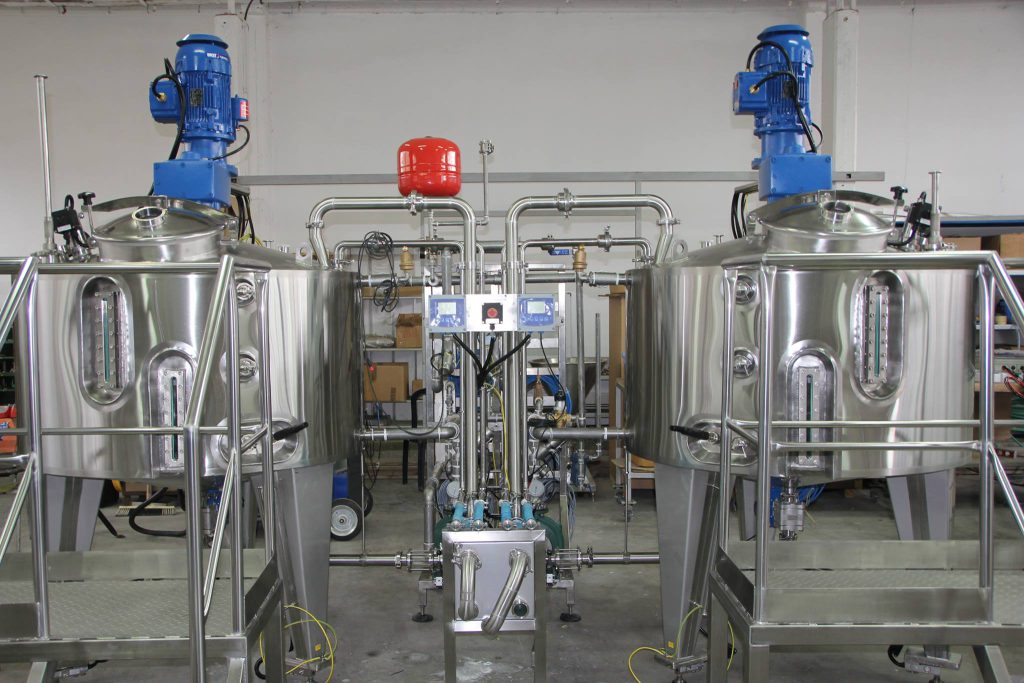
Mixing Tank Specifications for Mid-to-Large Breweries
| Feature | Specification | Benefit |
|---|---|---|
| Capacity | 50–300+ HL | Scales to high-volume commercial production |
| Material | Food-grade stainless steel | Prevents contamination, resists corrosion |
| Agitator | Variable-speed drive | Adjustable mixing intensity by grain bill |
| Outlet | Conical bottom, flanged outlet | Clean, efficient transfer to lautering |
Fermentation Tanks: Where Hygiene and Thermal Control Decide the Flavor Outcome
Once wort is cooled and oxygenated, it moves to fermentation tanks — in modern breweries, almost always cylindro-conical tanks (CCTs). This is the “cold block” of the brewery, where yeast converts sugar to alcohol and CO2, and tank design has a direct line to final flavor.
Larger operations run tall CCTs with capacities reaching into the thousands of hectoliters to manage volume and specialty runs. Two design factors matter more than tank size:
Thermal control. Fermentation generates significant heat, and uneven cooling produces uneven flavor. Better fermenters use dimple-plate cooling jackets — a thin, spot-welded shell that circulates glycol against the tank wall. The dimpled geometry forces turbulent flow rather than the laminar flow a smooth jacket produces, which transfers heat faster for the same glycol flow rate. Well-designed multi-zone dimple jackets with improved insulation have demonstrated 8–15% lower glycol runtime in pilot comparisons against simpler jacket designs (Vesfil).
Surface finish and CIP. Contamination risk in a fermenter is mostly a cleanability problem. Hygienic fermenter interiors typically target Ra ≤0.8 µm — a smoothness benchmark drawn from ASME BPE surface-finish criteria — because rougher surfaces give bacteria more places to anchor and make CIP (Clean-in-Place) cycles less reliable (Craft Brewing Business).
Beer Flash Pasteurization: What the Numbers Actually Mean
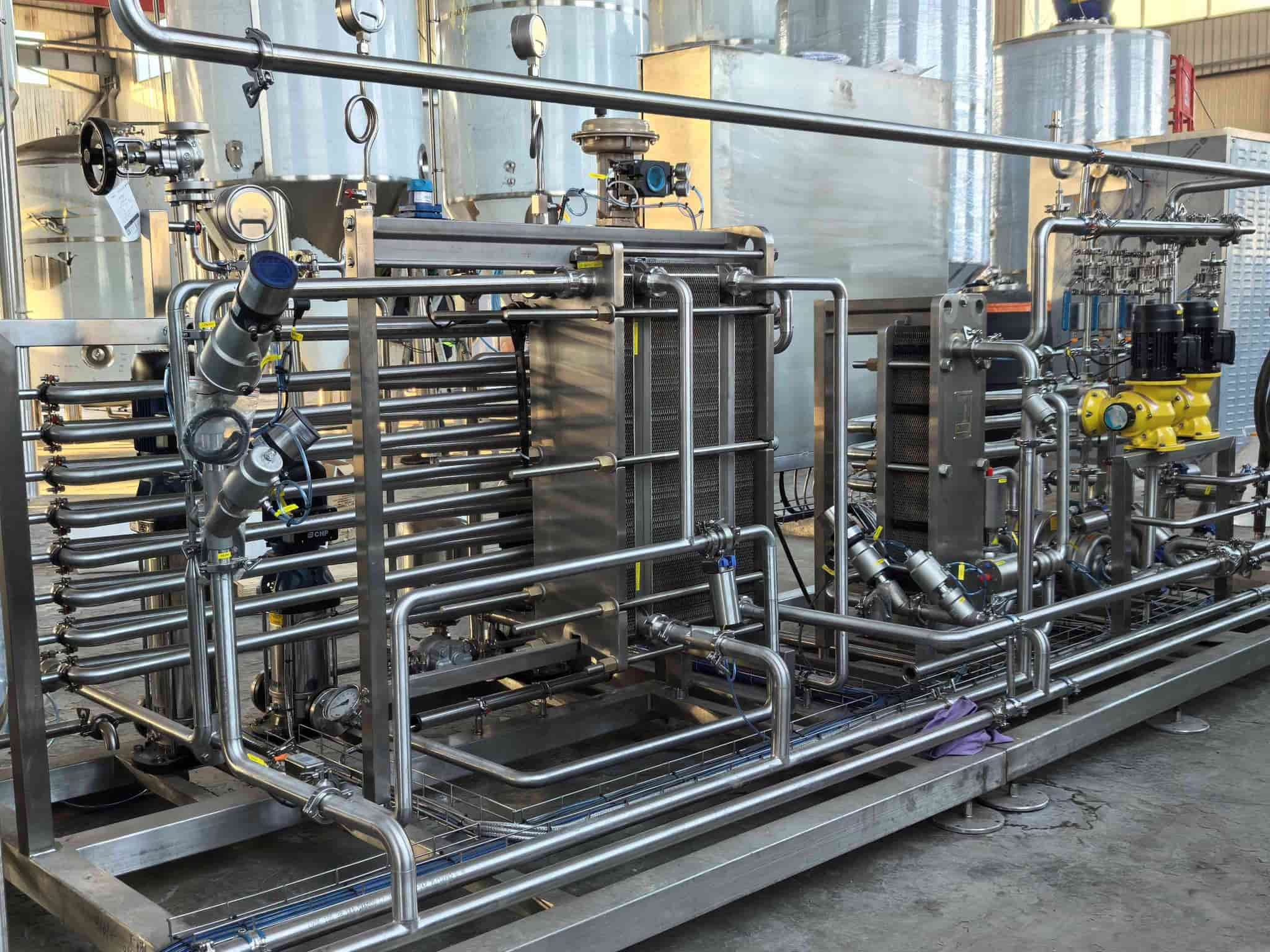
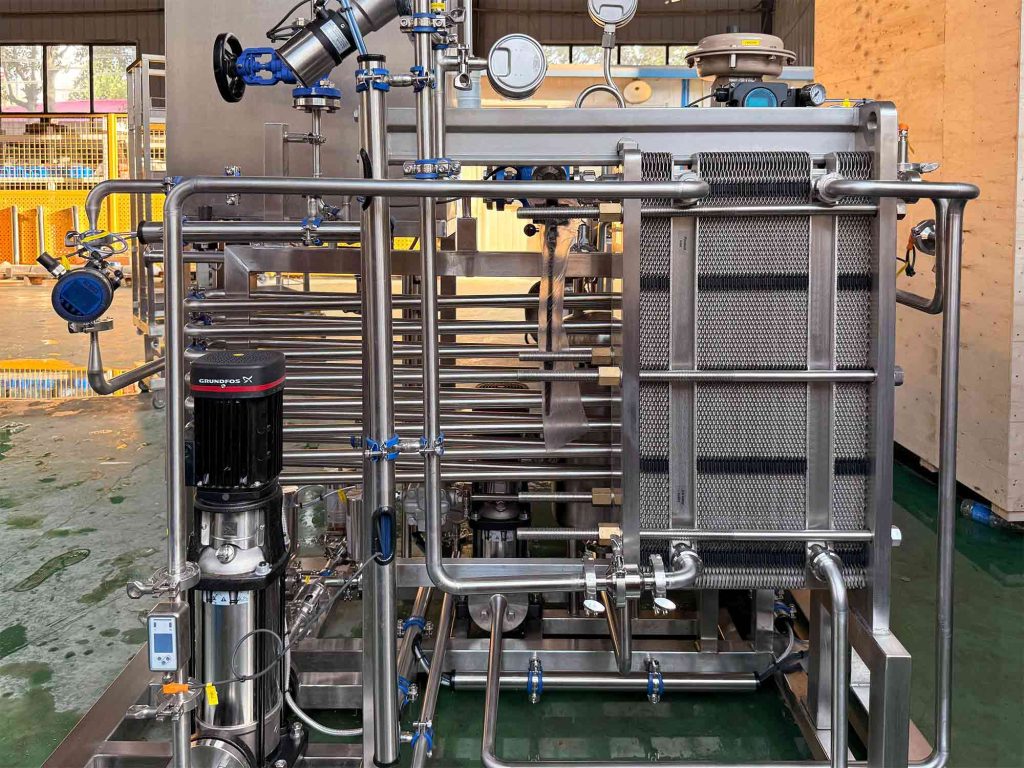
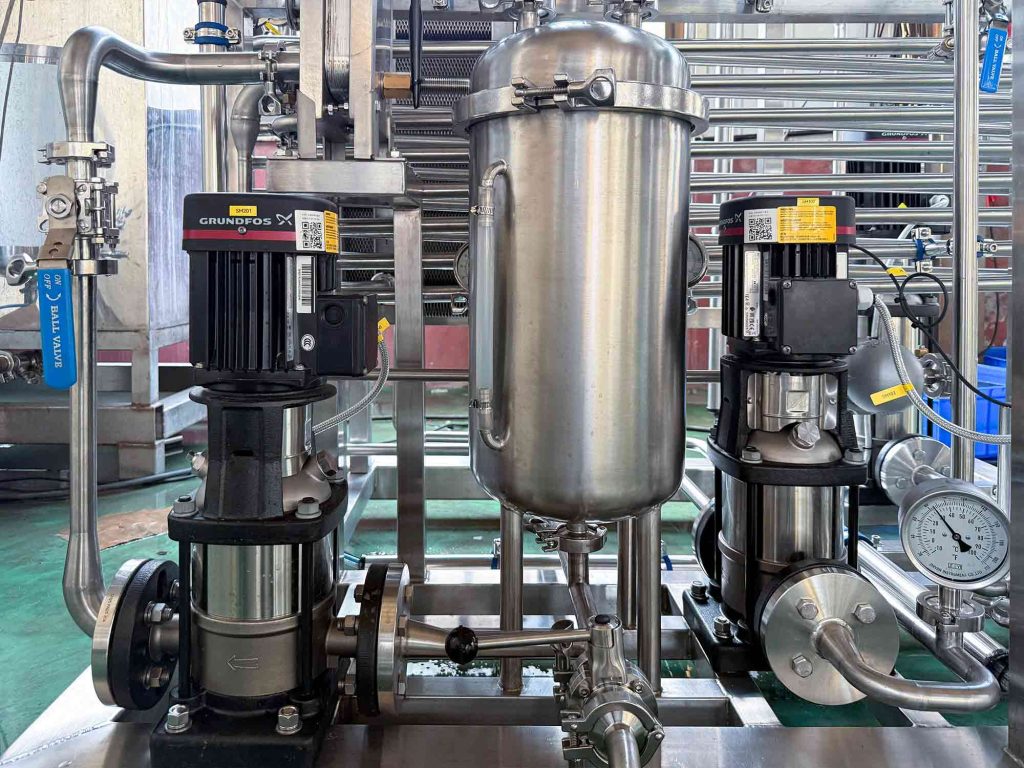
After fermentation, filtration, and aging, flash pasteurization extends shelf life before packaging. It’s a High-Temperature Short-Time (HTST) process: beer is rapidly heated, held briefly, then rapidly cooled — typically around 72°C for 20–30 seconds.
The dose delivered by any temperature/time combination is measured in Pasteurization Units (PU), calculated as:
PU = t × 1.393(T−60)
where t = holding time in minutes, T = temperature in °C
One PU is defined as the lethal effect of one minute at 60°C, and the formula’s exponential term means every extra degree above 60°C sharply increases lethality — which is why HTST works: a few seconds at 72°C delivers a meaningful dose without the extended heat exposure that damages flavor. Most commercial lagers target 15–25 PU, with roughly 14–15 PU typically considered the practical minimum for shelf-stable packaging; the exact target varies by beer style, raw materials, and a brewery’s own microbial risk tolerance (SiWC Brewery; Brewing Science).
Why breweries choose flash over tunnel pasteurization:
- Flavor retention: Rapid heating and cooling means less cumulative thermal stress than tunnel pasteurization, which holds beer at lower heat for much longer.
- Energy efficiency: Less time heating and cooling a continuous stream translates to lower energy use per hectoliter at high volume.
- Footprint: A flash pasteurizer’s plate heat exchanger takes up a fraction of the floor space a tunnel pasteurizer needs.
Illustrative PU Calculations
| Scenario | Temperature | Holding Time | Calculated PU |
|---|---|---|---|
| Typical flash pasteurization | 72°C | 25 seconds | ~22 PU (within typical 15–25 PU target) |
| Higher-dose run | 73°C | 30 seconds | ~37 PU (above typical target — more heat load on flavor) |
| Tunnel pasteurization (comparison) | 60°C | ~15 minutes | ~15 PU, delivered far more slowly |
The comparison matters: hitting a target PU faster, at higher temperature, is not automatically better. Above the typical range, added PU buys extra microbial safety margin at the cost of more flavor-damaging heat exposure — the right target is the lowest PU that reliably achieves the shelf life a brewery needs, not the highest one the equipment can produce.
Integrating All Three Systems
On a real production line, these three systems are interdependent, not sequential purchases:
- Automation: PLC systems link mixing, fermentation, and pasteurization to hold consistent temperature and timing across the line without manual handoffs.
- Cleaning: All three need to run compatible CIP protocols — a hygienic fermenter feeding into a poorly cleanable mixing tank still creates a contamination path.
- Capacity matching: Mixing tank throughput has to match fermentation and pasteurization capacity, or one stage becomes a bottleneck that idles the other two.
Frequently Asked Questions
What is the primary advantage of a dedicated mixing tank in a large brewery?
It improves mixing between malt and water, which reduces feed time, cuts dust from dry crushing, and prevents caking in downstream piping — all of which protect brewhouse yield.
How do fermentation tanks maintain the right temperature?
Dimple-plate cooling jackets circulate glycol against the tank wall in a turbulent flow pattern, removing fermentation heat faster than a smooth jacket at the same flow rate.
Is flash pasteurization better than tunnel pasteurization?
For most high-volume operations, yes on flavor and footprint: flash pasteurization delivers the same PU dose in seconds rather than minutes, which means less cumulative heat exposure and a smaller equipment footprint. Tunnel pasteurization remains preferred in some packaging formats where in-bottle pasteurization after sealing is required.
What PU range should a standard lager target?
Most commercial lagers target 15–25 PU using the standard formula (PU = t × 1.393^(T−60)), with roughly 14–15 PU as a practical minimum for shelf stability. Going well above this range adds microbial margin at the cost of flavor.
What maintenance does a mixing tank need?
Regular CIP cycles to clear grain residue, plus periodic inspection of agitator seals and temperature sensors to keep mixing performance consistent.
Conclusion
Mastering these three systems is less about any single piece of equipment and more about how they connect: a mixing tank that extracts sugar efficiently, fermenters that hold temperature and clean reliably, and a pasteurizer dosed to the PU a beer actually needs rather than the highest number the equipment can hit.
SKE designs and manufactures mixing tanks, fermentation tanks, and flash pasteurization systems built to work as one line, not three separate purchases. Contact SKE to review your current brewhouse capacity and where the real bottleneck sits.
- Facebook: SKE Equipment Facebook
- Email: info@skeequipment.com
Fill out the contact form below for customized solutions. We fully support all your production equipment demands for breweries and beverage plants.