
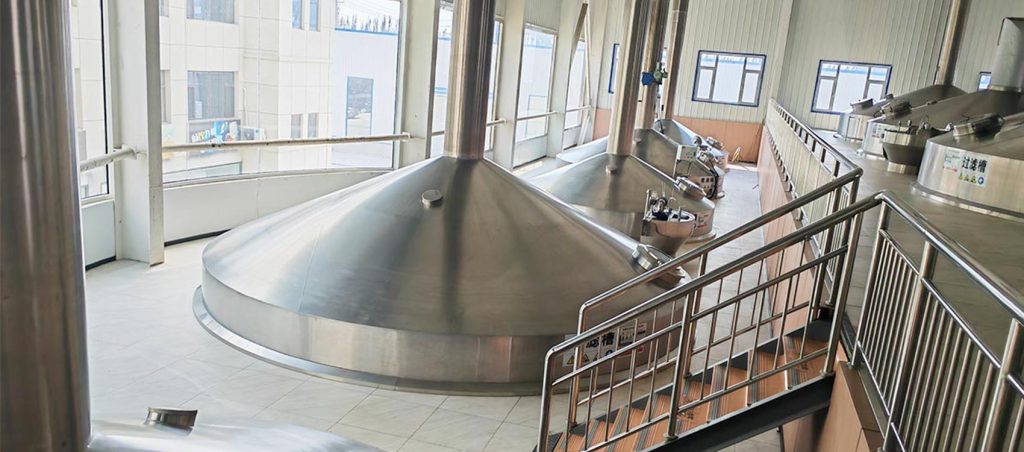
A brewery that grows from small-batch production to thousands of hectoliters per year needs more than larger brewing vessels. It needs a reliable production system that can handle repeated brewing cycles, maintain consistent beer quality, and support future growth.
A commercial brewhouse is designed to meet these demands. It brings together specialized brewing vessels, pumps, heat exchangers, piping, and control systems to manage the hot side of beer production. Unlike a small brewing setup, a commercial system must support regular production schedules and repeatable process conditions.
This guide explains how commercial brewhouse systems work, how different vessel configurations affect production, and why automation is important for large-scale brewing. It also provides practical advice for breweries planning a new facility or upgrading existing equipment.
What Defines a Commercial Brewhouse?
A brewhouse is the hot-side section of a brewery. It handles the main processes that turn malt and other ingredients into wort before fermentation begins.
The main brewing steps include:
- Mashing: Malt is mixed with hot water to convert starch into fermentable sugars.
- Lautering: Liquid wort is separated from spent grain.
- Wort boiling: The wort is boiled, and hops are added according to the recipe.
- Whirlpool separation: Hop particles and other solid materials are separated from the wort.
- Wort cooling: A heat exchanger cools the wort to the required fermentation temperature.
A commercial brewhouse combines these processes with equipment designed for regular and repeated operation.
There is no universal batch-size limit that defines a commercial brewhouse. Some smaller commercial breweries use systems with capacities of several hundred liters, while large industrial breweries operate systems capable of producing tens of thousands of liters per batch.
The main difference is the production requirement. A commercial brewing system must support the brewery’s target output, daily brewing schedule, labor capacity, and product quality standards.
At SKE, we design and manufacture commercial brewery equipment for different production scales. Each system is planned around the customer’s batch size, production targets, available space, and future expansion needs.

Commercial Brewhouse Vessel Configurations
Vessel configuration is one of the most important decisions when planning a commercial brewhouse. The number and arrangement of vessels affect process scheduling, equipment investment, and production flexibility.
Commercial brewhouses commonly use two-vessel, three-vessel, four-vessel, and five-vessel configurations. Each option has different advantages.
Two-Vessel Brewhouse
A two-vessel brewhouse combines several brewing processes into two main tanks.
A common arrangement includes:
- Mash and lauter tun
- Brew kettle and whirlpool
This configuration requires less floor space and usually has a lower initial equipment cost. It can be suitable for smaller commercial breweries, brewpubs, and businesses with moderate production targets.
However, combining processes can increase waiting time between brewing steps. This may limit the number of batches that can be completed each day.

Three-Vessel Brewhouse
A three-vessel system usually separates the mash tun, lauter tun, and kettle/whirlpool functions.
This arrangement gives brewers more control over mashing and wort separation. It also allows some operations to overlap, helping improve the use of brewing time.
A three-vessel commercial brewhouse is often suitable for growing regional breweries that need higher output without investing in a larger four-vessel system.
Four-Vessel Brewhouse
A four-vessel brewhouse separates the main brewing processes into four dedicated vessels:
- Mash tun
- Lauter tun
- Wort kettle
- Whirlpool tank
Each vessel has a specific function. This makes process scheduling more flexible and allows different brewing stages to take place at the same time.
For example, while one batch is boiling in the kettle, the next batch can begin lautering. This reduces unnecessary waiting and helps improve daily production efficiency.
For breweries with high output targets and frequent brewing cycles, a four-vessel brewhouse is often a practical choice. It is also a common option for a large scale brewing system designed for multi-batch daily production.

Five-Vessel Brewhouse
A five-vessel brewhouse provides additional process separation and scheduling flexibility.
One possible configuration includes:
- Mash mixer
- Mash tun
- Lauter tun
- Wort kettle
- Whirlpool tank
The exact arrangement can vary according to the brewing process and equipment design. Separating more operations can help large breweries manage complex recipes and high production demands.
However, adding more vessels does not automatically increase production. Heating capacity, pumping systems, wort cooling, cleaning time, and the overall brewing schedule must also support the target output.
Comparison of Commercial Brewhouse Configurations
| Configuration | Main Features | Typical Application |
|---|---|---|
| 2-vessel | Combined brewing processes, compact layout | Small commercial breweries |
| 3-vessel | Better process separation and scheduling | Growing regional breweries |
| 4-vessel | Independent vessels for major brewing stages | Large commercial breweries |
| 5-vessel | More process flexibility and separation | High-capacity industrial breweries |
The best configuration depends on the actual production plan, not simply the number of vessels. A properly designed three-vessel system may be more suitable than an oversized four-vessel system for a brewery with moderate output.
Why Automation Matters in Commercial Brewing
As production increases, manual operation becomes more difficult to manage. Operators must control temperatures, pumps, valves, liquid levels, and process timing across multiple brewing stages.
Even small operating differences can affect wort quality and beer consistency.
This is why commercial brewhouse automation plays an important role in modern breweries.
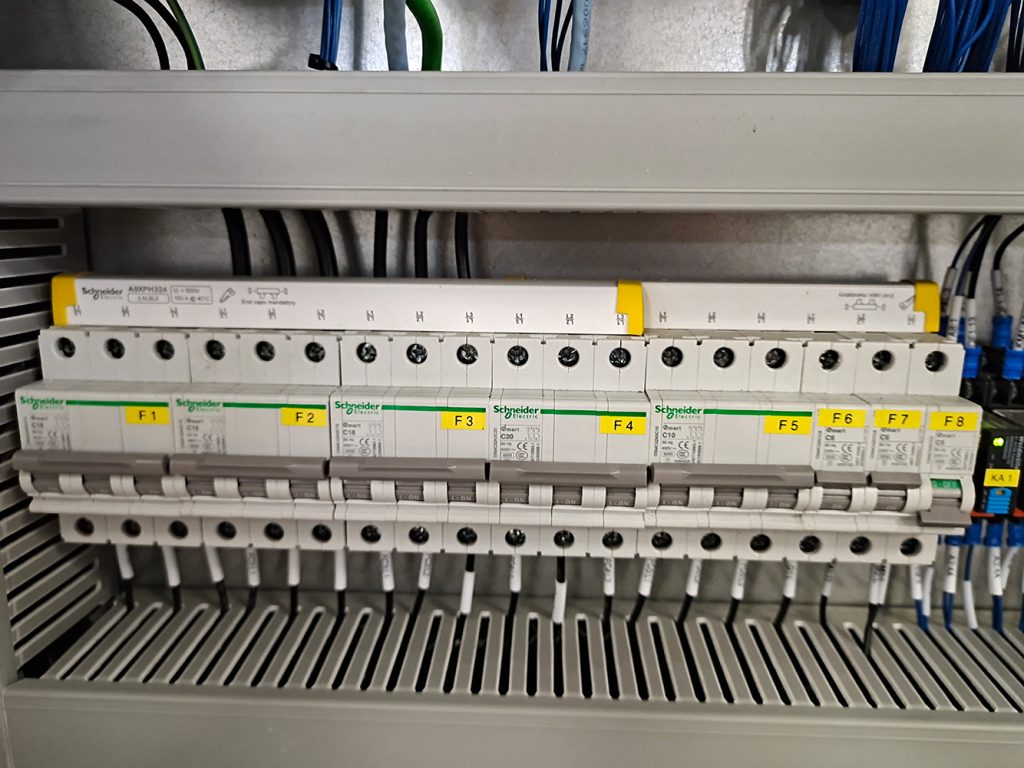
PLC and HMI Control
Most automated commercial brewing systems use programmable logic controllers (PLCs) and human-machine interfaces (HMIs).
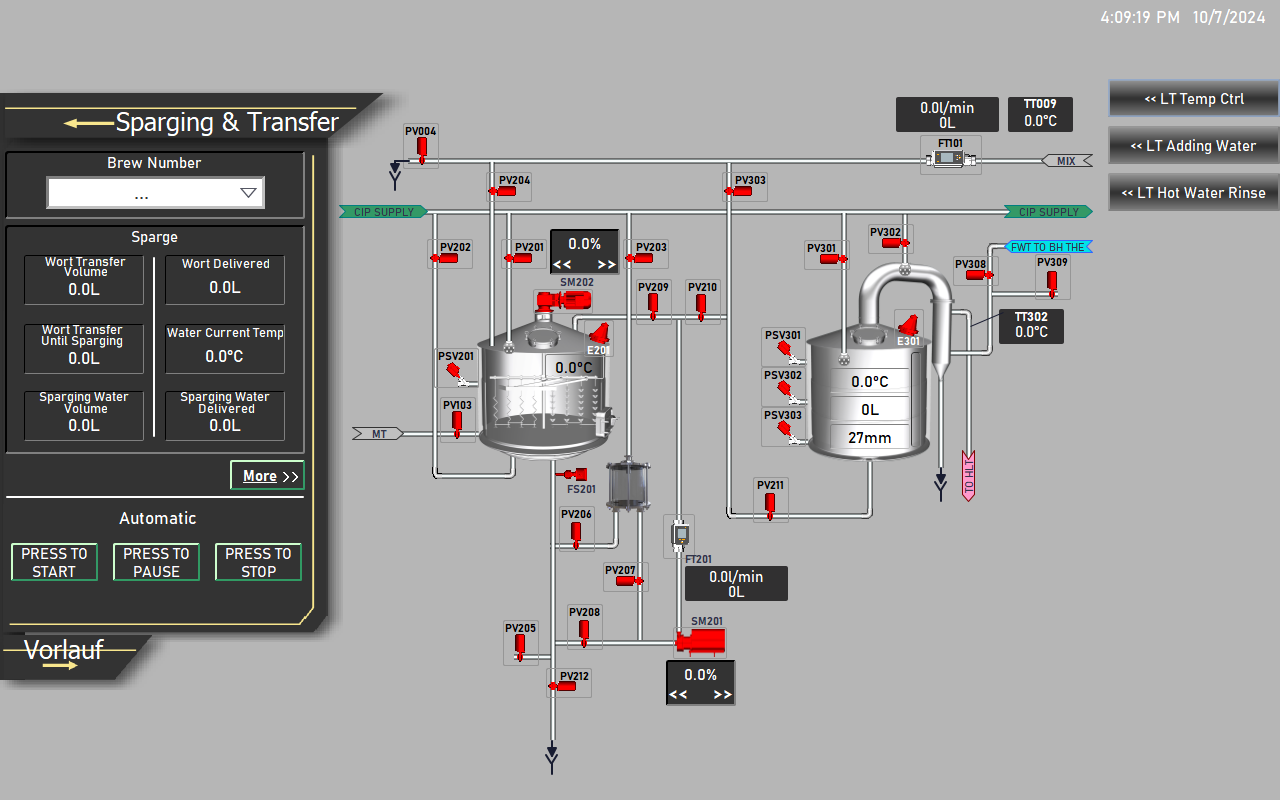
The PLC manages equipment operations according to programmed process logic. The HMI provides an interface where operators can monitor system conditions and control brewing operations.
Depending on the system design, automation can manage:
- Mash temperature and timing
- Water and wort transfer
- Pump and valve operation
- Kettle heating and boiling control
- Whirlpool process sequences
- Equipment status and alarm monitoring
Operators can select recipes and follow process information through the control interface.
This helps reduce manual operating errors and makes brewing procedures more repeatable.
Siemens and Industrial Automation Components
Siemens PLCs and HMIs are widely used in industrial automation, including food and beverage production.
With engineering platforms such as TIA Portal, system integrators can configure control logic, operator interfaces, equipment monitoring, and communication between different devices.
For a commercial brewhouse, these functions help operators manage brewing sequences and monitor important process conditions.
At SKE, we can integrate Siemens and other industrial-grade automation components according to project requirements. Control options include manual, semi-automatic, and fully automatic systems.
The appropriate level depends on the brewery’s production scale, staffing arrangements, process complexity, and investment budget.

Better Process Consistency and Production Management
Automation offers more than convenient equipment operation.
It helps breweries follow repeatable recipes and maintain more consistent process conditions from batch to batch.
For example, automatic temperature control can reduce unnecessary temperature changes during mashing. Automated valve sequences can also help ensure that wort moves through the correct process stages.
Other benefits include:
- Reduced dependence on manual operation
- More consistent brewing procedures
- Easier process monitoring
- Faster identification of operating problems
- Better production records
- Improved coordination between equipment
Automation does not replace the brewer’s technical knowledge. Instead, it gives operators better tools to manage complex brewing operations.
SKE Commercial Brewhouse Manufacturing and Engineering
Choosing a commercial brewhouse manufacturer is an important part of a brewery investment project. Equipment quality, engineering design, manufacturing capability, and technical support all affect long-term operation.
SKE has been manufacturing brewery equipment since 2000, providing commercial brewing equipment and complete brewing solutions for different production capacities and project requirements.
Our engineering and manufacturing capabilities support different stages of a brewery project, from equipment configuration and process planning to stainless steel fabrication and system integration.
Our commercial brewhouse solutions can include:
- Customized mash tuns, lauter tuns, brew kettles, and whirlpool tanks
- Food-grade stainless steel brewing vessels
- Stainless steel equipment fabrication and manufacturing
- Integrated process piping and pump systems
- Manual, semi-automatic, and fully automatic control options
- Siemens PLC and HMI integration according to project requirements
- Equipment installation, commissioning, and operator training
We focus on matching equipment configuration with the brewery’s actual production process. This includes considering vessel capacity, process connections, equipment layout, and the requirements of other brewery systems.
Whether a customer is building a new brewery, expanding an existing facility, or upgrading an older large brewery brewhouse, SKE can provide equipment design and manufacturing support based on project requirements.
The goal is to build a commercial brewing system that delivers stable performance, consistent brewing results, and room for future development.
Frequently Asked Questions
Q1: What is the difference between a commercial brewhouse and a craft brewhouse?
The main difference is production scale and operating requirements. A commercial brewhouse is generally designed for regular production, repeated brewing cycles, and higher output. It may also include more specialized vessels and automated control systems.
Q2: Is a four-vessel brewhouse better than a three-vessel system?
Not always. A four-vessel system offers more process separation and scheduling flexibility, but it also requires a higher equipment investment and more installation space. A three-vessel system may be a better choice for breweries with moderate production targets.
Q3: How many batches can a commercial brewhouse produce per day?
There is no fixed number. Daily output depends on batch size, vessel configuration, mashing and lautering time, boiling time, cleaning cycles, and heating and cooling capacity. A detailed process schedule is needed to estimate actual production.
Q4: Does a commercial brewhouse need an automatic control system?
Not every brewery needs full automation. Manual systems can work well for smaller operations. However, semi-automatic and fully automatic controls can improve process consistency, reduce manual work, and make production easier to manage as the brewery grows.
Q5: Can a commercial brewhouse be customized?
Yes. Commercial brewhouses can be customized according to batch size, production targets, building layout, heating method, vessel configuration, and automation requirements. Custom design is especially useful for breweries with specific production processes or future expansion plans.
Q6: What should I consider when choosing a commercial brewhouse manufacturer?
Look at manufacturing experience, equipment materials, engineering capabilities, automation options, installation support, and after-sales service. A reliable manufacturer should understand the complete brewing process rather than simply supply individual tanks.
Contact Us
If you have any further questions, feel free to reach out!
- Facebook: SKE Equipment Facebook
- Email: info@skeequipment.com
Fill out the contact form below for customized solutions. We fully support all your production equipment demands for breweries and beverage plants.