
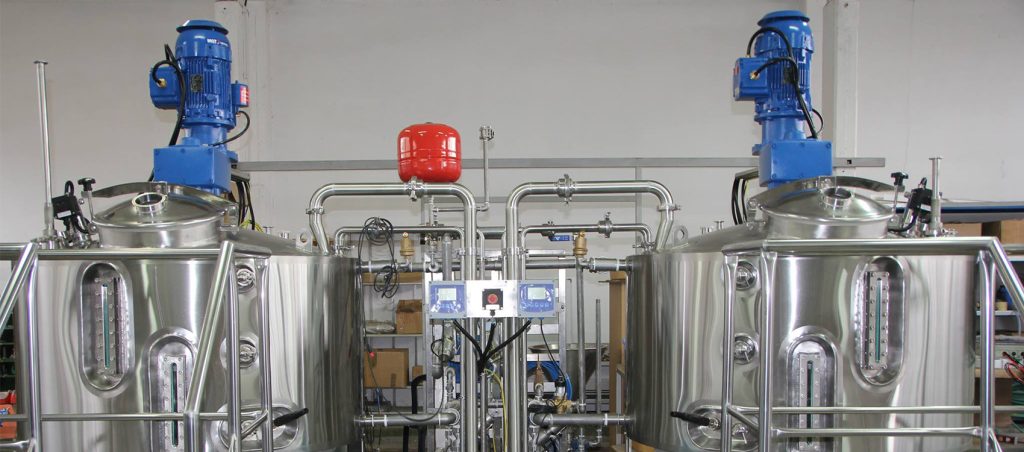

A brewery mixing tank should be selected for a defined mixing task: dissolving an ingredient, blending liquids, suspending solids or preparing a syrup. Tank volume is only the starting point. The product, required uniformity and time available determine the agitator and vessel configuration.
Key takeaways
- Define the mixing result before specifying motor power or speed.
- Treat portability, heating and cleaning as separate design choices.
- Confirm performance at both the smallest and largest intended batch sizes.
Describe the product and the mixing endpoint

Give the supplier the liquid’s viscosity over its operating temperature range, density, solids content and tendency to foam. Explain how ingredients enter the vessel and what demonstrates that mixing is complete.
For a syrup, the endpoint might be complete dissolution and a consistent concentration in representative samples. For a liquid blend, it might be uniform composition without excessive air entrainment. Those are different duties, even if the tanks have the same capacity. For example, a clear sample from the outlet does not establish that powder has dissolved if undissolved material remains on the bottom. Agree representative sample locations and inspect for retained solids during the trial.
Sulzer’s technical discussion of agitator optimisation illustrates why agitators should be assessed against the application. A higher motor rating is not, by itself, proof of a better mixing result.
Match the agitator to the operating range

Impeller geometry, position, speed and vessel shape work together. Specify the minimum fill level as well as the maximum batch. An arrangement that performs well at full volume can behave differently with a small development batch.
Ask how the supplier will evaluate circulation, solids distribution or dissolution time. If the product is sensitive to air, describe that constraint explicitly rather than asking only for rapid mixing. Include any limitations on shear or temperature.
Choose vessel features by function

| Feature | Decision it should support |
|---|---|
| Heating or cooling jacket | Reaching and maintaining the required product temperature |
| Closed top | Controlling product exposure and the charging arrangement |
| Bottom outlet | Draining the actual product with acceptable retained volume |
| Sampling point | Checking the blend without an unsuitable transfer procedure |
| Mobile frame | Moving the vessel under defined loading and floor conditions |
A portable tank can also be jacketed or fitted for cleaning in place. These categories overlap. Compare the complete configuration rather than treating fixed, portable and jacketed tanks as mutually exclusive alternatives.
Check materials and cleanability
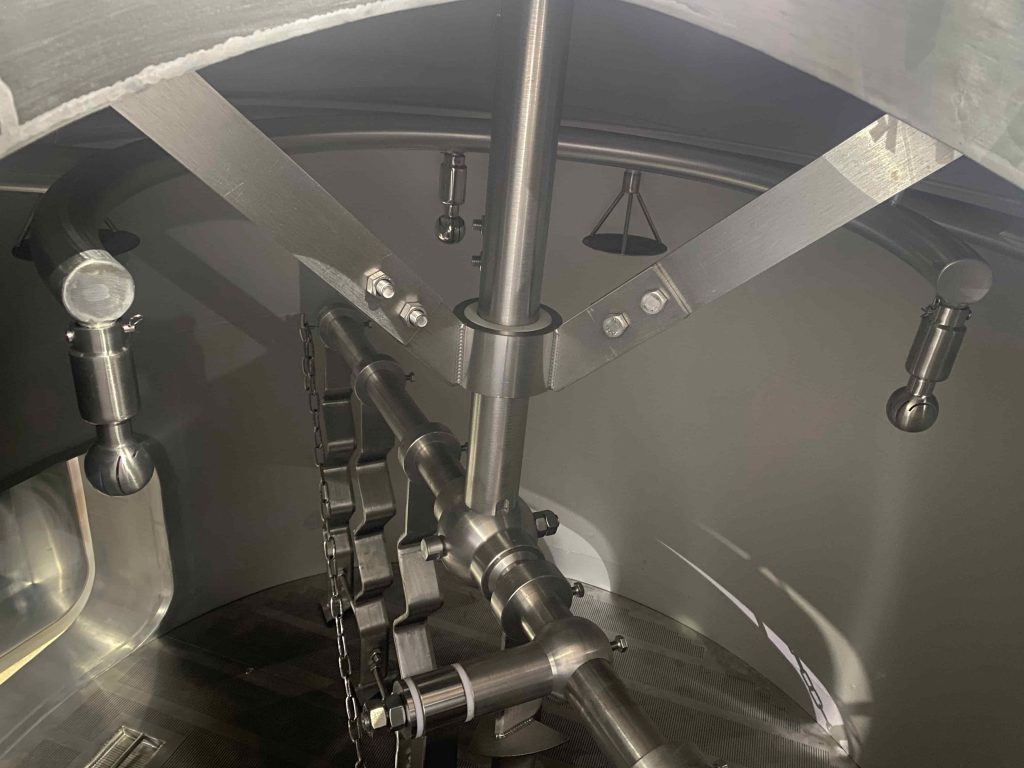
Select stainless steel and seals for the product and cleaning conditions. Grade 316L is not a universal requirement, and stainless steel is not immune to corrosion. Outokumpu’s corrosion guidance explains why the environment and surface condition matter.
Review welds, instrument connections and the area around the agitator shaft. Cleaning coverage and drainage need to be demonstrated for the assembled vessel. Product and cleaning-chemical duties should not be casually interchanged simply because both use stainless steel tanks.
Test the production sequence, not just the mixing stage
Include ingredient charging, heating, mixing, sampling, discharge and cleaning in the batch-time estimate. A short mixing time does little for output if discharge or changeover dominates the shift.
For continuous dosing applications, compare batch preparation with the requirements of a carbonation and blending system. A mixing vessel also has a different duty from a fermenter; pressure service and fermentation capability must be specifically designed.
What to send with a quotation request
Provide representative product data, the batch range, mixing endpoint, temperature schedule, utility availability and a layout drawing. Include cleaning and maintenance access in the acceptance criteria. The turnkey brewery guide explains how these requirements fit into the wider production system.
About this article: Prepared for the SKE Equipment blog with AI-assisted research and editing. Original byline: Mandy, equipment marketing specialist. The linked references support the technical background; this article does not report an SKE equipment trial or a project-specific engineering review.