
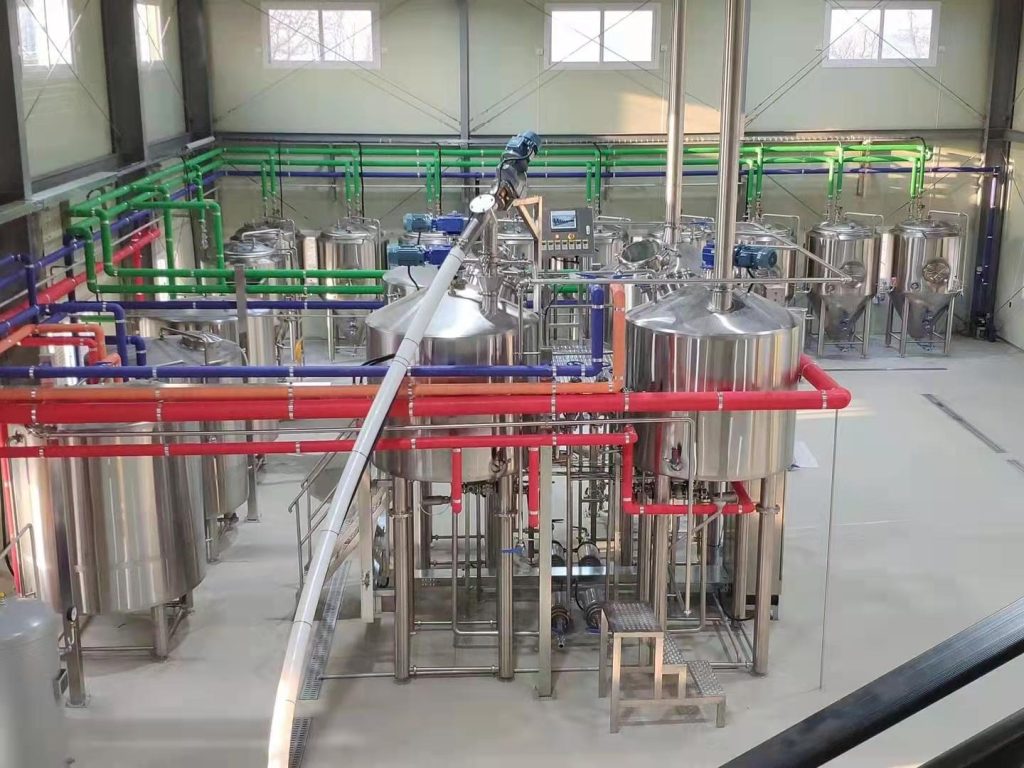

A flexible auger uses a rotating spiral inside a tube to move bulk material. In a brewery, its suitability depends on the grain, route and required duty. Tube diameter alone does not establish throughput, and a general description of flexible conveyors does not define the limits of a particular model.
Key takeaways
- Give suppliers the actual route, including bends and elevation changes.
- Request capacity for the specified malt and installation, not an unspecified catalogue condition.
- Verify grain handling, cleanout and dust-control requirements separately.
Map the grain route before selecting a model
Identify the source hopper or silo, weighing point, mill and receiving vessel. Show the route length, vertical rise, bends, supports and inspection access on a drawing. Include available space around the inlet and discharge rather than only the tube centreline.
A malt handling system should coordinate these stages. If weighing accuracy or mill feeding is important, specify how the conveyor starts, stops and responds when the receiving equipment is unavailable.
Distinguish flexibility from unrestricted routing
Flexicon’s flexible screw conveyor overview describes configurations for different directions and inclines. That establishes the range of the technology, not the capabilities of every supplier’s model.
A model rated for an incline below 90 degrees should not be assumed suitable for vertical conveying. Obtain the permitted incline, bend radius, route length and support requirements for the actual proposed model.
Compare capacity on stated conditions

Ask for mass throughput with the intended malt, bulk density, moisture condition and route. A horizontal test figure cannot be assumed to apply unchanged to a longer inclined route with bends.
| Input | Why the supplier needs it |
|---|---|
| Malt and specialty-grain range | Defines the materials the system must handle |
| Required mass flow and operating window | Connects conveying capacity to the brew schedule |
| Length, incline and bends | Defines the installation being evaluated |
| Feeding arrangement | Determines how consistently material enters the conveyor |
| Start-stop pattern | Establishes the operating duty and control requirements |
| Receiving equipment | Identifies permissives, levels and shutdown conditions |
For a route comparison, suppose two proposed paths reach the same receiving hopper: route A is shorter but uses more bends, while route B is longer with fewer bends. Keep the malt, required mass flow, inlet arrangement and start-stop duty identical in the supplier evaluation. Neither route can be declared higher-capacity from length alone; ask for the rated duty and limits for each complete path. This is a planning example, not a measured capacity comparison.
Published reference figures are not a substitute for a project-specific selection. Request the applicable model datasheet and the conditions behind each capacity claim before using it in production planning.
Check material condition after conveying
If grain integrity matters to the process, include it in a trial. Compare representative samples before and after conveying instead of assuming that every flexible auger handles every malt gently. For grist transport, evaluate the resulting particle distribution against the milling and mash-separation requirements.
Maintenance access matters as well. Ask how the spiral and tube are inspected or replaced, where product can remain and how the equipment is emptied between duties.
Specify cleanout and dust management
An enclosed tube helps contain material, but it does not remove all dust risks at intake, discharge or maintenance points. Include those interfaces in the site’s assessment and installation design.
For different grain types, define acceptable carryover and a verified cleanout method. Do not claim that an air purge prevents cross-contamination without evidence for the specific system and acceptance criterion. Dedicated routes may be needed where separation requirements demand them.
Connect controls to the brewery schedule
Clarify level signals, mill permissives, blocked-discharge response and batch identification. The conveyor should fit the production sequence described in the turnkey brewery plan, including future changes to storage and milling capacity.
For a useful enquiry, supply the route drawing and material information together. Ask the supplier to return a model selection with its assumptions, limitations and acceptance checks. This is more dependable than choosing the largest diameter and hoping it covers the installation.
About this article: Prepared for the SKE Equipment blog with AI-assisted research and editing. Original byline: Mandy, equipment marketing specialist. The linked references support the technical background; this article does not report an SKE equipment trial or a project-specific engineering review.