
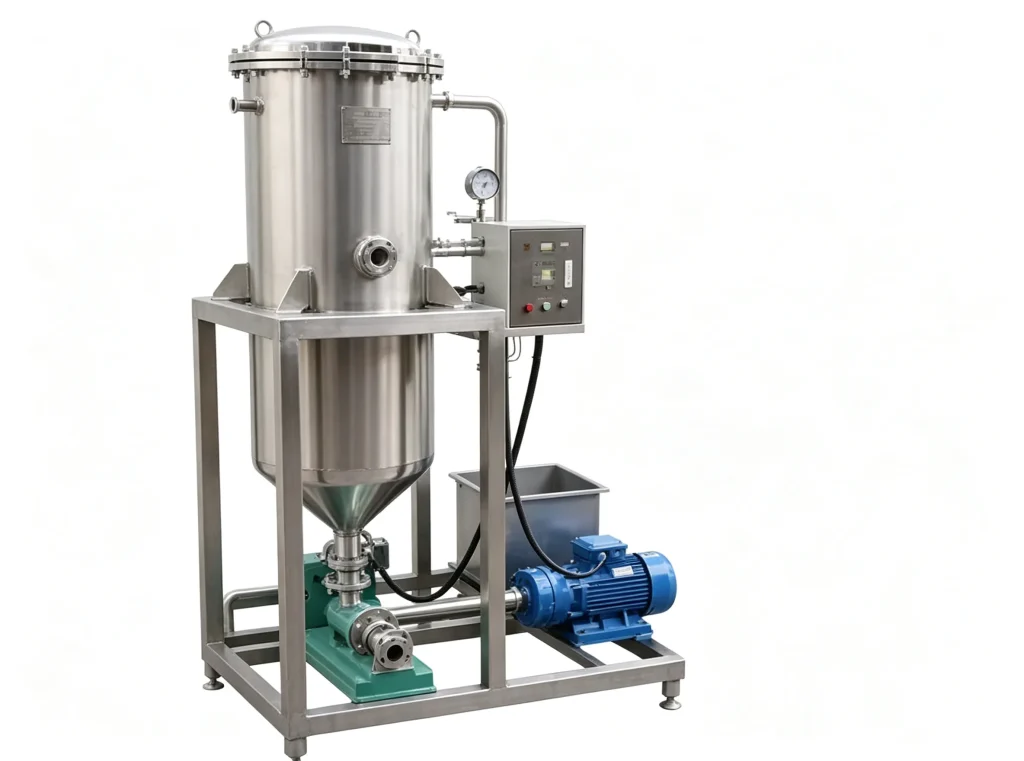
In modern brewing, consistency isn’t a nice-to-have, it’s the whole promise a brand makes to its customers. Achieving that consistency across millions of hectoliters, at some of the biggest breweries on earth, comes down partly to a technology most drinkers have never heard of: vacuum degassing equipment.
This piece covers why leading global breweries have made degassing standard practice, the production-standard gap it closes, and how to evaluate a system for your own scale. For a deeper technical walkthrough of the mechanism itself, plus a real installation case study, see our companion article, Vacuum Degassing: The Secret to Premium Beer Stability.
Key Takeaways
- Water in equilibrium with air at 20°C holds about 9.03 mg/L (roughly 9,000 ppb) of dissolved oxygen (Fondriest) — a well-run vacuum degassing system pushes that below 10 ppb, a reduction of roughly 99.9%.
- The compound most responsible for the papery, cardboard-like “stale beer” flavor, trans-2-nonenal, is detectable by taste at concentrations as low as about 0.08 ppb (ASBC), which is why even small amounts of residual oxygen matter.
- Craft-scale operations commonly run 50–150 ppb dissolved oxygen; large industrial brewers target under 10 ppb as standard practice.
The Real Enemy of Fresh Beer: Dissolved Oxygen
To understand why vacuum degassing equipment matters, start with the problem it solves: dissolved oxygen.
Oxygen gets into beer through water, transfer lines, pumps, and tank filling, and once dissolved, it drives a set of oxidation reactions that quietly damage the product. Much of the resulting “stale” character traces back to trans-2-nonenal, an aldehyde with a sensory detection threshold around 0.08 ppb (ASBC) — low enough that oxidation doesn’t have to go far before a drinker notices. Beyond the papery, cardboard-like flavor, oxidation can also darken the beer’s color and fade delicate hop aroma.
For a craft brewer, one affected batch is a loss. For the biggest brewers, producing thousands of liters per hour and shipping worldwide, the same problem at scale means a much larger recall risk and real brand damage — which is exactly why they invest heavily in removing oxygen before packaging.
What Is Vacuum Degassing Equipment?
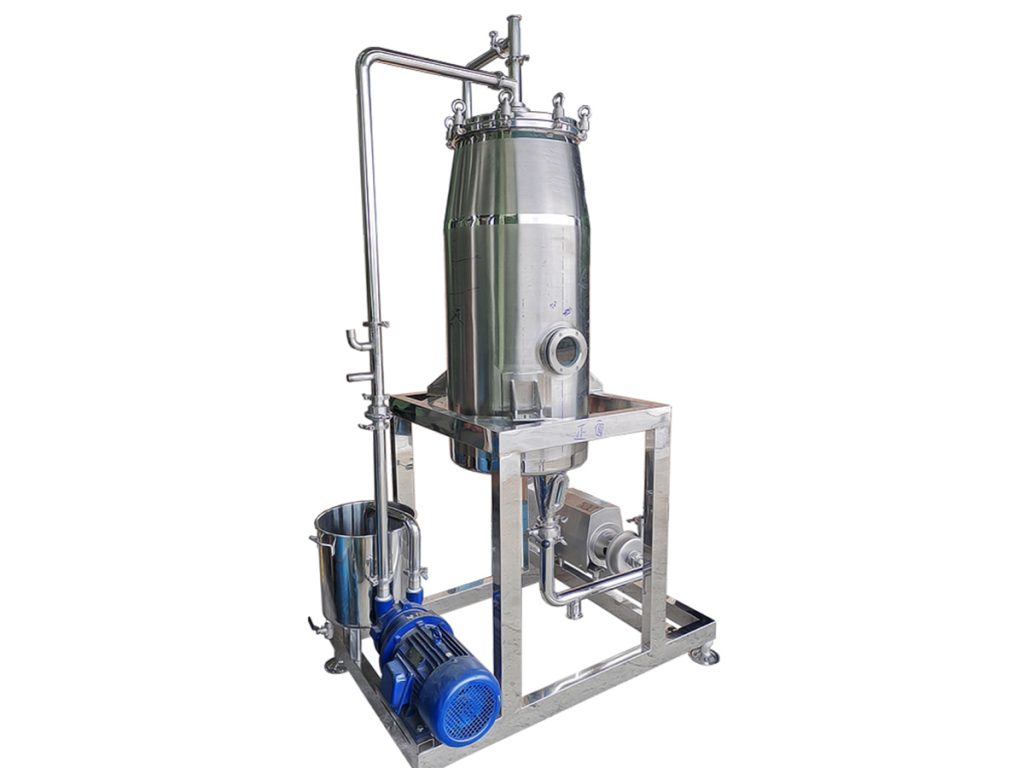
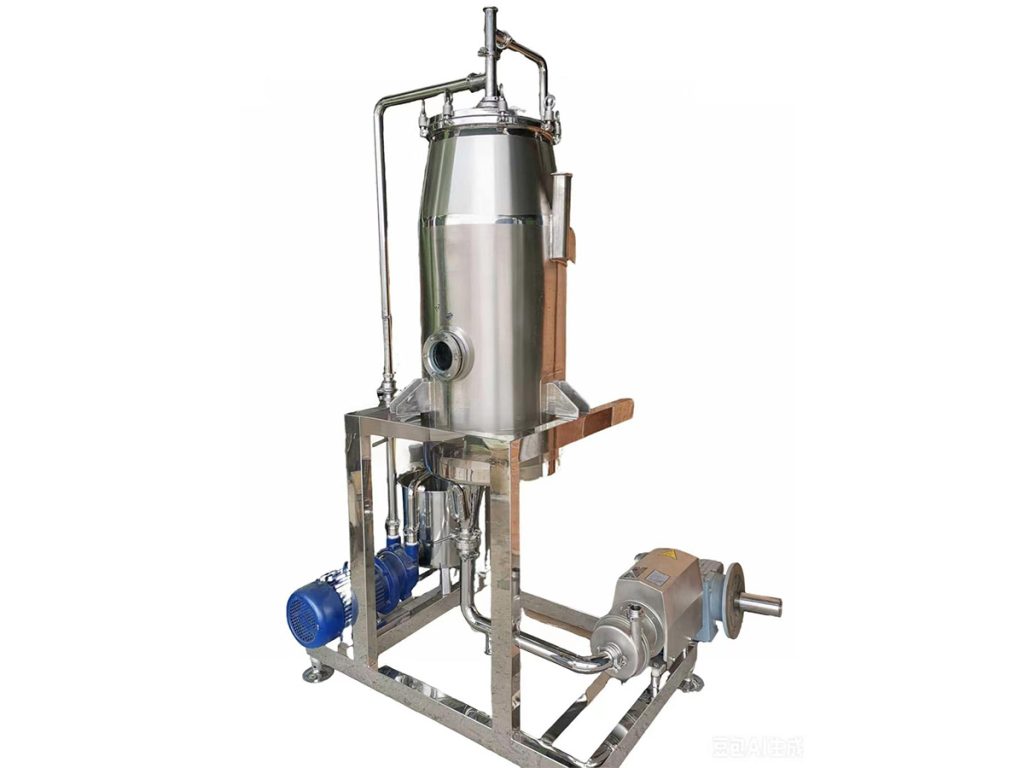
Vacuum degassing equipment removes dissolved gases from liquids, targeting dissolved oxygen in a brewery context (though it can also remove CO2 or nitrogen). A vacuum pump creates a low-pressure environment inside a sealed vessel; since gases are less soluble in liquids under low pressure, dissolved gases bubble out as the liquid enters, and the pump carries them away. (For the full stage-by-stage mechanism and a real installation walkthrough, see our technical guide.)
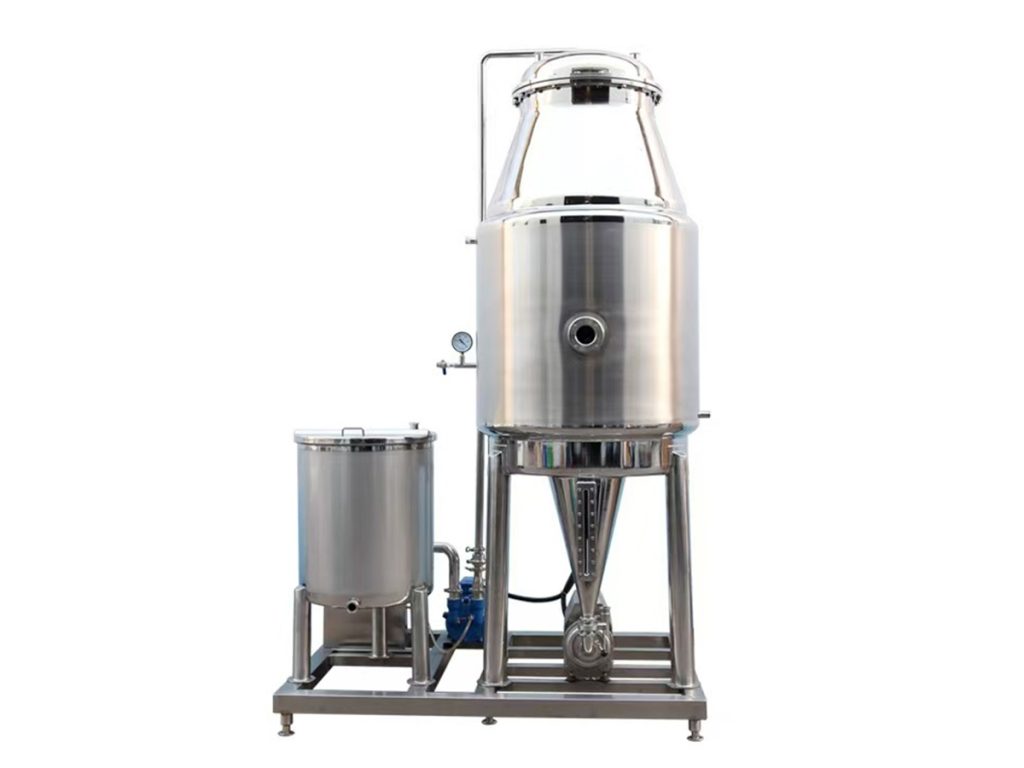
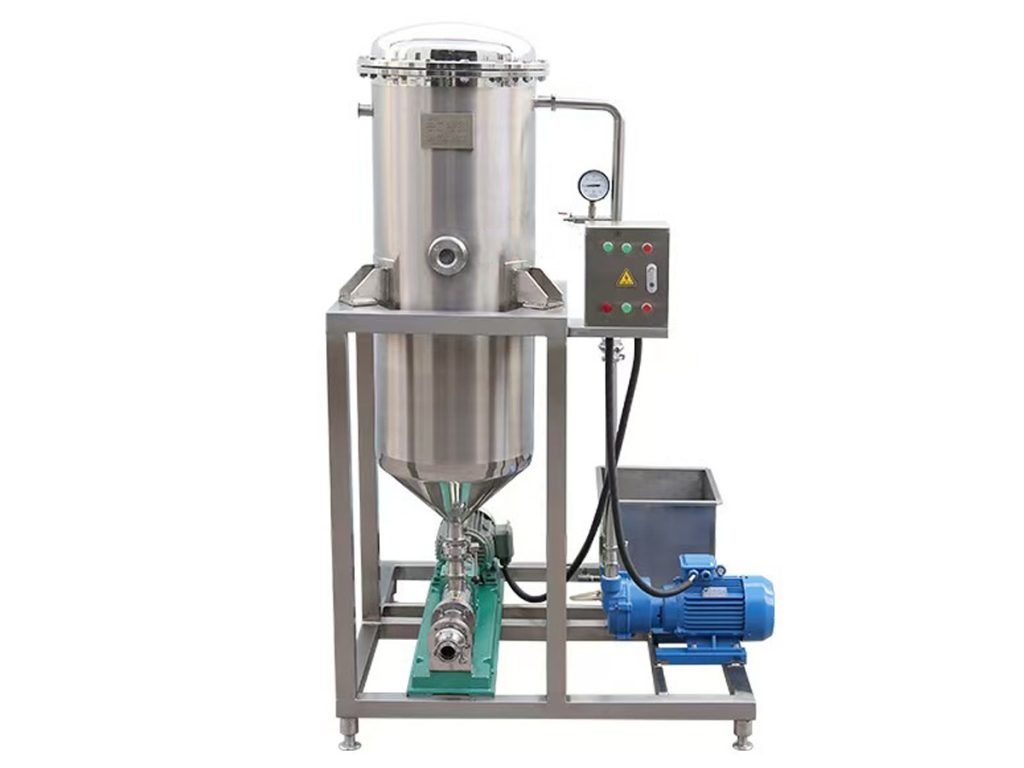
A standard system includes a feed pump, a vacuum tank or column, a vacuum pump, and control sensors monitoring dissolved oxygen in real time — together preparing a stable base liquid ready for filling.
How Tank Degassing Fits Into the Brewery
“Tank degassing” describes the process happening inside the vacuum vessel, and it typically shows up at two points in a brewery: water treatment and final product treatment.
1. High-Gravity Dilution Water
Many large breweries use high-gravity brewing: brewing a stronger beer, then diluting it with water right before packaging to save energy and space. That dilution water has to be essentially oxygen-free, since adding it back at the last moment would undo the careful oxygen control upstream. Vacuum degassing treats this water directly.
2. Final Beer Stripping
Sometimes the degassing unit runs on the finished beer itself, removing excess carbon dioxide or dialing dissolved oxygen down to a precise target, usually below 10 ppb. This effectively “resets” gas levels right before packaging, so a predictable, stable liquid enters the filling line every time.
Comparing Production Standards
The table below shows the gap that vacuum degassing equipment closes between craft-scale and large-scale industrial operations.
| Production Aspect | Small Craft Brewery Standard | Standard for Biggest Brewers (Using Degassing) |
|---|---|---|
| Dissolved Oxygen Target | 50 – 150 ppb | < 10 ppb |
| Water for Dilution | Often untreated or carbon-filtered | Vacuum-deaerated water mandatory |
| Shelf Life Expectancy | 3 – 6 months | 9 – 12 months or longer |
| Flavor Consistency | Can vary batch to batch | Nearly identical across all batches |
| Packaging Speed | Slower due to foaming risks | High speed, stable filling operation |
| Process Control | Manual checks frequently | Fully automated online DO monitoring |
Adopting a professional degassing unit is what moves a brewery from craft-standard to industrial-standard quality and consistency.
The Benefits of Using a Degassing Unit
The case for a degassing unit goes well beyond removing oxygen for its own sake — it delivers real operational and financial advantages.
1. Extended Shelf Life
Reducing dissolved oxygen to near-zero levels slows oxidation significantly, letting beer hold its fresh flavor for months longer — essential for brands that sit in containers or warehouses before reaching a distant consumer.
2. Improved Filling Efficiency
Oxygen and CO2 in the beer cause foaming, and foam means waste and under-filled containers. Removing those gases lets filling machines run at full speed with fewer stoppages and higher output per hour.
3. Consistent Flavor Profile
Oxidation quietly rewrites a recipe batch by batch. Locking in gas levels through tank degassing keeps the flavor in Chicago the same as the flavor in Tokyo — the kind of consistency that builds brand trust.
4. Cost Savings
The upfront investment is significant, but reduced product waste, longer shelf life (fewer returns), and faster filling speeds add up to a lower total cost of ownership over time.
The Role of Automation in Modern Degassing
Degassing used to be a manual or semi-manual process. Today’s systems are highly automated, which matters enormously for facilities running 24/7 — nobody wants to rely on manual valve turning to hold oxygen levels steady around the clock. Modern PLC-controlled systems monitor DO continuously, adjust vacuum pressure automatically to hold set points, log data for quality assurance, and trigger alarms if oxygen rises above threshold. (See our technical guide for how the vacuum mechanism itself works stage by stage.)
How to Choose the Right Degassing Unit for Your Scale
Not all systems are built the same. Key factors to weigh:
- Capacity: can it handle your peak flow rate, measured in hectoliters per hour, not just your average?
- Material quality: high-grade stainless steel (304 or 316L) to withstand cleaning agents and resist corrosion.
- CIP compatibility: full Clean-in-Place support, so sanitizing doesn’t require dismantling the system.
- Oxygen target: confirmed, real-world performance at your required DO target (e.g., under 10 ppb), not just a spec sheet number.
- Space: a physical footprint that actually fits your existing layout.
- After-sales support: installation support, training, and spare parts availability from the manufacturer.
SKE: Your Partner for Professional Degassing Solutions
SKE manufactures brewery and beverage processing equipment built around these exact standards: premium 304/316L stainless steel construction, advanced PLC automation, compact designs for tight production spaces, and capacity customized to your production goals. We work with you to integrate the degassing unit into your existing line, train your team, and provide ongoing support.
Frequently Asked Questions (FAQ)
Why do the biggest brewers use vacuum degassing instead of other methods?
It’s the most efficient way to remove oxygen from large volumes of liquid continuously, without relying on purchased stripping gases.
What is the typical oxygen reduction rate for tank degassing?
Water in equilibrium with air holds roughly 9,000 ppb dissolved oxygen at 20°C (Fondriest); a well-run degassing process can bring that below 10 ppb, a reduction of roughly 99.9%.
Can a degassing unit be used for non-alcoholic beer production?
Yes — the same vacuum process used for oxygen removal can also gently strip alcohol, making the equipment useful for low- and non-alcoholic beverage production too.
Is vacuum degassing the same as deaeration?
Essentially, yes. Applied to water specifically, it’s often called deaeration; vacuum degassing equipment is the technology that achieves it for brewing and dilution water.
How does SKE ensure the quality of its vacuum degassing equipment?
High-grade materials and rigorous testing on every system before delivery, built to the hygiene and performance standards the brewing industry expects.
Conclusion
The biggest brewers in the world treat oxygen as the enemy of fresh beer, and vacuum degassing equipment as the standard weapon against it. Adopting tank degassing and a reliable degassing unit means longer shelf life, faster packaging lines, and the same consistent flavor for every customer, wherever they are.
Ready to bring your brewery up to that standard? Contact SKE to discuss a system built for your scale.