
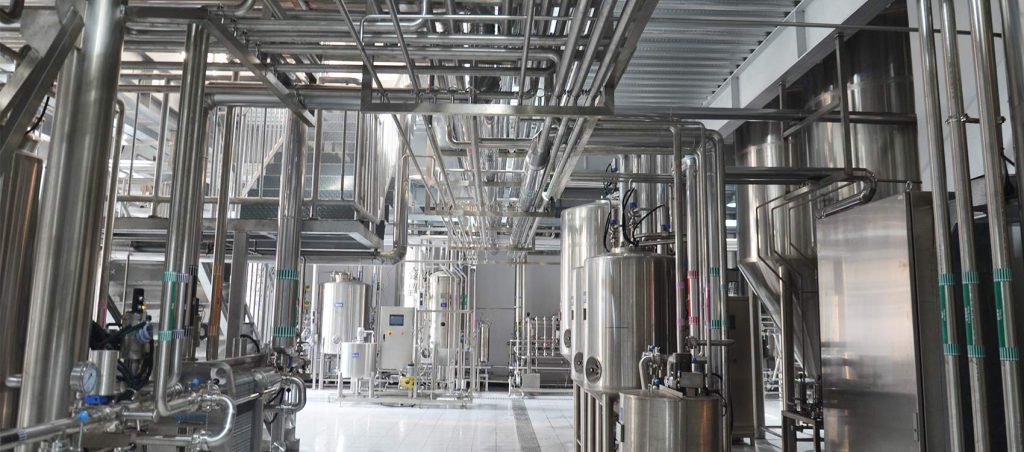
A brewery equipment FAT and SAT checklist should show what was tested, the conditions, the measured result and who accepted it. Factory acceptance testing (FAT) covers the agreed checks before shipment. Site acceptance testing (SAT) covers the installed system and its site interfaces. A factory pass does not close a site test that has not been performed.
Use the checklist to build your protocol and the worked records to distinguish passes, failures and untested items. The numerical examples are hypothetical—not SKE equipment ratings, customer results or operating limits. Your purchase specification and qualified project team must set the actual criteria.
Key takeaways
- Agree acceptance limits and test conditions before the test starts.
- Keep simulated controls, water trials and product trials separately identified.
- Record acceptable output and interruptions, not just a machine’s displayed speed.
- Give unresolved items a named owner, a due date and a retest record.
FAT vs SAT: what belongs at each stage?
| Stage | Main question | Result to retain |
|---|---|---|
| FAT | Does the supplied equipment meet the agreed factory-test scope? | Signed test records, deviations and a shipment decision |
| SAT | Does the installed system meet the agreed site-test scope? | Installed-loop and interface results, utility conditions and unresolved items |
| Product trial, when included | Does the system meet the defined duty with the specified product and package? | Product conditions, sampling results and measured performance |
Decide where each check belongs before manufacture. Hargrove’s FAT readiness checklist specifically calls for identifying work reserved for SAT, individual sign-off fields and a punch list. Commissioning activities and acceptance tests may overlap, but a signature should identify the scope it closes.
For a larger installation, align this protocol with the responsibilities in your turnkey brewery plan. An item excluded from the supplier’s contract may still be needed for a successful site test.
Brewery equipment acceptance checklist
The IDs below are suggested record references. Select relevant checks and add project-specific limits; this is not a certification standard. Tests involving pressure, electricity or protective functions require qualified personnel and approved procedures.
Factory checks before dispatch
| Test ID | Check | Evidence required before closing the item |
|---|---|---|
| FAT-01 | Equipment identity and quantity | Tags and components matched to the approved equipment list |
| FAT-02 | Construction and connections | Inspection against the specified drawings, connection sizes and access requirements |
| FAT-03 | Item-linked documents | Required material, inspection and instrument records traceable to the supplied equipment |
| FAT-04 | Working volume and stated limits | Agreed volume basis and operating limits distinguished from nominal vessel size |
| FAT-05 | Transfer sequences | Recorded route, valve states and sequence result for each route in scope |
| FAT-06 | Alarms and interlocks | Expected and observed responses, with physical and simulated inputs distinguished |
| FAT-07 | Software and settings | Version record, required backups and agreed operator documentation |
| FAT-08 | Outstanding work | Open items, owners and explicit decision on whether shipment can proceed |
A valve opening in manual mode does not establish that the automatic transfer sequence selects the correct destination. Test the route and its required permissives as defined in the approved control description. A simulated input checks the control response; the installed sensor and wiring still need their agreed checks.
Site checks after installation
| Test ID | Check | Evidence required before closing the item |
|---|---|---|
| SAT-01 | Delivery and reassembly | Identification, condition and installation changes recorded |
| SAT-02 | Utility availability | Required supply conditions measured at agreed connection points during the test load |
| SAT-03 | Instrument loops | Installed device, wiring, signal scaling, display and alarm results |
| SAT-04 | Process interfaces | Confirmed source/destination routes and responsibility for third-party equipment |
| SAT-05 | Cleaning functions and outcome | Circuit and cycle records plus separately agreed cleaning-outcome evidence |
| SAT-06 | Performance duty | Defined product or test medium, conditions, duration and measured results |
| SAT-07 | Training and handover | Manuals, settings, training records and outstanding-item status |
| SAT-08 | Final closure | Retest evidence, approved deviations and the relevant sign-off |
KROHNE’s commissioning scope includes installed-instrument checks, analogue/digital loop tests, alarm settings and final documentation. These are useful planning categories, not a statement that SKE includes every service in every quotation.
Set acceptance criteria for the actual brewery duty
Replace broad phrases such as “good cooling” or “full capacity” with a test the team can repeat. Identify the medium, measurement points, instruments, conditions and tolerances before recording a result.
For a brewhouse, define batch working volume and the conditions behind heating or transfer-time requirements. For a wort cooler, specify the inlet temperatures, flow and cooling supply associated with the required outlet condition. For fermentation tanks, keep working volume, cooling-control checks and protective-device documentation distinct.
For a filling line, define the product, package, observation period and treatment of rejects and stops. A displayed running speed is not the same as acceptable output over the agreed trial. The beer filling-line comparison explains the wider layout and throughput choices.
Worked example: record a water-transfer test
Hypothetical example only. Assume the parties agreed to demonstrate transfer of 1,200 L of water within 20 minutes under a documented setup. The example records below illustrate the calculation; they do not establish a design duty or a required number of repeat tests.
| Record | Volume | Elapsed time | Calculated average flow | Time criterion | Result |
|---|---|---|---|---|---|
| Run 1 | 1,200 L | 20 min | 60 L/min | At most 20 min | Boundary result: apply agreed uncertainty rule |
| Run 2 | 1,200 L | 24 min | 50 L/min | At most 20 min | Fail |
| Run 3, after corrective work | 1,200 L | 18 min | About 66.7 L/min | At most 20 min | Within the stated time limit; confirm the agreed uncertainty rule |
Average flow = transferred volume ÷ elapsed time. Thus 1,200 ÷ 24 = 50 L/min. The result misses the hypothetical time requirement even though the pump transferred the full volume.
Retain the failed run. Record the actual instrument references, route, water temperature, utility readings and corrective action; do not invent a cause from this table. The final run does not erase the failure or prove repeatability beyond the agreed test procedure. Measurement uncertainty and tolerances must be part of the real protocol, especially when a result lies on a limit.
This water test documents the defined water duty. It does not establish wort cooling performance, beer quality or cleaning effectiveness.
Worked example: distinguish line speed from accepted output
A separate hypothetical packaging trial requires at least 2,000 acceptable packs per hour, assessed over a 30-minute window. The record shows 1,000 filled packs, including 20 rejects. Assume the log also records 4 minutes of stops within that window. All stops count toward elapsed time for this example.
| Measurement | Recorded or calculated result |
|---|---|
| Observation period | 30 min = 0.5 h |
| Total filled packs | 1,000 |
| Rejected packs | 20 |
| Acceptable packs | 1,000 − 20 = 980 |
| Accepted output rate | 980 ÷ 0.5 = 1,960 packs/h |
| Agreed example requirement | 2,000 acceptable packs/h |
| Decision for this trial | Fail: 1,960 is below 2,000 |
A gross count of 1,000 packs in 30 minutes equals 2,000 packs/h, but that is not the accepted-output metric agreed here. If the operator excludes the 4 stopped minutes, the denominator becomes 26 minutes. That produces 980 ÷ (26 ÷ 60), or approximately 2,262 acceptable packs/h while running. It still does not satisfy the agreed whole-window test: the relevant result remains 1,960 packs/h. Do not switch the denominator after seeing the result. Log reject causes and interruptions, agree corrective work, and repeat the relevant test. Record any different contractual availability measure explicitly.
Keep cleaning verification separate from a water run
A successful water route test shows that water followed the tested route. It does not show that a cleaning cycle removes the brewery’s production soils or meets its microbiological acceptance criteria.
For a CIP system, agree the circuits, return paths, operating conditions, sampling locations and method for assessing the cleaning result with the brewery’s quality team. Record the cycle conditions and outcome evidence separately. EHEDG’s test-method guidance explains that equipment tests do not establish performance in every specific application; the food manufacturer must establish cleaning regimes suitable for its process.
Avoid universal cleaning temperatures, chemical concentrations or swab limits copied from an unrelated installation. Use the validated requirements and approved procedures for the actual equipment and product.
Copy this record format and close each open item
Use these fields for each FAT or SAT check:
- Test ID and equipment tag: identify the check and the physical item.
- Requirement and document revision: state the criterion being tested.
- Setup and conditions: identify the medium, route, utilities and measuring instruments.
- Expected result: record the agreed pass criterion before testing.
- Actual result and evidence: link readings, logs, photographs or sample records.
- Status: pass, fail, not tested or approved deviation.
- Operator, witness and date: identify responsibility for the record.
- Open-item owner, due date and retest: document how unresolved work will close.
A factory simulation can pass while its installed-loop check remains “not tested.” Give those checks separate records. Decide which open items block shipment, start-up or final acceptance through the agreed project procedure; an unresolved protective-function test should not disappear into a general “minor items” note.
Include training and documentation in handover. Alfa Laval’s commissioning description lists test runs, performance checks, operator training and documented handover. Use those categories to clarify the scope of your own purchase.
To discuss an SKE project, send your equipment list, production duty, site utility information and proposed acceptance criteria through the SKE contact page. Agreeing the evidence before testing makes the eventual acceptance decision easier to verify.
Editorial note: Prepared for the SKE Equipment blog with AI-assisted research and editing. Editorial contact: Mandy, equipment marketing specialist. The numerical examples are invented teaching scenarios with transparent calculations, not equipment specifications or SKE project data. This article is a sourced planning guide, not a project-specific engineering review.