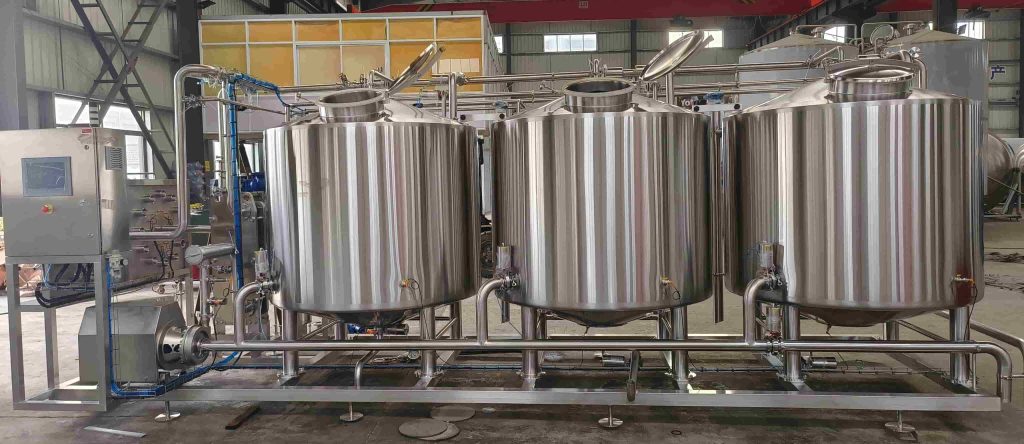
By the SKE Process Engineering Team, which designs and manufactures CIP systems, brewhouse tanks, and complete sanitary process equipment for regional and large breweries worldwide.
Key Takeaways
- Dead zones form wherever spray coverage, flow, or drainage falls short of a tank or pipe run’s actual geometry, and they are a leading cause of inconsistent CIP results as breweries scale up equipment size.
- Fixed CIP balls suit smaller vessels (roughly up to 1,000 L), while rotary CIP ball spray devices deliver the mechanical impact needed for larger tanks; equipment must meet 3-A Sanitary Standards for hygienic design to be reliably CIP-cleanable in the first place.
- A typical caustic wash runs around 71–82°C (160–180°F), per published CIP process guidance, followed by an acid rinse to remove beerstone before final sanitization.
Introduction: A Common Challenge for Growing Breweries
Running a regional brewery is exciting. You are growing your brand, making more beer, and reaching new customers. But growth brings a specific plumbing problem: as you add more tanks and longer pipe runs, cleaning gets harder to control, and areas that were easy to reach by hand or by a small CIP loop can quietly become hidden trouble spots.
These trouble spots are called dead zones: places where cleaning solution does not make reliable contact with the surface. Left unaddressed, they let residue and microorganisms build up, which can show up later as off-flavors, contamination, or a spoiled batch. For a regional brewery, that is not a minor inconvenience. A single lost batch and a customer-facing quality complaint both cut directly into a reputation you have spent years building.
This is where CIP cleaning tanks come in. A well-designed clean-in-place system cleans your equipment automatically and thoroughly, using calibrated flow, temperature, and chemistry instead of manual scrubbing. It saves time, water, and chemicals, and it protects your beer quality more consistently than a crew with a garden hose ever could.
In this guide, we will walk through how CIP cleaning tanks work, the role of CIP ball and CIP ball spray devices in eliminating dead zones, and what to look for when you are buying new equipment or upgrading a system you have outgrown.
What Are Dead Zones and Why Do They Matter?
A dead zone is any area inside a tank or pipe where cleaning solution cannot reach with enough coverage, flow, or mechanical force to actually remove soil. These areas hide residue and give bacteria a place to survive a cleaning cycle that otherwise looked complete.
In a regional brewery, dead zones most often show up in the same handful of locations:
- Around manways and access doors
- Under internal coils, agitators, or fittings
- In pipe branches and dead legs that see poor flow
- At the bottom of tanks with shallow or off-center drainage
- Behind sample valves and sight glasses
Dead zones are dangerous precisely because they are invisible during normal operation. A tank can look clean, pass a quick visual check, and still carry residue in a corner the spray pattern never touched. Even a small amount left behind is enough to contaminate the next batch.
In a small brewpub, staff can sometimes compensate by hand-cleaning the worst spots. That approach does not scale. Once you are running larger tanks and more connected equipment, manual cleaning becomes impractical: it consumes labor hours you do not have and puts workers inside confined spaces they should not need to enter as often as manual cleaning requires.
That is why sanitation engineers treat CIP system design, not manual touch-up, as the real fix. The Brewers Association’s sanitation resource hub makes the same point: sanitation in a brewery of any size depends on more than good CIP practices alone. It depends on equipment that was built to be cleaned in the first place, with no hidden spots for solution to miss.
How CIP Cleaning Tanks Work in a Brewery
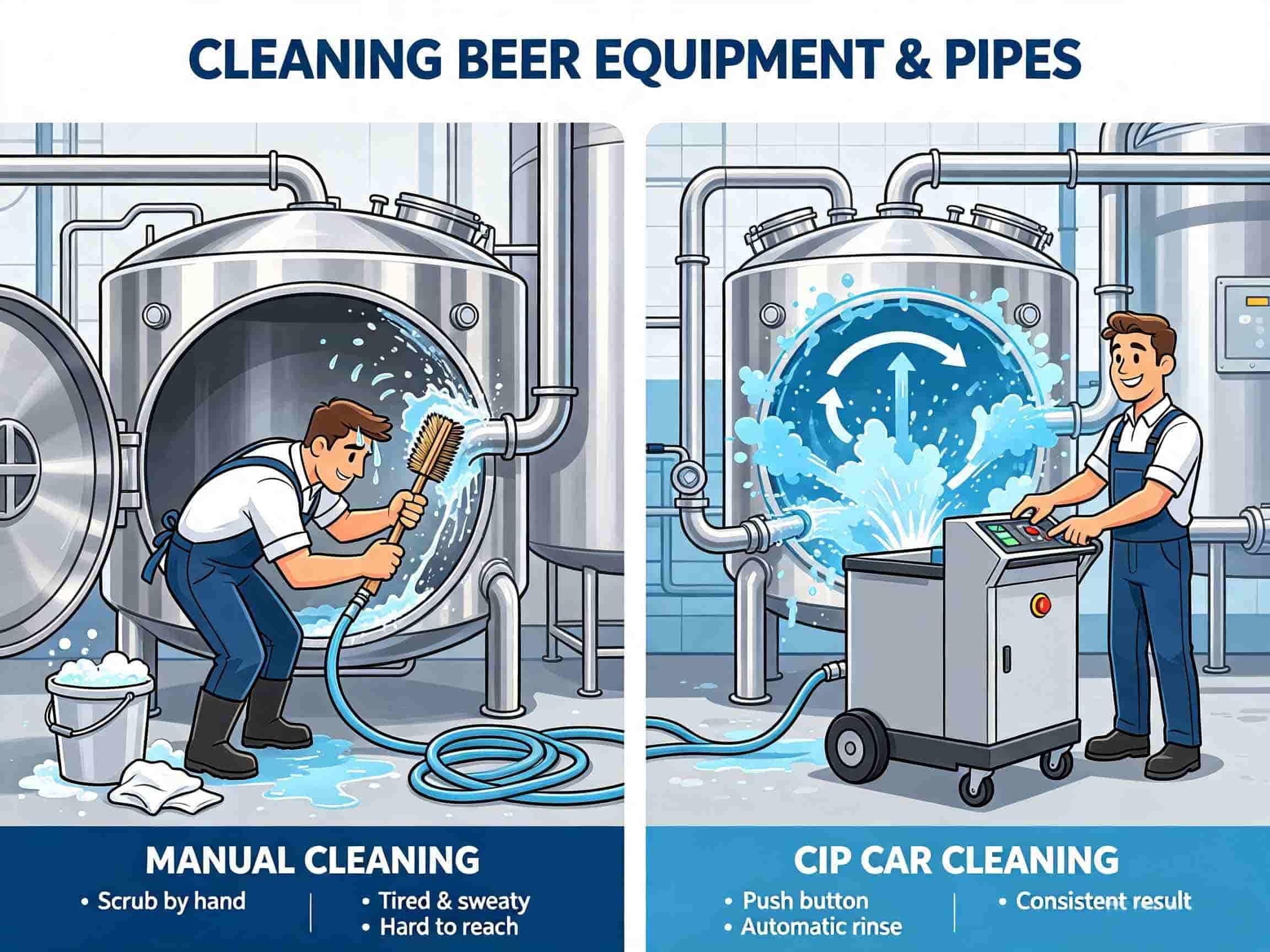
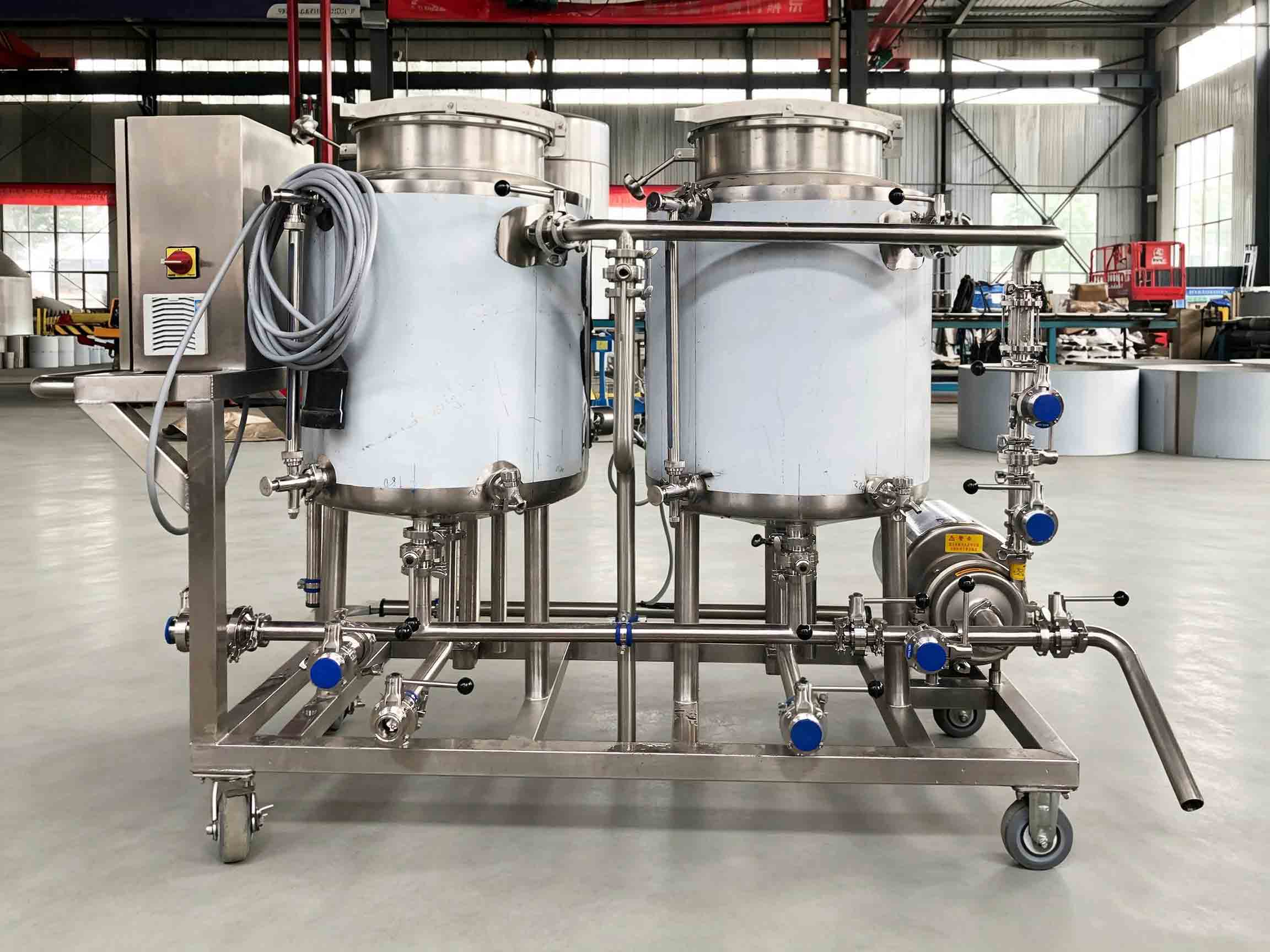
CIP cleaning tanks are the heart of the cleaning system. They store and prepare the cleaning solutions (water, caustic, acid, and sanitizer) that circulate through the rest of the CIP loop.
Here is how a typical cycle runs in practice. Water and chemicals are mixed and heated in the CIP cleaning tank, then a pump sends the solution through pipework to whichever vessel needs cleaning. Inside that vessel, the solution is sprayed onto the surfaces by a CIP ball or CIP ball spray device, which is responsible for distributing it evenly across the tank walls rather than dumping it in one spot. After the solution has done its work, it drains back to the CIP cleaning tank, where some systems reuse it for several cycles to cut chemical and water costs.
A typical cleaning cycle follows six steps:
- Hot water pre-rinse
- Caustic wash (removes organic soil, yeast, and proteins)
- Intermediate water rinse
- Acid wash (removes beerstone and other mineral deposits)
- Final rinse
- Sanitization
Each step targets a different type of soil. The caustic wash strips organic residue (yeast, proteins, and hop material) and typically runs at roughly 71–82°C (160–180°F), based on published CIP procedure guidance from Gorman & Smith Beverage Equipment; exact set points vary by chemical supplier and equipment manufacturer, so always follow your own system’s validated parameters. The acid wash that follows removes beerstone, a calcium-oxalate mineral scale that caustic alone will not touch, a mechanism explained in detail by Brew Your Own’s overview of hygienic brewing chemistry.
For a regional brewery, having well-designed CIP cleaning tanks is what keeps every one of those six steps consistent from batch to batch, instead of depending on an operator’s judgment call about how long to run each phase.
The Role of CIP Ball and CIP Ball Spray Devices
The spray device is one of the most consequential parts of any CIP system, because it determines how, and whether, the cleaning solution actually reaches every tank surface.
There are two main types of spray devices used in breweries.
Fixed CIP Ball
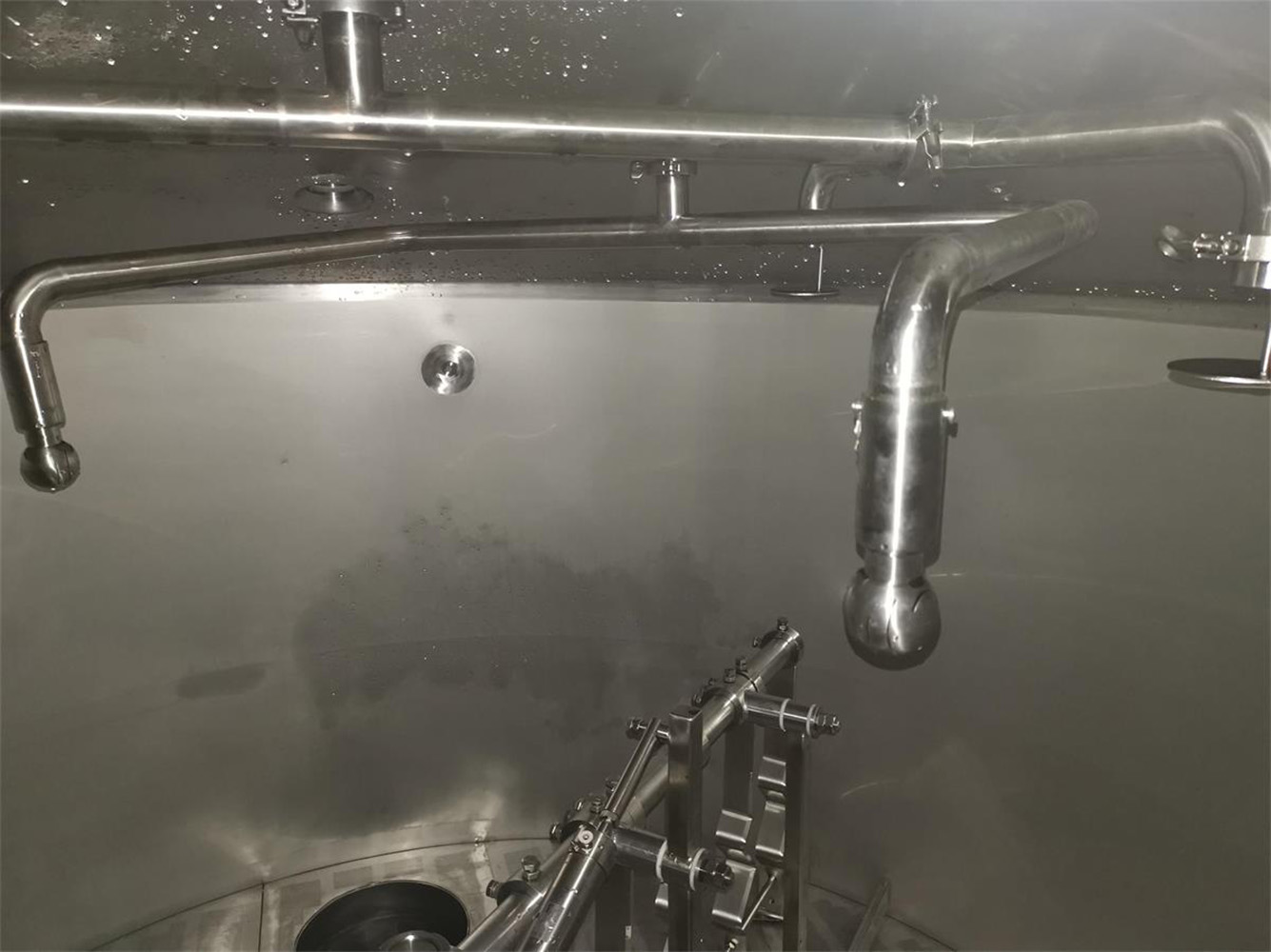
A CIP ball is a hollow sphere with small holes machined into its surface. Cleaning solution sprays out through those holes in a fixed pattern that covers the tank interior. With no moving parts, it is simple and reliable, and it works well for smaller tanks up to roughly 1,000 liters.
The tradeoff is that a fixed CIP ball’s coverage depends entirely on flow and pressure staying within spec. Drop the pressure and some areas of a larger tank will not get enough cleaning solution, which is exactly how a dead zone starts.
Rotary CIP Ball Spray
A rotary CIP ball spray device adds spinning nozzles that create a stronger, more targeted spray pattern as they rotate through the solution flow. The added mechanical action helps remove stubborn soil, which is why rotary devices are the more common choice for larger tanks.
For a regional brewery, the choice between a fixed CIP ball and a rotary CIP ball spray comes down to tank size and cleaning demand: SKE’s engineering team sizes this decision per vessel rather than applying one spray technology across an entire brewhouse.
Why Traditional Systems Fail in Regional Breweries
Many regional breweries start with equipment sized for a much smaller operation, then keep running the same CIP system as they scale up. That mismatch is where most dead-zone problems originate. The most common failure points are:
Limited spray coverage: a single CIP ball sized for a smaller vessel leaves gaps in a larger tank’s spray pattern, and those gaps become dead zones.
Low flow and pressure: an undersized pump cannot push solution against the tank walls with enough force, so residue stays put even when solution technically reaches the surface.
Clogged spray holes: breweries using dry hops in particular see hop particles clog CIP ball spray holes over time; once clogged, the spray pattern shifts and some areas get no solution at all.
Poor pipe design: long pipe runs and dead legs reduce flow velocity to the point where cleaning solution cannot reach every section of the system.
Inadequate drainage: tanks that do not drain completely let cleaning solution pool, which leaves residue behind instead of carrying it out with the rinse.
These five problems compound each other, and they are common in regional breweries that expanded production without also upgrading the CIP system underneath it. The result is inconsistent cleaning and a rising risk of contamination that often is not caught until a batch is already affected.
SKE’s No-Dead-Zone Solution for Regional Breweries
Cleaning should be built into equipment design from the start, not bolted on afterward. SKE designs systems for regional breweries around five principles.
Sanitary tank design: smooth interiors with no sharp corners, and fittings selected for easy cleaning rather than lowest cost. Surface finish and construction detail like this are exactly what 3-A Sanitary Standards govern for hygienic food and beverage equipment: the industry benchmark for whether a vessel can actually be cleaned in place.
Optimized CIP ball spray technology: a high-quality fixed CIP ball for smaller tanks, and rotary CIP ball spray devices for larger ones, matched to each vessel rather than standardized across the whole brewhouse.
Dead-leg-free piping: piping designed to drain completely, with no sections where liquid can sit and turn into a hidden contamination risk.
Advanced control systems: CIP loops that monitor temperature, flow, and pressure in real time and alert the operator when a parameter drifts out of range, instead of relying on a fixed timer.
Customized cleaning recipes: different beers create different soils: a dry-hopped IPA leaves more hop residue than a light lager, so cleaning recipes are tuned to the product, not applied uniformly.
Put together, these five principles mean manual touch-up cleaning becomes the exception rather than the routine, which saves labor, water, and chemicals over the life of the system. For more on how the underlying CIP hardware fits into a full brewhouse cleaning loop, see our guide to CIP machines for modern breweries.
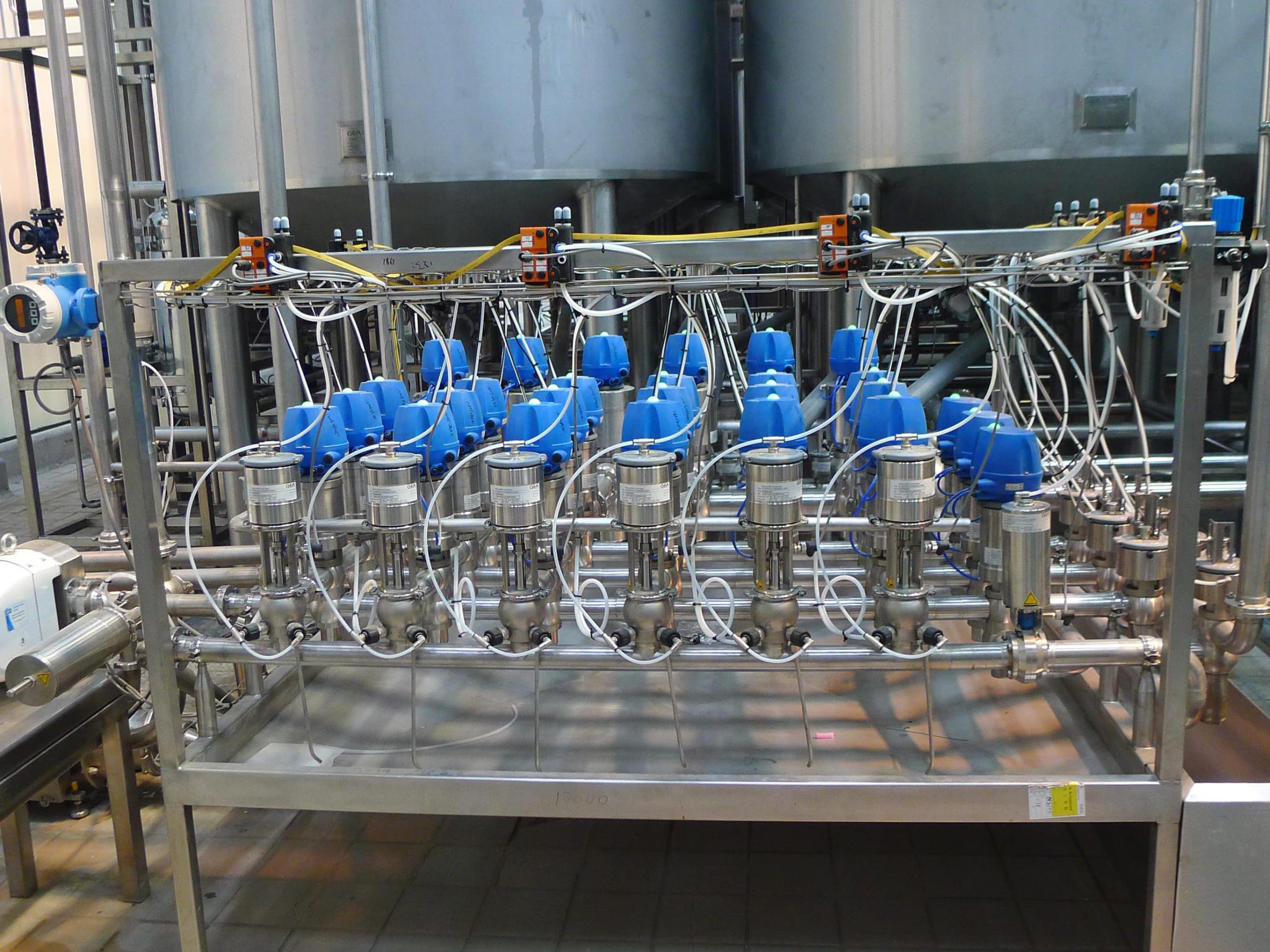
Key Parameters for Effective CIP Cleaning
Getting the best results from CIP cleaning tanks means controlling several parameters together, not optimizing any one of them in isolation.
| Parameter | Why It Matters |
|---|---|
| Temperature | Heat improves chemical reaction rates; caustic washes are typically run around 71–82°C (160–180°F). |
| Flow rate | Sufficient flow ensures the CIP ball spray reaches and covers every surface, not just the areas closest to the inlet. |
| Pressure | Pressure supplies the mechanical action that physically dislodges soil, working alongside the chemical action of the wash. |
| Chemical concentration | Too little chemical will not clean effectively; too much wastes product and can damage equipment surfaces over time. |
| Contact time | The solution needs enough dwell time on the surface to dissolve the soil, not just pass over it. |
| Drainage | Tanks and pipes must drain completely after each phase, or residual solution dilutes the next step in the cycle. |
These parameters interact: if temperature runs low, the chemicals underperform even at the correct concentration; if flow runs low, the CIP ball cannot spray with the pattern it was designed for. A well-controlled CIP system holds all six in range automatically, which is what makes results repeatable across every cycle rather than dependent on one variable happening to be right.
Comparison of Spray Solutions for Regional Breweries
The table below compares fixed and rotary spray devices against SKE’s no-dead-zone system design across the factors that matter most for a growing brewery.
| Feature | Fixed CIP Ball | Rotary CIP Ball Spray | SKE No-Dead-Zone System |
|---|---|---|---|
| Coverage | Limited for large tanks | Good coverage | Full coverage by design |
| Cleaning impact | Moderate | High | High, with optimized pressure |
| Dead zone risk | Medium to high | Low | Minimized by sanitary geometry and matched spray devices |
| Best for tank size | Up to 1,000 L | 1,000 L and above | All sizes, device matched per vessel |
| Maintenance needs | Check holes for clogging regularly | Check bearings and rotation | Low, engineered for reliability |
| Manual cleaning needed | Often | Occasionally | Rarely |
| Water usage | High | Medium | Lower, with optimized cycle timing |
| Initial cost | Low | Medium | Higher upfront, lower long-term cost |
For a regional brewery weighing these tradeoffs, the right answer usually depends on how fast you expect to scale: a fixed CIP ball can be the right call for a single small tank today, while a system engineered for zero dead zones pays back its higher upfront cost once you are running several larger vessels that all need consistent, hands-off cleaning.
Practical Tips for Better CIP Cleaning
Even the best CIP cleaning tanks and CIP ball spray devices depend on good day-to-day procedure. A few habits make a measurable difference:
Pre-rinse with hot water: clearing loose debris before the chemical wash makes the caustic step more effective, since it is not spending contact time dissolving material a plain rinse would have removed anyway.
Check your spray pattern: periodically run a visual test on the CIP ball to confirm it still covers all surfaces. Clogging or wear can shift a pattern gradually enough that no one notices until residue shows up downstream.
Clean the spray device regularly: hop particles clog CIP ball spray holes faster than most operators expect; a soft brush after each cycle prevents the buildup from ever reaching the point where coverage drops.
Monitor chemical strength: test strips catch caustic concentration drift before it becomes a cleaning failure, not after.
Keep records: logging temperature, time, and chemical usage for each cycle is what lets you spot a slow drift in performance before it becomes a contamination event.
Train your operators: human error, not equipment failure, is the most common root cause behind CIP cleaning failures. A well-designed system still depends on someone running it correctly.
Inspect tanks periodically: even a well-engineered CIP system benefits from an occasional visual inspection to confirm it is performing as designed, not just as installed.
FAQ About CIP Cleaning Tanks for Regional Breweries
Q1: What is a CIP cleaning tank and why is it important for a regional brewery?
A CIP cleaning tank is a vessel that holds and prepares cleaning solutions for a clean-in-place system. For a regional brewery, it matters because it is what keeps chemical concentration and temperature consistent from cycle to cycle, which is the foundation of reliable cleaning results and protected beer quality.
Q2: How does a CIP ball differ from a CIP ball spray device?
A CIP ball is a fixed device with holes that spray cleaning solution in a set pattern and has no moving parts. A CIP ball spray device with rotating nozzles provides stronger mechanical impact and better coverage, which is why it is more often used for larger tanks.
Q3: What is a dead zone and how does it affect beer quality?
A dead zone is an area where cleaning solution cannot reach with enough coverage or force to remove soil. Residue that builds up in these spots can carry over into the next batch, leading to contamination and off-flavors.
Q4: How often should I clean the CIP ball spray device?
Check and clean it after every cleaning cycle. Hop particles clog the holes faster than most operators expect, and that risk is higher for breweries that regularly dry-hop.
Q5: Can I upgrade my existing CIP system?
In many cases, yes. The catch is that you need to evaluate the whole system, not just swap the spray device, since flow, pressure, and drainage all have to be matched to whatever spray technology you install. SKE offers retrofits and upgrades sized for regional breweries.
Q6: Is manual cleaning still needed with a good CIP system?
With a properly designed system, manual cleaning is rarely needed for routine cycles. Periodic visual inspection is still worth doing, both to confirm performance and to catch early wear before it becomes a coverage gap.
Conclusion: The Right Choice for Your Regional Brewery
Cleaning is one of the most consequential parts of brewing, not a background task. A well-designed CIP system protects both your beer quality and the reputation that quality builds.
For a regional brewery, choosing the right CIP cleaning tanks and spray devices means choosing a system that reaches every surface and eliminates dead zones by design, not by hoping the spray pattern happens to cover a tank it was never sized for.
SKE designs equipment for growing breweries around no dead zones or dead legs, spray technology matched per vessel, real-time process control, and cleaning recipes tuned to what you actually brew. If you are also evaluating the tanks themselves, our guides to stainless steel mix tanks and CIP tank cleaning fundamentals cover the vessel side of the same sanitary-design question.
Ready to talk specifics? Contact SKE and we will help you design a cleaning system sized to your brewery’s tanks, product mix, and growth plans.
- Facebook: SKE Equipment Facebook
- Email: info@skeequipment.com
Fill out the contact form below for customized solutions. We fully support all your production equipment demands for breweries and beverage plants.